 Skip to content

UK Steel Band Panorama
Complete History, Winners, Songs and Arrangers
A reference-backed guide to Britain’s ‘Champions of Steel’
Results current through 2025
2026 competition scheduled for 29 August 2026
Prepared for Steelasophical • Updated 19 August 2026
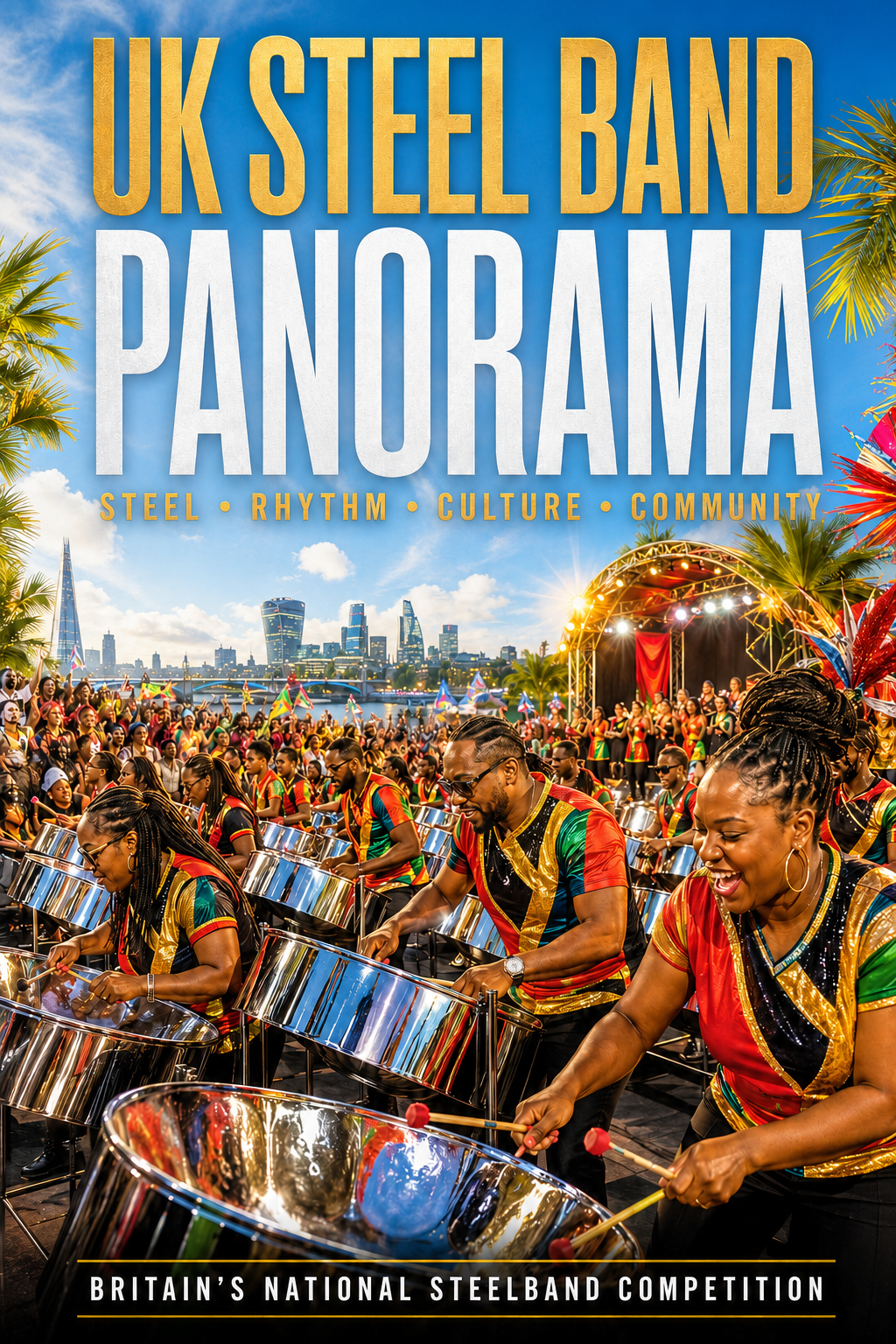
UK Steel Band Panorama | Steelasophical
The night when London listens to steel
On the Saturday before Notting Hill Carnival, the UK steelband community gathers for one of the most demanding and emotionally charged nights in British Caribbean culture. Panorama is not a casual concert and it is not background entertainment. It is a championship in which whole orchestras, supported by arrangers, tuners, captains, drillers, managers, volunteers and families, turn a single song into an extended musical statement. The result can feel orchestral, percussive, theatrical and communal at the same time: melody flashes across the frontline pans, inner voices interlock, basses push the harmony forward, and the engine room supplies the pulse that makes a large crowd move as one.
The formal prize is the title of UK National Panorama champion, often described through the long-running ‘Champions of Steel’ identity. The deeper prize is a place in a living history. Every winning band joins a roll of honour that began in 1978 with Paddington Youth. Every winning arranger becomes part of a lineage that links Trinidad and Tobago’s national instrument with generations of musicians raised in London, Coventry, Huddersfield, Plymouth and other parts of Britain. A Panorama performance may last only minutes on the competition stage, but it is built from weeks of repetition, revision and collective discipline.
This guide tells that story and provides the most useful single view of the results: year, champion, winning song, winning arranger, second place and third place. The podium record is complete from 1978 to 2025, including ties, the two separate 1989 listings preserved in the historical archive, and the 2020 cancellation. Winning songs and arrangers are included wherever they can be verified from accessible digital records. Where the surviving public archive gives the podium but does not identify the tune or arranger, the table says ‘Not verified’ rather than filling the gap with a guess.
| Scope note The 2026 UK National Panorama is scheduled for Saturday 29 August 2026, after this article’s publication date. The latest completed result is therefore 2025. The main table follows the adult/large-band championship lineage; the new small-band division introduced in 2025 is noted separately. |
From Trinidadian invention to a British cultural institution
To understand why Panorama matters, it helps to begin before the competition existed. Steelpan was developed in Trinidad and Tobago through extraordinary experimentation with metal, pitch and ensemble design. Its migration to Britain was not a simple act of importing a finished musical product. It was a process of performance, teaching, instrument building, community organisation and cultural persistence. Pan Podium’s history of the movement records that steelpan appeared on British television in 1950 through Boscoe Holder and his Caribbean Dancers. In 1951, the Trinidad All Steel Percussion Orchestra—TASPO—performed at the Festival of Britain on London’s South Bank, giving many British listeners their first direct encounter with the instrument.
Source: Pan Podium — The History of Steelpan in Notting Hill Carnival and Steelband Panorama
Some TASPO musicians remained in Britain, and the knowledge they carried helped pan take root. Sterling Betancourt, Russell Henderson and other pioneers became central to that story. Henderson’s ensemble was invited to Rhaune Laslett’s children’s event in Notting Hill in 1964. When the musicians moved through the streets and people followed, steelpan proved that it could do more than decorate a programme: it could organise public space, draw neighbours together and create a procession. Laslett’s larger Notting Hill Fayre and Pageant followed in 1966. Steelbands were not an afterthought to that emerging tradition; they were among the forces that gave it motion and sound.
By the 1970s, Britain had a growing network of steelbands, school programmes and community groups. The instrument had moved from novelty in the eyes of much of the British public to a serious practice with its own teachers, tuners, arrangers and competitive ambitions. The first UK Panorama took place in 1978 as a prelude to Notting Hill Carnival. Paddington Youth, led by Zac Herbert, won that inaugural contest, with Metronomes second and Glissando third. That first podium already revealed something important: youth work, community organisation and high-level musical performance were not separate strands. They were part of the same ecosystem.
The competition also created an annual deadline that accelerated development. Bands had to recruit, teach, rehearse, transport instruments and present a coherent arrangement under pressure. The standard rose because every ensemble could hear what its rivals had achieved. A strong bass idea, a daring modulation, a cleaner unison run or a more controlled ending became material for the entire movement to study. Panorama therefore functioned as both a contest and a public laboratory for steel orchestra music in Britain.
What happens in a Panorama performance?
A Panorama band begins with a tune of choice, usually a calypso or soca song with a clear melodic identity and enough rhythmic and harmonic potential to sustain major development. The arranger does not merely transcribe that song for steelpans. The arranger creates a competition work: an introduction that commands attention, statements of the original melody, variations, countermelodies, harmonic departures, rhythmic breaks, soloistic passages, call-and-response writing, transitions and a decisive conclusion. A familiar song may remain recognisable throughout, yet it is transformed into something far larger than the original recording.
The orchestra itself is organised in families of instruments. Tenors and other frontline pans often carry melody and intricate runs. Double tenors, double seconds and guitar or cello voices fill the inner harmony and rhythmic fabric. Bass pans anchor chord movement and give physical weight to the arrangement. The engine room—drum kit, iron, congas and other percussion—creates drive, controls changes in feel and helps the ensemble project beyond the stage. None of these parts succeeds alone. The thrill comes from dozens of players executing a single musical design with precision and conviction.
Judging rewards more than speed or volume. A winning performance needs musical development, balance, tone, rhythmic security, arrangement, interpretation and execution. The exact vocabulary used by organisers can evolve, but the underlying test is consistent: has the band turned its selection into a convincing Panorama statement, and has it delivered that statement cleanly on the night? A brilliant idea that is not secure can lose its impact; a perfectly rehearsed arrangement without contrast can feel cautious. Champions usually find the difficult balance between invention and control.
The arranger: architect, teacher and storyteller
The arranger occupies one of Panorama’s defining roles. Writing the music is only part of the job. In many bands, parts are taught by demonstration and memorised section by section. The arranger must communicate ideas to players with different levels of experience, hear how every register is balancing, revise passages that do not speak clearly outdoors, and build stamina so that the final minutes retain the same intensity as the opening. The arrangement must also suit the particular band: its sound, strengths, personnel, tuning and culture.
That is why the winning-arranger column matters as much as the winning tune. The record documents sustained partnerships—Annise ‘Halfers’ Hadeed with Ebony, Len ‘Boogsie’ Sharpe with Mangrove, André White with Mangrove, Leroy Clarke with Real Steel and Duvone Stewart with Ebony—as well as landmark interventions such as Geraldine Connor’s 1983 victory with Ebony and Victor and Stephon Phillip’s 1987 success with Phase One. Each name represents a different way of hearing what the steel orchestra can do.
Complete UK Steel Band Panorama results, 1978–2025
The table below treats the historical podium as the core record. Ties are shown exactly where the archive preserves them. A dash means that a placing did not exist because of a tie or cancellation. ‘Not verified’ means that the accessible digital sources consulted did not identify the winning selection or arranger with enough confidence to publish it as fact. This is especially common in the early years, when results lists survived more consistently than programmes and arranger credits.
| Year | Winner | Winning song | Winning arranger | Second | Third |
| 2025 | Mangrove | Cocoa Tea | André White | Real Steel | Metronomes |
| 2024 | Mangrove | How Ah Livin’ | André White | Ebony | Real Steel |
| 2023 | Ebony | Engine Room | Duvone Stewart | Mangrove | Pan Nation |
| 2022 | Ebony | Mash Up | Duvone Stewart | Mangrove | Pan Nation |
| 2021 | Mangrove | Happy Place | André White | Metronomes / Ebony (tie) | — |
| 2020 | Cancelled — COVID-19 | — | — | — | — |
| 2019 | Mangrove | Savannah Grass | André White | Metronomes | Ebony |
| 2018 | Mangrove | Hulk | André White | Ebony | Metronomes |
| 2017 | Ebony | Far From Finished | Duvone Stewart | Metronomes | Mangrove |
| 2016 | Ebony | Cheers to Life | Duvone Stewart | Mangrove | Metronomes |
| 2015 | Ebony | Ah Feeling | Duvone Stewart | Real Steel | Mangrove |
| 2014 | Real Steel | Pan in the Atmosphere | Leroy Clarke | Metronomes | Mangrove |
| 2013 | Real Steel | Hammer Time | Leroy Clarke | Metronomes | Mangrove |
| 2012 | Real Steel | Prophet of Pan | Leroy Clarke | Mangrove | CSI |
| 2011 | Mangrove | Is Ah Trini | André White | Ebony | CSI |
| 2010 | Ebony | Musical Fire | Samuel Dubois | Mangrove | Real Steel |
| 2009 | Ebony | Pan Redemption | Annise ‘Halfers’ Hadeed | Mangrove | CSI / Real Steel (tie) |
| 2008 | Ebony | Ten Commandments of Pan | Annise ‘Halfers’ Hadeed | Real Steel | Southside Harmonics |
| 2007 | Ebony | Sharing Licks | Samuel Dubois | Stardust | Mangrove |
| 2006 | Ebony | Colours Again | Annise ‘Halfers’ Hadeed | Stardust | Southside Harmonics |
| 2005 | Ebony | Action | Annise ‘Halfers’ Hadeed | Stardust | Southside Harmonics |
| 2004 | Mangrove | War 2004 | Kyron Akal | Ebony | Glissando |
| 2003 | Mangrove | Music in We Blood | Len ‘Boogsie’ Sharpe | Ebony | Glissando |
| 2002 | Mangrove / North Stars (tie) | Ben Lion / not verified | Len ‘Boogsie’ Sharpe / not verified | — | Real Steel |
| 2001 | Ebony | Stranger | Annise ‘Halfers’ Hadeed | Mangrove | Metronomes |
| 2000 | Mangrove | Picture on My Wall | Len ‘Boogsie’ Sharpe | Ebony | Glissand |
| 1999 | Ebony | Sweet and Sexy | Annise ‘Halfers’ Hadeed | Mangrove | Glissando |
| 1998 | Ebony | High Mas | Annise ‘Halfers’ Hadeed | Southside | Eclipse |
| 1997 | Ebony | One for De Savannah | Annise ‘Halfers’ Hadeed | Glissando | Eclipse |
| 1996 | Ebony | Mind Yuh Business | Annise ‘Halfers’ Hadeed | Eclipse | Mangrove |
| 1995 | Ebony | Four Lara Four | Annise ‘Halfers’ Hadeed | Pantonic | Lambeth Youth |
| 1994 | Ebony | Fire Coming Down | Annise ‘Halfers’ Hadeed | Pantonic | Lambeth Youth |
| 1993 | Ebony | Dus in Dey Face | Annise ‘Halfers’ Hadeed | Metronomes | Mangrove |
| 1992 | Ebony | One for the Road | Annise ‘Halfers’ Hadeed | Mangrove / Metronomes (tie) | Pantonic |
| 1991 | Ebony | Calypso Coup | Annise ‘Halfers’ Hadeed | Mangrove | London All Stars / North Stars (tie) |
| 1990 | Mangrove | Not verified | Not verified | Ebony | Metronomes |
| 1989 | Ebony | Free Up | Annise ‘Halfers’ Hadeed | Mangrove | Metronomes |
| 1989 | London All Stars | Not verified | Not verified | Stardust | |
| 1988 | Ebony | Not verified | Not verified | Metronomes | Mangrove |
| 1987 | Phase One | Pan in A Minor | Victor & Stephon Phillip | London All Stars | Stardust |
| 1986 | Mangrove | Not verified | Not verified | Ebony | Stardust |
| 1985 | London All Stars | Not verified | Not verified | Mangrove | Ebony |
| 1984 | Metronomes | Not verified | Not verified | Ebony | Mangrove |
| 1983 | Ebony | Not verified | Geraldine Connor | Metronomes | Mangrove |
| 1982 | Metronomes | Not verified | Not verified | Ebony | London All Stars |
| 1981 | Mangrove / Metronomes (tie) | Not verified | Not verified | — | London All Stars |
| 1980 | London All Stars | Not verified | Not verified | Ebony | Metronomes |
| 1979 | Metronomes | Not verified | Not verified | Paddington Youth | Ebony |
| 1978 | Paddington Youth | Not verified | Not verified | Metronomes | Glissando |
.
..
…
Table sources: podium placements from PanOnTheNet’s UK winners archive; winning selections and arrangers cross-checked against linked annual results, band histories and preserved performance records. Older gaps are marked rather than inferred.
How to read the record: ties, corrections and changing categories
A long-running cultural competition rarely produces a perfectly simple spreadsheet. The UK archive contains ties, interrupted seasons, venue changes, evolving organisational language and one especially dramatic correction. Reading the record responsibly means preserving those complications instead of tidying them away.
1981 and 2002: shared championships
In 1981, Mangrove and Metronomes were joint winners. Because the title was shared, the archive leaves second place blank and lists London All Stars third. The same logic appears in 2002, when Mangrove and North Stars shared first place, there was no separate runner-up, and Real Steel finished third. The 2002 result was historically important beyond the tie: North Stars, based in Huddersfield, became a champion from outside London, demonstrating the national reach implied by the competition’s name.
1989: two listings, not one confused result
The historical podium page contains two distinct 1989 entries. One is associated with Isaac Newton School and records Ebony first, Mangrove second and Metronomes third. The other is labelled Bromyard and records London All Stars first, Stardust second and Bromyard Centre third. Some simplified summaries mention only one 1989 champion, but a complete account should not collapse the two lines. The safest approach is the one used in this article: retain both exactly as the specialist archive presents them and label the contexts.
1991, 1992, 2009 and 2021: podium ties
In 1991, London All Stars and North Stars shared third. In 1992, Mangrove and Metronomes shared second, with Pantonic still listed third. In 2009, CSI and Real Steel tied for third. The 2021 competition produced a tie for second between Metronomes and Ebony, both on 255 points in the published result, so no third-place band was named. These details matter because a tie changes the podium structure; silently converting it into an ordered list would rewrite the adjudication.
2020: the missing performance that still belongs in the timeline
The 2020 competition was cancelled during the COVID-19 pandemic. It should remain in the table because the absence itself is historical. Panyard rehearsals, massed performance and Carnival infrastructure depend on people gathering at scale; the public-health crisis interrupted all of those conditions. When Panorama returned in 2021, Mangrove’s ‘Happy Place’, arranged by André White, became more than another title defence. It marked the restoration of a communal ritual after an unprecedented break.
2024: an announced winner, then an official correction
The 2024 result requires particular care. Ebony was initially announced as champion, and that announcement stood long enough for celebrations and early reports. Organisers later corrected the result: Mangrove was first, Ebony second and Real Steel third. The winning tune did not change—both Mangrove and Ebony had selected Farmer Nappy’s ‘How Ah Livin’’—but the title belonged to Mangrove and arranger André White. Any current history must use the corrected result, while acknowledging why earlier posts or memories may say something different.
Source: PanOnTheNet — corrected 2024 results
2025: large and small bands on the same historic night
The main championship continued in 2025 with Mangrove winning its thirteenth title through André White’s arrangement of Kes the Band’s ‘Cocoa Tea’. Real Steel placed second with the same selection arranged by Leroy Clarke, while Metronomes placed third with ‘Bet Meh’ arranged by Terrance ‘BJ’ Marcelle. The year also introduced a separate small-band Panorama: New Generation won, Eclipse was second and North Tyneside third. This article keeps the long adult/large-band lineage in its main table so that comparisons from 1978 onward remain consistent, but the new division is an important sign of expansion.
The championship eras
1978–1990: many champions build the foundation
The first thirteen seasons were comparatively open. Paddington Youth claimed the inaugural title. Metronomes won outright in 1979, 1982 and 1984 and shared the 1981 crown with Mangrove. London All Stars won in 1980 and 1985, as well as the separate Bromyard listing in 1989. Mangrove won in 1986 and 1990. Phase One entered for the first time in 1987 and won with Kitchener’s ‘Pan in A Minor’, arranged by Victor and Stephon Phillip. Ebony’s first championship arrived in 1983 through Geraldine Connor’s arrangement, making Connor the first woman recorded as arranging a UK Panorama-winning piece; Ebony returned to the top in 1988 and again in the Isaac Newton School listing for 1989.
This early variety reflects a movement still establishing its competitive centres. School and youth bands stood alongside family organisations and community orchestras. Some groups were rooted in West London’s Carnival geography; others travelled from elsewhere in Britain. The archive’s missing tune and arranger fields are frustrating, but the podiums still show a healthy distribution of power. No single band owned the first decade.
1991–1999: Ebony’s unmatched nine-year sequence
The 1990s changed the championship’s competitive shape. Ebony won every contest from 1991 through 1999, a nine-year uninterrupted streak. Annise ‘Halfers’ Hadeed arranged the winning works: ‘Calypso Coup’, ‘One for the Road’, ‘Dus in Dey Face’, ‘Fire Coming Down’, ‘Four Lara Four’, ‘Mind Yuh Business’, ‘One for De Savannah’, ‘High Mas’ and ‘Sweet and Sexy’. The list reveals both responsiveness to current pan repertoire and the value of a stable musical partnership.
A streak of this length is not merely nine good finals. It requires the band to renew itself every season while opponents study the previous victory. Players change, popular songs change and expectations rise. Repetition becomes dangerous: a champion has to sound recognisably itself without appearing formulaic. Ebony and Hadeed met that challenge by creating enough contrast, control and Panorama drama to remain ahead across an entire decade. The sequence remains the central dynasty in the UK competition’s history.
2000–2011: Mangrove and Ebony exchange control
Mangrove ended Ebony’s streak in 2000 with ‘Picture on My Wall’, arranged by Len ‘Boogsie’ Sharpe. Ebony replied in 2001 with Hadeed’s arrangement of ‘Stranger’. Mangrove then shared the 2002 title with North Stars and won outright in 2003 and 2004. The 2003 champion, ‘Music in We Blood’, again carried Sharpe’s musical signature; 2004’s ‘War 2004’ was arranged by Kyron Akal. Ebony answered with six consecutive titles from 2005 to 2010. Hadeed arranged the wins in 2005, 2006, 2008 and 2009, while Samuel Dubois arranged the 2007 and 2010 champions. Mangrove returned in 2011 with André White’s arrangement of ‘Is Ah Trini’, edging Ebony by a single point in the published results.
This era demonstrates that band identity can survive changes of arranger. Ebony’s organisation remained capable of winning with Hadeed and Dubois; Mangrove’s titles involved Sharpe, Akal and White. The competitive centre was still concentrated in two major London bands, but the musical routes to victory were diverse. Arrangers from Britain, Trinidad and Tobago and the wider diaspora brought different vocabularies into the same arena.
2012–2014: Real Steel’s Plymouth hat-trick
Real Steel broke the London duopoly with three consecutive championships. In 2012, Leroy Clarke’s arrangement of ‘Prophet of Pan’ won by eight points. The band retained the title in 2013 with ‘Hammer Time’ and completed the hat-trick in 2014 with ‘Pan in the Atmosphere’. A three-peat is difficult for any organisation; achieving it from Plymouth, while moving a large orchestra and its equipment into the capital, gave the run additional significance.
Real Steel’s success broadened the imaginative map of UK Panorama. It showed that a non-London programme could develop the technique, organisation and confidence needed to defeat the traditional powers repeatedly. Leroy Clarke’s dual role as arranger and manager also highlighted the connection between musical design and institutional leadership. The result was not a one-night upset but a sustained championship system.
2015–2025: Ebony, Mangrove and a modern arranger rivalry
Ebony returned to the summit in 2015 with ‘Ah Feeling’, beginning a three-year run under Duvone Stewart. ‘Cheers to Life’ followed in 2016 and ‘Far From Finished’ in 2017. Mangrove then won in 2018 and 2019 with André White’s arrangements of ‘Hulk’ and ‘Savannah Grass’. After the 2020 cancellation, Mangrove and White won again in 2021 with ‘Happy Place’, completing a three-title sequence across the interrupted calendar.
Ebony and Stewart responded with ‘Mash Up’ in 2022 and ‘Engine Room’ in 2023. Mangrove and White took the corrected 2024 championship with ‘How Ah Livin’’ and retained the title in 2025 with ‘Cocoa Tea’. The recent pattern has the clarity of a sporting rivalry, but the music prevents it from becoming repetitive. Some years several leading bands choose the same song, making arrangement and execution the decisive comparison. In others, contrasting selections create completely different emotional arcs. Either way, the arranger-band partnership sits at the centre of the result.
The leading bands by titles
The all-time totals through 2025 show both dominance and longevity. PanOnTheNet’s championship summary credits Ebony with 24 wins and Mangrove with 13. Metronomes have four, London All Stars and Real Steel have three each, and Paddington Youth, Phase One and North Stars have one apiece. Joint titles count for each co-champion, which is why Mangrove’s 1981 and 2002 victories and North Stars’ 2002 victory appear in the totals.
Source: PanOnTheNet — Total Career Steelband Panorama Wins, United Kingdom
Ebony: the benchmark
Ebony’s 24 titles stretch from 1983 to 2023. The band owns the defining 1991–1999 streak, but its record is more than that decade. It has won with Geraldine Connor, Annise ‘Halfers’ Hadeed, Samuel Dubois and Duvone Stewart, demonstrating an ability to absorb distinct musical leadership while maintaining institutional standards. Ebony’s wider community and educational work also matters: sustained youth development is how an orchestra replenishes the sections required for a large Panorama side.
Mangrove: continuity, community and competitive renewal
Mangrove’s 13 titles span 1981 to 2025. The band’s roots in Notting Hill and the history surrounding the Mangrove name give it a distinctive civic identity, while its championship record shows repeated reinvention. The recent partnership with André White has produced wins in 2011, 2018, 2019, 2021, 2024 and 2025. Earlier victories came through other arrangers and eras, including Len ‘Boogsie’ Sharpe and Kyron Akal. Mangrove’s story connects local continuity with a global circulation of pan musicians and ideas.
Metronomes, London All Stars, Real Steel and the one-title champions
Metronomes’ four titles are concentrated in the formative period—1979, the shared 1981 crown, 1982 and 1984—but the band has remained a regular finalist and podium presence. London All Stars’ championships in 1980, 1985 and the Bromyard entry for 1989 reflect the strength of a family-based organisation under Frank Rollock’s musical direction. Real Steel’s three titles form one unbroken 2012–2014 run. Paddington Youth will always own the honour of the first championship; Phase One’s first-entry victory remains one of the great surprise stories; and North Stars’ shared 2002 title stands for the national reach of pan beyond London.
Arrangers who changed the sound of the competition
Panorama history is often discussed through bands, but arrangers provide another map of influence. Their work is not interchangeable. One arranger may favour long harmonic journeys and motivic development; another may build around relentless rhythmic lift, sharp sectional dialogue or a theatrical sequence of breaks. The winning record captures only the final placing, yet those names point to bodies of work that players and audiences remember in musical detail.
Annise ‘Halfers’ Hadeed
Hadeed’s collaboration with Ebony produced the nine consecutive championships of the 1990s and additional wins around that run. Surviving band histories credit fifteen Ebony victories to the partnership between 1989 and 2009. The achievement combines quantity with continuity: Hadeed repeatedly found new structures for current tunes while writing for an orchestra expected to win. His name is inseparable from Ebony’s emergence as the competition’s dominant institution.
Len ‘Boogsie’ Sharpe
Sharpe brought one of the steelpan world’s most celebrated compositional voices into Mangrove’s competitive history. The documented UK winners include ‘Picture on My Wall’ in 2000 and ‘Music in We Blood’ in 2003, while the 2002 co-winning Mangrove performance used ‘Ben Lion’. His writing is associated with motivic development, harmonic surprise and an intimate understanding of what different pan voices can contribute. The partnership illustrates how UK Panorama has always been connected to the wider international circulation of arrangers and players.
André White
White has defined Mangrove’s modern championship sound. His winning years—2011, 2018, 2019, 2021, 2024 and 2025—include close contests, repeated-tune battles and the unusual pressure of defending a corrected result. ‘Savannah Grass’, ‘Happy Place’, ‘How Ah Livin’’ and ‘Cocoa Tea’ are different songs, but each became a vehicle for clarity, energy and contemporary Panorama architecture. White’s work also represents the transatlantic character of modern pan, with musical lives and influences moving between New York, Britain and Trinidad and Tobago.
Leroy Clarke and Duvone Stewart
Leroy Clarke led Real Steel’s 2012–2014 hat-trick and has continued to place highly with both Real Steel and other orchestras. His three wins remain a model for building a regional programme into a national champion. Duvone Stewart’s work with Ebony generated consecutive titles in 2015, 2016 and 2017, followed by wins in 2022 and 2023. Both arrangers show how a sustained relationship lets a band develop a shared vocabulary: players learn the arranger’s phrasing and demands, while the arranger learns how to write into the band’s strongest sound.
Geraldine Connor and the importance of documented firsts
Geraldine Connor’s 1983 victory with Ebony deserves particular emphasis. Specialist steelpan histories identify her as the first woman to arrange a winning UK Panorama piece. The surviving online record does not reliably name the tune, which is why the table marks that field as unverified, but the arranger credit itself is well documented. Preserving such credits matters: without them, histories of innovation can default to the most visible institutions and overlook the people who broke barriers inside the music.
Why Panorama matters beyond the trophy
The competition is a peak-performance event, but its social value is created across the year. Panyards provide rehearsal space, teaching, intergenerational contact and a place to belong. Teenagers can play beside adults with decades of experience. Parents transport children and feed rehearsing players. Tuners maintain instruments; volunteers build racks, organise uniforms, fundraise and solve the hundred practical problems that stand between an idea and a stage-ready orchestra. The public sees the final performance, but the cultural infrastructure is collective.
Panorama also asserts steelpan as a serious orchestral medium. The instrument has sometimes been reduced in British popular imagination to a visual shorthand for beaches or holidays. A competition arrangement resists that stereotype. It demands memory, technique, endurance, dynamic control, harmonic understanding and ensemble discipline. The repertoire can be joyful and danceable without being musically simple. Indeed, part of Panorama’s genius is that complexity and communal pleasure are not treated as opposites.
The event further embodies a Black British and Caribbean diasporic history that is both local and international. Notting Hill’s streets, community centres and panyards are specific places shaped by migration, racism, resistance and creativity. At the same time, tunes, arrangers, players and ideas travel across borders. A London band may perform a Trinidadian soca hit through the arrangement of a New York-based musician, with players whose families come from many countries. Panorama does not dilute those histories into a generic multicultural image; at its best, it lets their connections be heard.
Experiencing Panorama in person
A first-time visitor should expect an evening with the atmosphere of a final, not a seated recital. Supporters arrive with strong loyalties. Bands rehearse nearby and the sound carries through the surrounding area. The stage performance is the official moment, but the build-up—players gathering, racks moving, percussion checking balance, snippets of arrangement heard at a distance—is part of the experience. The physical impact of a large steel orchestra is difficult to reproduce through a phone speaker: bass vibrations, iron, drums and the bright projection of the frontline occupy the body as well as the ear.
Practical arrangements change, so visitors should use the official Notting Hill Carnival site for current times, tickets, access and venue information. For 2026, the organisers list the UK National Panorama for Saturday 29 August at Emslie Horniman’s Pleasance Park, with Junior Panorama at 5 p.m. and the adult competition at 8 p.m. The event is ticketed, and the official page states that proceeds are distributed among performing bands. Arriving early gives time to enter, find a position and absorb the pre-competition atmosphere.
Current information: Official Notting Hill Carnival Panorama 2026 page
The future of the UK Steel Band Panorama
The next phase of Panorama will be shaped by participation, resources and documentation. The introduction of a small-band division in 2025 creates another route into the national event, especially for organisations that cannot field the personnel or equipment required by the largest orchestras. Junior Panorama on the same stage and same night strengthens the visible pathway from youth performance to the adult championship. Those changes can broaden the field without weakening the prestige of the historic title.
Sustainability remains a practical challenge. Large bands need rehearsal space, secure storage, tuned instruments, transport and skilled teaching. Rising costs can narrow participation even when musical interest is strong. Ticket revenue, public support, sponsorship and year-round bookings all help, but long-term strength depends on treating steelbands as cultural institutions rather than seasonal decoration. The people who create Britain’s biggest night of pan need viable conditions in February as well as August.
Documentation is equally important. The missing song and arranger credits in early digital records are a warning. Programmes, adjudication sheets, audio, video, photographs and oral histories should be preserved with consistent metadata. A future researcher should be able to identify not only who won, but what was played, who arranged it, who tuned the pans and how participants understood the season. Good archives turn memory into shared cultural inheritance.
Musically, the competition will continue to negotiate tradition and change. New production styles in soca, evolving pan layouts, younger arrangers and different audience expectations will influence the sound. Yet the central challenge is likely to remain recognisable: take one song, expand it through the steel orchestra, teach it to a large group, and deliver it under pressure with enough imagination and unity to move both judges and crowd.
A roll of honour that is still being written
From Paddington Youth in 1978 to Mangrove in 2025, the UK Steel Band Panorama tells a story of musical excellence built through community. Its champions include youth bands, family organisations, London institutions and regional challengers. Its decisive figures include celebrated international arrangers and local pioneers whose credits are only now being gathered with the care they deserve. The podium table gives the competition a skeleton; the rehearsals, friendships, rivalries and performances give it life.
The most important lesson in the record is not simply that Ebony has won 24 times or Mangrove 13, impressive as those totals are. It is that the title has remained meaningful across nearly five decades. Bands still commit months of energy for a few minutes on stage. Supporters still debate arrangements and results. Young players still step into an instrument whose British history reaches back through Notting Hill, TASPO and the pioneers who made steelpan heard in post-war Britain. Panorama survives because each generation chooses to make the tradition present again.
For readers discovering the competition, the next step is simple: listen to the archived performances, visit a panyard where appropriate, support the bands and experience Panorama live. For event planners seeking the sound of steelpan beyond Carnival, Steelasophical brings professional steelband performance and DJ entertainment to weddings, corporate events and celebrations across the UK. Visit steelband.co.uk and help keep the appreciation of pan active all year round.

Sources and further listening
PanOnTheNet — UK Steelband Panorama Winners, 1978–2025
PanOnTheNet — Total Career Steelband Panorama Wins, United Kingdom
Pan Podium — The History of Steelpan in Notting Hill Carnival and Steelband Panorama
PanOnTheNet — 2025 UK Panorama Results
PanOnTheNet — corrected 2024 UK Panorama Results
PanOnTheNet — 2023 UK Panorama Results
PanOnTheNet — 2022 UK Panorama Results
PanOnTheNet — 2021 UK Panorama Results
PanOnTheNet — 2013 UK Panorama Results
PanOnTheNet — 2012 UK Panorama Results
Google Arts & Culture / Notting Hill Carnival — Meet Ebony
When Steel Talks — historic Mangrove 2000 ‘Picture on My Wall’ performance
When Steel Talks — Stephon Phillip interview and Phase One history
Official Notting Hill Carnival — Panorama 2026
SEO publishing notes
| Suggested meta title | UK Steel Band Panorama: Winners, Songs & History |
| Meta description | Explore the complete UK Steel Band Panorama history from 1978 to 2025, including every winner, winning song, arranger, second and third place. |
| Suggested URL slug | /uk-steel-band-panorama-winners-history/ |
| Focus keyphrase | UK Steel Band Panorama |