 Skip to content

007 Casino Royale Movie
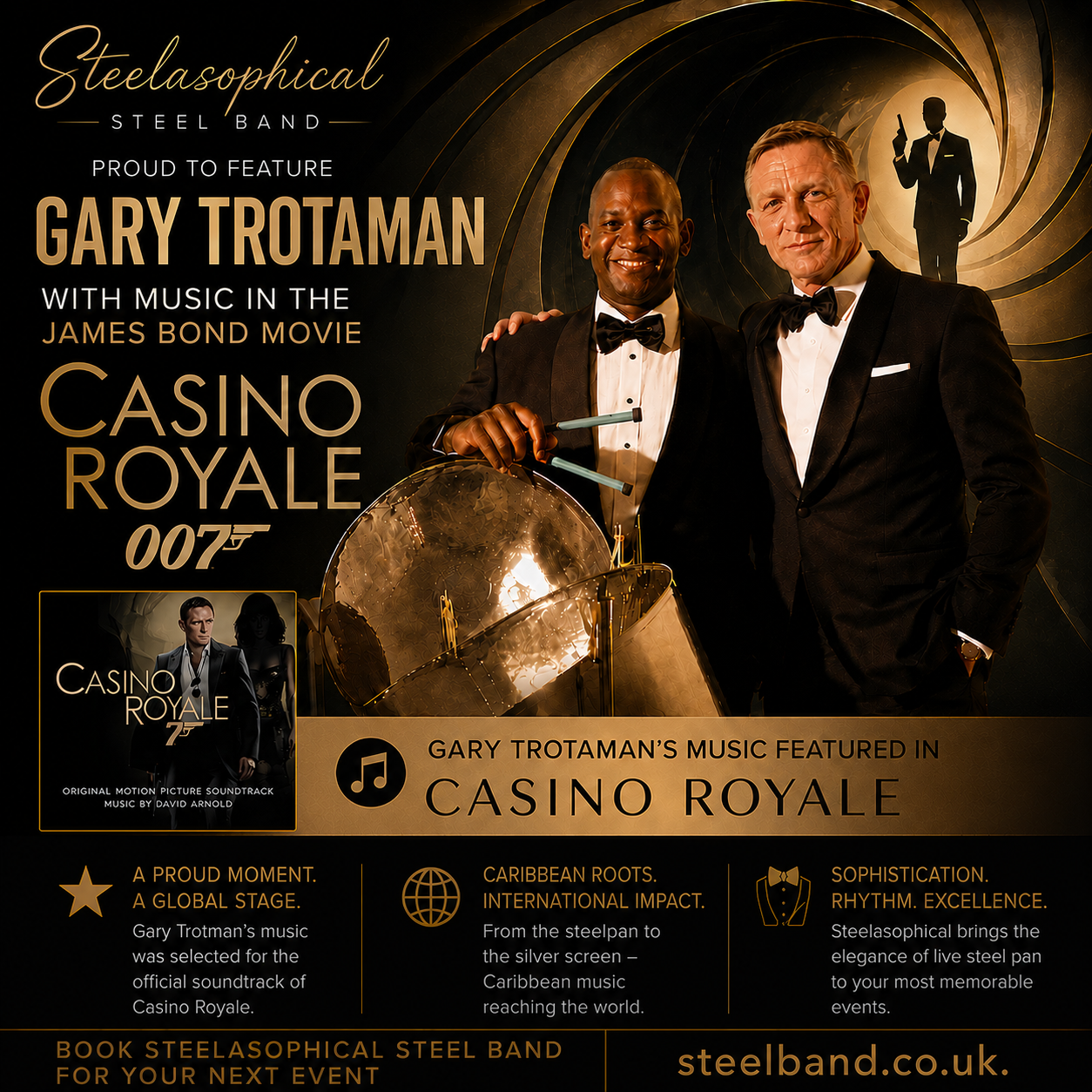
For many musicians, hearing their work in a major cinema release would be a career-defining moment. When that film belongs to the James Bond franchise, the achievement becomes even more remarkable. Gary Trotman, the musician behind Steelasophical Steel Band DJ, has a genuine connection to the world of 007: his arrangement and performance of the traditional Jamaican song “Linstead Market” was used in the 2006 James Bond film Casino Royale.

This is an important claim, so it is worth stating it accurately. Gary did not compose David Arnold’s official orchestral score, and “Linstead Market” was not the film’s main theme. The title song, “You Know My Name,” was written by Chris Cornell and David Arnold and performed by Cornell. Gary’s contribution was a separate piece of music incorporated into the film: “Linstead Market,” a traditional song arranged and performed by Gary Trotman and supplied courtesy of ARC Music Productions International Ltd.
The credit is recorded in the film’s soundtrack information. The specialist James Bond reference site MI6-HQ lists “Linstead Market” as arranged and performed by Gary Trotman, while IMDb’s soundtrack credits carry the same attribution. It is a wonderful connection between Caribbean musical culture, a dedicated professional musician and one of the most successful film series ever created.
Gary Trotman’s Place in the Music of Casino Royale
Film music does far more than fill silence. It establishes location, changes the emotional temperature of a scene and tells the audience something before a character has spoken. In Casino Royale, Gary Trotman’s version of “Linstead Market” is heard during the section set in the Bahamas, helping to give the scene a recognisable Caribbean identity.
Gary’s Bond connection is more than an impressive biographical detail. A production on the scale of Casino Royale carefully selects and licenses every piece of music. Gary’s credit confirms both his creative contribution and the professional route through which it reached the finished film.
What Is “Linstead Market”?
“Linstead Market” is a traditional Jamaican folk song associated with mento, one of Jamaica’s foundational musical forms. The story concerns a market seller who takes ackee to Linstead Market but is unable to sell enough to provide for her children. Although the melody is often performed with warmth and rhythmic energy, the story underneath it reflects hardship, disappointment and everyday working life.
That combination of an inviting melody and a more poignant narrative is part of the song’s lasting power. “Linstead Market” has travelled through generations, classrooms, concert halls and many different arrangements. The Smithsonian Folkways collection includes Louise Bennett’s 1954 recording, showing its established place in Jamaican cultural history.
Gary Trotman did not claim to have written the traditional song. His credited role was to arrange and perform the version used by the filmmakers. An arranger shapes elements such as tempo, texture, rhythm, structure and atmosphere, respecting the original while giving it a distinctive musical voice.
For Gary, whose career is built around Caribbean music and steelpan, the song was a natural fit. Its Bond appearance introduced the traditional Jamaican melody to viewers who may not have known its title or history.
What Is Casino Royale About?
Released in 2006 and directed by Martin Campbell, Casino Royale introduced Daniel Craig as James Bond. Rather than continuing directly from the tone of the previous films, it reset the character near the beginning of his career. The official James Bond website describes the story as taking place just after Bond earns his “00” status and his licence to kill.
The film opens with a black-and-white sequence showing the two kills required for Bond to become 007. This Bond is highly capable but not yet the perfectly controlled secret agent familiar from later adventures. He is impulsive, physical, proud and still learning the cost of his decisions.
Bond’s first major pursuit takes him to Madagascar, where he chases a bomb maker named Mollaka through a spectacular parkour sequence. Information recovered during the mission leads Bond to the Bahamas and to Alex Dimitrios, a man connected to the criminal financier Le Chiffre.
Le Chiffre, played by Mads Mikkelsen, manages money for terrorist organisations. He plans to profit by betting against the value of an airline company and then arranging the destruction of its new aircraft. Bond prevents the attack at Miami Airport, leaving Le Chiffre in a desperate position: he has lost a vast amount of his clients’ money and must recover it before they discover what has happened.
His solution is a high-stakes Texas Hold’em tournament at Casino Royale in Montenegro. MI6 sends Bond to bankrupt him, hoping that a defeated Le Chiffre will seek British protection in exchange for information about his terrorist clients.
Bond is accompanied by Vesper Lynd, a Treasury representative played by Eva Green. She controls the money required for his entry into the tournament and is far more than a decorative companion. Intelligent, observant and emotionally guarded, Vesper challenges Bond from their first conversation. Their verbal exchanges are among the film’s most memorable scenes because each quickly identifies the other’s strengths, insecurities and carefully maintained defences.
The poker game becomes a battle of nerve. Bond must study Le Chiffre, control his ego and survive attempts to remove him from the table. Jeffrey Wright also appears as CIA officer Felix Leiter, beginning a friendship that continues through the Daniel Craig era.
As Bond and Vesper grow closer, the mission develops into something more emotionally complicated. Bond begins to imagine a life outside the service, but the world around them is built on concealed motives and impossible choices. Without revealing every final detail, the Venice section transforms the story from an espionage thriller into the experience that shapes the Bond audiences will see in the films that follow.
At its heart, Casino Royale is about the creation of James Bond. It asks how a gifted but reckless agent becomes the controlled, suspicious and emotionally armoured 007 of legend. The casino provides the film’s glamorous centrepiece, but love, trust, betrayal and consequence give the story its lasting impact.
Why Casino Royale Changed James Bond
Before the film opened, Daniel Craig’s casting attracted considerable debate. His finished performance changed the conversation, combining physical intensity with fear, arrogance, tenderness and grief beneath Bond’s controlled exterior.
The approach came directly from the filmmakers’ intention to reinvent the character. Producer Barbara Broccoli has explained that they wanted to explore Bond’s inner life and show why he became the man audiences knew. Craig, after reading the script, recognised it as a chance to reset the toughness, humour and familiar traditions of the series. The official 007 feature on how Daniel Craig became Bond gives a fascinating account of that process.
The film reduces extravagant gadgets and concentrates on character, practical action and consequence. Bond makes mistakes, gets hurt and allows pride to affect his judgement. Even the famous introduction, “The name’s Bond, James Bond,” is held back until the closing moments.
The Wider Sound of Casino Royale
Music was essential to this reinvention. David Arnold composed the score, with Nicholas Dodd orchestrating and conducting. Chris Cornell performed “You Know My Name,” which he co-wrote with Arnold. Its hard-edged sound suits a story about a man becoming 007.
Interestingly, the complete traditional James Bond Theme is not deployed in its most familiar form until the end. Arnold instead weaves musical ideas from “You Know My Name” through the score, allowing Bond’s musical identity to develop alongside the character.
Within that larger soundscape, Gary Trotman’s “Linstead Market” performs a different job. It is source music connected to the setting rather than the principal dramatic score. This is precisely why the wording matters: Gary had music used in Casino Royale, with a clear arrangement and performance credit, but he was not the composer of the official soundtrack. The accurate story is already impressive and needs no exaggeration.
Fun Facts About Casino Royale
1. It was Daniel Craig’s first James Bond film
Casino Royale began Craig’s five-film run as 007. He returned in Quantum of Solace, Skyfall, Spectre and No Time to Die. His debut also earned him a BAFTA Leading Actor nomination, a rare level of acting recognition for a Bond performance.
2. The story comes from Ian Fleming’s first Bond novel
Ian Fleming published Casino Royale in 1953. It introduced Bond, Le Chiffre and Vesper Lynd. The rights history was complicated, which is why the title had previously appeared as a 1954 television adaptation and a 1967 comedy before EON Productions made its official version.
3. The opening is unique in the official Bond series
The pre-title sequence is presented in black and white. The film also delays the familiar gun-barrel image, incorporating it into the action at the end of Bond’s second qualifying kill. According to the official 007 site, it was the first Bond film not to begin with the traditional gun-barrel sequence.
4. The parkour chase used a genuine pioneer of the discipline
Sébastien Foucan, who plays Mollaka, is a leading practitioner associated with the development of freerunning. That is one reason the Madagascar chase feels so fluid and dangerous: Bond is pursuing a character played by an athlete with extraordinary real-world movement skills.
5. The Aston Martin roll set a record
At Millbrook Proving Ground, stuntman Adam Kirley rolled an Aston Martin DBS seven times, setting a Guinness World Record for cannon rolls in a car. Guinness confirms that The Fall Guy later surpassed it.
6. The airport sequence was not filmed in Miami
The attempted Miami Airport attack was filmed partly at Prague Airport and partly at Dunsfold Aerodrome in Surrey. Production design and editing turned them into one convincing location.
7. The film contains no Q or Miss Moneypenny
Casino Royale was the first official Bond film to omit both characters. Their absence supports the stripped-back approach and keeps the focus on Bond, Vesper, M and the central operation.
8. Vesper’s red dress was carefully planned
Costume designer Lindy Hemming dressed Vesper in red for Venice and kept the colour away from the extras. It makes her immediately visible in the crowd and subtly references Don’t Look Now.
9. A yacht received exceptional access in Venice
Special permission allowed Bond and Vesper’s Spirit 54 yacht to travel along the Grand Canal between the Accademia and Rialto bridges. The official 007 production notes say it was the first yacht permitted to sail that stretch in many years.
10. The collapsing Venetian building combined engineering and effects
The production combined an interior set with a one-third-scale exterior model. Computer-controlled hydraulics coordinated their movement and created the illusion of a building sinking into the canal.
11. The title song breaks with Bond tradition
“You Know My Name” does not share the film’s title. It was also released separately and did not appear on the original soundtrack album, although its musical ideas can be heard throughout Arnold’s score. The song reached number seven on the UK Singles Chart.
12. Gary Trotman is part of the film’s credited musical detail
Among the orchestral score, title theme and other musical elements is the traditional “Linstead Market,” arranged and performed by Gary Trotman. For Steelasophical clients, that creates a rare proposition: the musician entertaining at their wedding, party or corporate event has an authentic credit connected to the James Bond film series.
What the Bond Connection Means for Steelasophical
Gary Trotman’s Casino Royale credit reflects qualities that continue to define Steelasophical: musicianship, cultural authenticity, versatility and professional standards. Film and live entertainment both require music that creates the right atmosphere at precisely the right moment. Steelpan can welcome wedding guests, warm a drinks reception, energise a summer celebration or give a corporate occasion a memorable Caribbean identity.
The story also shows that Caribbean music belongs on the world’s biggest stages. A traditional Jamaican song can move from community memory to a modern arrangement and then into an international film. Gary’s part in that journey is worth celebrating.
Bring a Touch of 007 and the Caribbean to Your Event
If you would like entertainment with genuine experience, a distinctive story and a premium professional presentation, consider Steelasophical Steel Band DJ. Gary Trotman brings the same musical attention to weddings, parties and corporate events that has helped his work travel internationally—including into the world of James Bond.
Visit Steelasophical at steelband.co.uk to explore performance options and make an enquiry.
Gary Trotman’s Bond achievement can be expressed in one accurate and memorable sentence: his arrangement and performance of the traditional Jamaican song “Linstead Market” was incorporated into the 2006 James Bond film Casino Royale. It was not the official score and not an original composition by Gary—but it was his credited performance and arrangement, heard in one of the most celebrated 007 films of the modern era.
From Linstead Market to Casino Royale, and from the cinema screen to your celebration, Steelasophical continues to live by its promise:
We bring the Caribbean to you.