Skip to content


What Is a Steel Drum? How It Works and How to Play One
Steel Drum Guide What It Is How It Works and How to Play
A steel drum, more accurately called a steelpan, is a pitched percussion instrument developed in Trinidad and Tobago. Its playing surface is shaped into separate note areas, and a player strikes those areas with small rubber-tipped mallets to play melodies, chords and rhythmic parts. The instrument has a bright, ringing sound, but it can also play gently and expressively.
A steelpan is not a standard drum kit; it is a melodic percussion instrument. You use two mallets to find notes across a shaped metal surface and listen for clean pitches. You do not need to be an experienced drummer or read music to begin.
This guide explains what a steelpan is, how it developed, how its notes make sound, what the main pan types do and how a beginner can start playing. It also covers what to look for when borrowing or buying an instrument, how to care for it and when to ask a professional tuner for help.

What Is a Steel Drum
A steel drum is a musical instrument made from shaped and tuned steel. Players and steelband communities generally call it a steelpan or simply pan. “Steel drum” remains a familiar name, especially in searches, but it can give the wrong impression that the instrument is an ordinary drum. A steelpan produces definite musical pitches. Strike one note area and you hear a tuned note; strike another and you hear a different one.
The instrument belongs to the idiophone family. An idiophone produces sound through the vibration of the material from which it is made. A steelpan does not need a stretched drumhead, strings or a reed. Its shaped metal surface vibrates when a player strikes one of its note areas. The exact shape and tuning of that area determine its pitch and tone.
A steelpan can be played alone, with a singer, in a small group or as part of a large steel orchestra. In an ensemble, different pans cover different registers and musical roles. Some carry the tune, some provide harmony, and lower pans support the bass line. Other percussion instruments may keep the pulse and add rhythmic detail.
The terms “steelpan,” “steel pan” and “steel drum” commonly refer to the same Trinidad and Tobago instrument. “Pan” is the shortest and most familiar term among players. The name “steel drum” is not entirely wrong, but “steelpan” better describes a pitched instrument with many tuned notes rather than a single drum sound.

Steelpan and Handpan Are Different Instruments
A steelpan is sometimes confused with a handpan because both are metal instruments with visible note areas, but they have different histories, construction and playing methods.
A traditional steelpan has a concave playing surface and is played with rubber-tipped mallets. It is designed to produce a range of clear pitches that can carry melody and ensemble parts. A handpan is usually a convex, closed-shell instrument played with the hands or fingers. It often has fewer notes and a softer, more resonant sound. The names can overlap in casual conversation, but a handpan is not simply a small steelpan played by hand.
If you are shopping, check that the instrument is specifically described as a steelpan or steel drum and confirm how it is meant to be played. Product listings can use broad labels such as “steel drum,” “tongue drum,” “tank drum” or “handpan” for different instruments. Ask for a note layout, range, tuning information and a recording of the instrument before you decide.
Is It Part of a Drum Kit
No. A drum kit is a collection of drums and cymbals usually played with sticks, pedals and coordinated limbs to create rhythm. The steelpan is a pitched percussion instrument. A player uses mallets to play notes and melodies. Both instruments belong broadly to percussion, but their roles and techniques are quite different.
That difference can be useful for a drummer. Learning pan can develop pitch awareness, careful listening and melodic phrasing. A steelpan player also thinks about timing and rhythm, but the first challenge is often locating the right notes cleanly and controlling their ring.
Where the Steelpan Came From
The steelpan developed in Trinidad and Tobago, especially in the Carnival culture of Port of Spain. Its history is connected to people’s persistence in making music under colonial restrictions and to a continuing tradition of musical invention and community life.
During the late nineteenth century, authorities in Trinidad restricted some percussion instruments in Carnival. Tamboo-Bamboo ensembles grew in that setting: players struck lengths of bamboo to create pitches and rhythms. As bamboo wore out, musicians experimented with metal containers, and steelpan developed through many experiments.
The instrument’s early development is generally placed in the 1930s and 1940s. Trinidad and Tobago’s National Library and Information System Authority links it to Carnival and Tamboo-Bamboo traditions, while the National Archives places its invention in Trinidad during the 1930s. Its history reflects the work of many players, builders, tuners and communities, rather than a single inventor.
Early pans were simpler than many modern instruments. Pioneers refined the note fields, surface shape, mallets and note arrangements. These advances helped steelbands develop increasingly complex arrangements, including calypso, popular songs, jazz and classical repertoire.
Steelpan innovation continues. Modern instruments are made in a range of sizes and configurations, and research into materials, tuning, amplification and manufacturing has expanded the instrument’s possibilities. The steelpan is now Trinidad and Tobago’s national instrument and is played by bands, schools, community groups and professional musicians around the world.
When you hear a steelpan, you are hearing more than a clever object made from a barrel. You are hearing the result of a specific cultural history and generations of skilled work. That context matters when learning about the instrument. Treating it only as a novelty “island drum” misses both its musical range and the people who shaped it.
How a Steelpan Makes Sound
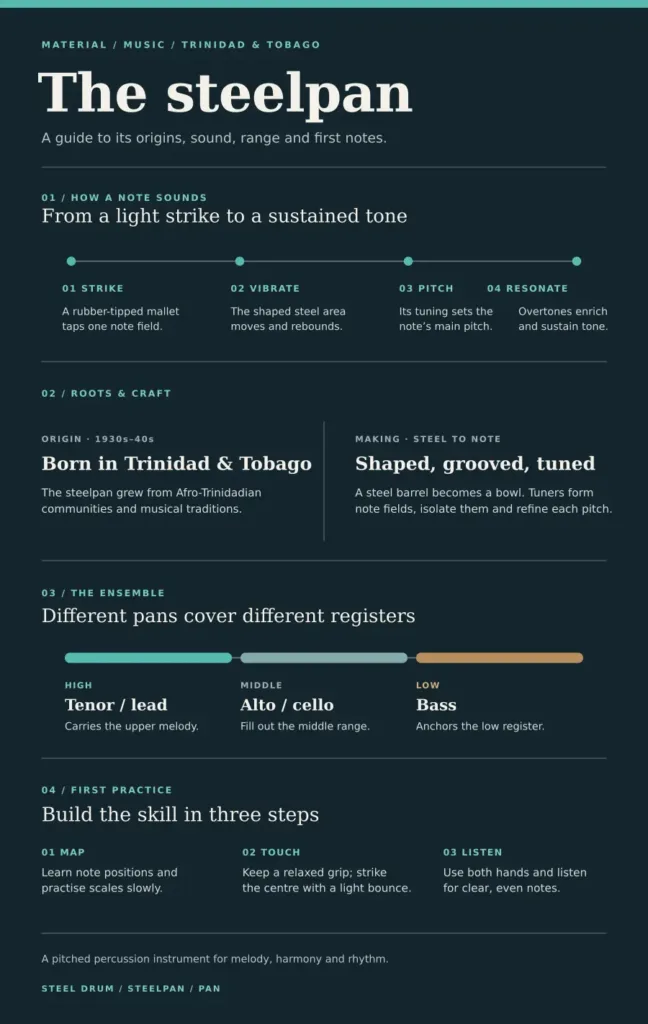
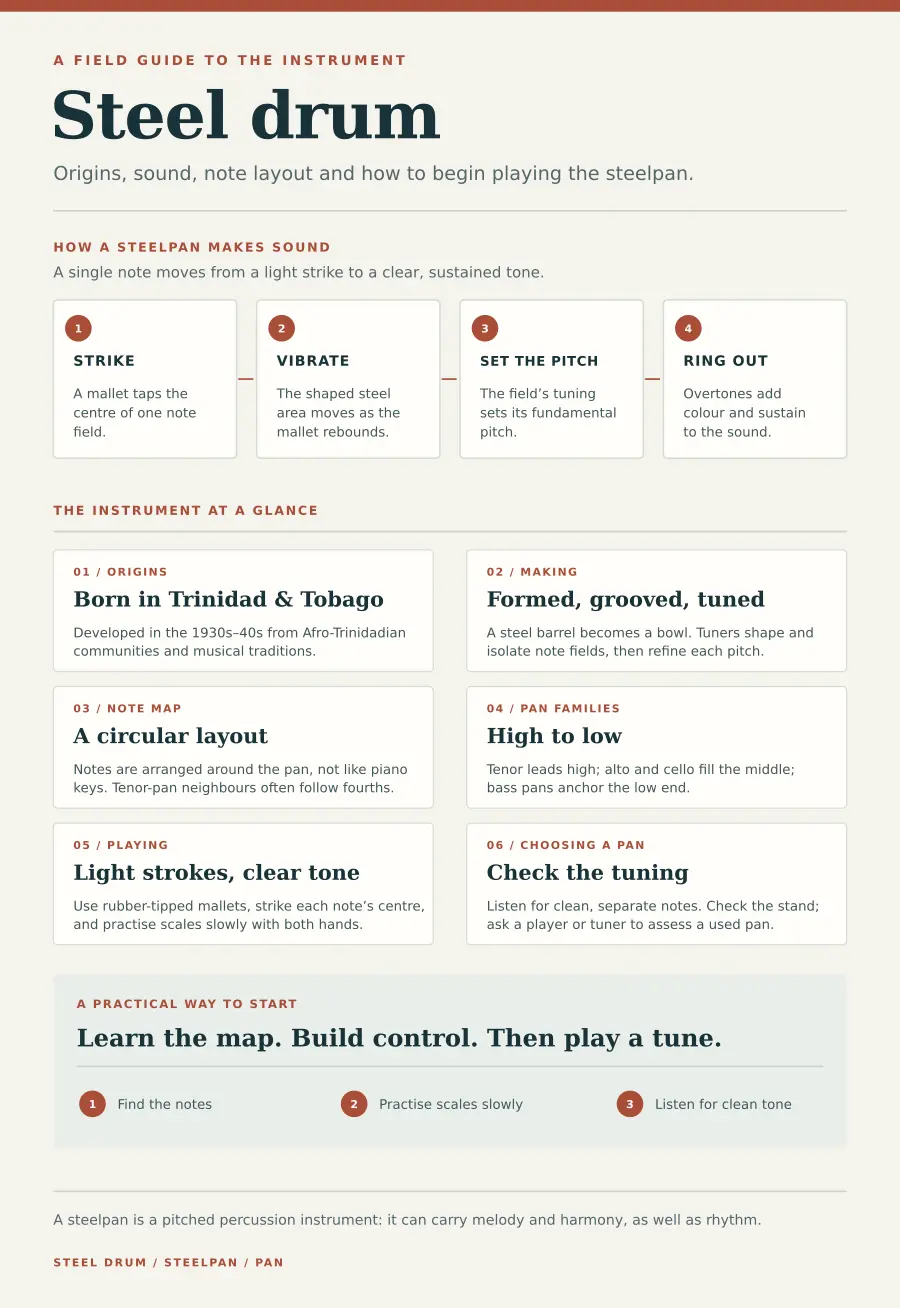
A steelpan begins with a steel container or purpose-made steel shell. A pan maker shapes the playing surface into a bowl-like form. The surface is then marked, formed and tuned into individual note areas. Each note area vibrates at particular frequencies when struck. A tuner adjusts the shape and tension of the metal until the note reaches its intended pitch and tone.
The process is more precise than simply hammering dents into a barrel. The note areas must be shaped consistently, separated enough to respond clearly and tuned so that the instrument sounds musical across its range. Pan construction includes several stages, and the exact process varies by maker and instrument type. Trinidad and Tobago’s National Training Agency describes competencies such as sinking the surface, marking and drafting note areas, grooving, preparing the pan and tuning it for pitch and timbre. The American Society of Mechanical Engineers also describes the pan-making process as a sequence of forming, heating, tuning and finishing steps.
Notes and Vibration
A note on a steelpan is both a musical pitch and a physical region on the playing surface. When a mallet contacts that region, the metal vibrates. Those vibrations create the sound you hear. The player’s strike point, mallet, force and timing all affect the result, but the note’s core pitch comes from the pan’s formed and tuned metal.
Steelpan notes are not simply small independent bells attached to a frame. They are parts of one connected sheet of steel. The maker and tuner shape the playing surface so each note responds as clearly as possible while the surrounding notes remain controlled. Grooves between note areas help define their boundaries and influence how the notes vibrate. The interaction between the shape, tension and surrounding metal is one reason pan tuning requires specialist skill.
A good note has a clear pitch and a musical tone. Depending on the instrument and its tuning, a note may contain a fundamental pitch and higher partials that give it colour. The result can sound bright, warm, sweet or percussive, depending on the pan, the mallets and the player’s touch. A steelpan does not produce only a blunt “clang.” A controlled strike can create a clean note that rings long enough to carry a melody.
Why the Notes Ring
Unlike a drumhead that gives a short burst of noise, a steelpan note often sustains after the mallet has bounced away. That resonance is part of the instrument’s appeal. It allows a melody to flow and gives the pan a shimmering quality.
The ring also asks the player to be precise. If you strike the wrong area or let notes overlap unintentionally, the result can become muddy. Players learn to control note length through timing, touch and, in some musical contexts, damping techniques. A beginner should first aim for a clean strike and an even sound. Note damping can come later, once the basic pitch map and rhythm are becoming familiar.
The rubber on the mallet matters. Mallets are designed to strike the steelpan without damaging it and to produce a usable tone. Different mallets can have different levels of hardness and weight, which affects attack and volume. Do not assume any rubber mallet is appropriate. Use the mallets supplied with the instrument or ask the maker or teacher which type is suitable.
Why Tuning Is Specialist Work
A steelpan is a finely tuned instrument. Repeated playing, impacts, environmental conditions and the instrument’s construction can affect tuning over time. A pan that sounds out of tune may need a professional inspection, but a player should not try to correct it by hammering the notes. Untrained adjustments can permanently damage the shape or make the pan harder to tune.
Tuning is a craft that involves listening and measuring pitch, then making controlled adjustments to the metal. The National Training Agency in Trinidad and Tobago describes steelpan tuning as a separate set of competencies from pan construction, including setting pitch and adjusting timbre and loudness. That distinction is useful for owners: a pan maker and a tuner may offer related but different services, and you should ask what work an instrument needs before commissioning it.
Types of Steelpan
Steelbands use different pan types for different ranges and musical roles. Names and exact note counts vary by maker and tradition, so these are general descriptions.
Tenor Pan
The tenor pan, sometimes called the lead or high tenor, commonly carries the main melody. It is a higher-pitched pan and a practical choice for solo playing. Many beginner resources use the tenor, but check the actual range and layout of the instrument you will learn on.
Double Tenor and Double Second
These instruments use two pans and can cover a wider range or different role than a single tenor. Depending on the arrangement, they may play melody, countermelody or harmony. Learning two surfaces can be more demanding, so a single tenor may be simpler at first.
Guitar, Cello and Bass Pans
Mid-range guitar and cello pans support harmony, chords and rhythmic patterns. Bass pans cover lower notes and provide the foundation of the ensemble. Some bass instruments use several pans, with each carrying a small group of notes.
Choosing a Pan for Solo Practice
A tenor is often a practical starting point for melodies, but your choice depends on the music you want to play, budget, space, transport and access to a teacher. Ask about the range, note layout, tuning, accessories and service history. Request a slow recording of each note, and get an experienced player to assess a used instrument. A community steelband may lend or rent a pan while you decide.
How the Notes Are Arranged
The note layout is one of the first surprises for a new player. A piano places notes in a repeating left-to-right pattern. A steelpan places its notes around a shaped playing surface. On many tenor pans, notes are arranged using a pattern related to the circle of fifths. This groups certain pitches in a way that can support musical relationships and helps explain why the layout does not look like a keyboard.
It is important not to treat one diagram as a universal map. Layouts vary by instrument type, maker, model and tuning. A tenor pan, double seconds and bass pans do not all present the same arrangement. Even within a pan family, there can be differences. If you are learning on a particular instrument, use a note map made for that instrument rather than memorising a generic picture from the internet.
The unfamiliar layout can feel awkward at first. Learning a pan means building a physical map of the notes and the movement between them. Slow, repeated practice makes that map more automatic.
Ask for the note names, octave range and a chart that matches your instrument. If an online diagram differs from your pan, follow the instrument in front of you and ask your teacher to explain the difference.

What You Need to Begin
You do not need a large equipment setup to start learning. You need access to a steelpan that is in usable tune, the correct mallets, a stable stand or frame and a safe place to practise. A music stand or printed note chart can also help during early sessions.
Borrow or Rent Before You Buy
A quality steelpan can be a significant investment, and beginners may not yet know which type suits them. Check with local steelbands, schools, arts organisations and music programmes to see whether they lend or rent instruments. Some groups let beginners try a pan during a rehearsal or introductory session. That gives you a chance to learn whether the instrument fits your interests before you buy.
If you decide to purchase, ask an experienced player or teacher to help you assess it. Steelpans are handmade or hand-finished instruments, and price alone does not tell you how well a particular pan plays. Ask about the maker, tuning, service history, included accessories, transport case and whether a professional setup is available.
Be careful with generic online listings that call any metal percussion object a steel drum. A low-cost tongue drum can be enjoyable, but it is not the same as a tuned steelpan. If your goal is to join a steelband or learn traditional steelpan technique, confirm that you are buying an instrument designed for that purpose.
Stand and Playing Height
A tenor pan is usually supported on a stand or frame. The pan should sit securely and should not sway when you play. Set the playing surface at a height that lets your shoulders stay relaxed and your elbows bend naturally. The exact height depends on your body and the instrument, so make small adjustments until you can reach the notes without hunching or stretching.
Some players sit, while others stand. Follow your teacher’s setup advice and choose a position that lets you move comfortably. If you feel pain, numbness or persistent strain, stop and adjust your posture rather than trying to play through it. Good technique should feel controlled, not forced.

Mallets
Steelpan mallets are often called sticks, pan sticks or mallets. They have a handle and a rubber playing tip. The correct tip and weight depend on the instrument and musical context. A mallet that is too heavy or too hard can create an unpleasant tone and may put unnecessary stress on the pan.
Hold the mallet with a relaxed grip. You want control, but you do not need to squeeze. The hand should guide the mallet while allowing it to rebound after the strike. A teacher can check your grip early and save you from building tension into your technique.
How to Play a Steel Drum
The best way to begin is to play slowly and accurately. Do not start by trying to perform a fast song. Your first job is to find the notes, strike them cleanly and listen to the sound they make.
1. Set Up Comfortably
Place the pan on a stable stand and make sure it will not move while you play. Stand or sit with your back comfortable, shoulders loose and feet balanced. Let your arms hang naturally. Your elbows should be slightly bent, with enough space to move both hands around the pan.
Before you play, check that your mallets are the correct pair and that the rubber tips are secure. If a tip is loose or damaged, replace or repair it before using it. Do not use a mallet with exposed hard material that could mark the playing surface.
2. Hold the Mallets Lightly
Grip each mallet between the thumb and fingers, leaving the wrist relaxed. Avoid holding it like a hammer. The goal is to let the mallet move freely and rebound after contact. Tension makes it harder to aim and can tire your hands quickly.
There is no single grip shape that suits every player and every mallet. Ask a teacher to show you a comfortable grip and check that your wrists remain loose. If your hands feel cramped, pause, shake them out and reset.
3. Find the Note Areas
Use a note chart that matches your pan. Start by locating a few notes rather than trying to memorise the whole surface. Say the note name aloud before you strike it. Then listen to the pitch and compare it with a tuner or reference recording if you have one.
Avoid placing stickers or tape directly on the playing surface unless the maker or teacher says it is safe. Some players use labels as a temporary learning aid, but adhesives can leave residue or affect the finish. A paper chart beside the pan is a safer default.
4. Aim for a Clean Strike
Each note area has a region where it responds clearly. Begin with gentle strokes near the centre of the note, but follow the maker’s guidance if the pan’s note shape suggests a different contact area. Strike and rebound. Do not press the mallet into the metal or drag it across the surface.
Listen for a clear pitch. If the note sounds dull, harsh or mixed with another pitch, slow down and check your contact point. Do not compensate by hitting harder. A controlled strike is usually clearer than a forceful one.
5. Practise a Small Group of Notes
Choose three or four notes from a simple phrase or scale. Play them slowly in order. Keep the spacing even and let each note ring naturally. Then repeat the sequence with the other hand leading, if your teacher’s method allows it. The aim is accuracy and comfort, not speed.
Once the notes feel familiar, expand the group. Build the map gradually. Trying to learn every note at once can make the pan feel confusing, while short patterns give your hands a clear route to remember.
6. Develop Both Hands
Melodies often move across the pan, so both hands need to contribute. Beginners sometimes rely on the dominant hand and use the other only when necessary. That can limit movement and make phrases feel awkward later.
Practise simple patterns with each hand. Then use alternating strokes where they feel natural. Hand assignments depend on the melody and the layout, so do not force a rigid rule if it makes a phrase harder to play. A teacher can help you choose sensible sticking patterns for a specific song.
7. Add Rhythm and Musical Shape
Once you can find a phrase’s notes, play it with a steady pulse. Count out loud or use a slow metronome setting. Keep your strokes consistent and listen for the way notes overlap. Then shape the melody with small changes in volume, timing and phrasing.
A steelpan can be expressive at low volume. You do not need to hit hard to make a phrase feel confident. Work on an even tone first, then make deliberate changes when the music calls for them.
A Beginner Practice Plan
Short, regular practice is more useful than a long session that leaves your hands tired. Try a 15- to 20-minute session several times a week, adjusting the time to your comfort and schedule.
Start with a minute or two of relaxed movement. Check your posture, shoulders and grip. Play a few single notes and listen to how clearly they ring. Then spend five minutes locating notes from your chart. Name each note before striking it and pause if you lose track of where you are.
Use the next five minutes for a small scale or pattern. Keep the tempo slow enough that you can hit the centre of each note without rushing. If you miss a note repeatedly, isolate that movement and practise it on its own rather than replaying the whole passage at speed.
Spend another few minutes on a melody you enjoy. Choose a song you can hum, because your ear will help you notice when the notes are wrong. Finish by playing a phrase slowly and evenly, then record a short take on your phone. Listening back can reveal timing or pitch problems that you do not notice while concentrating on your hands.
End the session before fatigue causes your grip to tighten. If your wrist or forearm becomes sore, stop and rest. Pain is not a normal requirement of practice. If discomfort returns, ask a teacher to check your setup and technique.

A Simple Four-Week Starting Path
For the first week, focus on posture, grip and note names. In the second, add a short scale or pattern and practise using both hands. In the third, learn a simple melody you can hum. In the fourth, record yourself and choose one improvement target, such as steadier timing or cleaner strikes. Treat this as a flexible guide, not a promise: progress depends on practice, instruction and the instrument.
Beginner Mistakes and How to Fix Them
Hitting Too Hard
A forceful hit can sound harsh and make the mallet bounce unpredictably. It can also make accuracy worse. Try lowering the mallet from a shorter distance and allowing it to rebound. If the note is unclear, check the strike location and the instrument’s condition before adding force.
Gripping the Mallets Tightly
A tight grip limits the mallet’s movement and creates fatigue. Pause every few minutes to relax your fingers and shake out your hands. Your grip should be secure enough to guide the mallet, but loose enough to let the wrist move.
Memorising a Layout That Does Not Match Your Pan
Online diagrams can differ. If you memorise the wrong layout, practice becomes frustrating. Confirm the pan type, tuning and note map with your teacher or maker. Keep the chart beside the instrument and label it with the model or tuning so you do not confuse it with another pan.
Playing Too Fast Too Soon
Speed hides mistakes rather than fixing them. Slow a phrase until you can play it accurately several times. Increase the tempo in small steps, and return to a slower pace when accuracy drops.
Using Only the Dominant Hand
This habit may work for a few simple notes but makes wider melodies harder. Include short two-hand patterns from the start. Keep them easy enough that both hands remain relaxed.
Practising Without Listening
It is possible to focus so much on finding notes that you stop hearing the music. Pause after a phrase and ask: Was the pitch clear? Was the rhythm steady? Did notes ring into one another? Recording yourself can help, but listening in the moment matters too.
Treating a Tuning Problem as a Technique Problem
If one note sounds consistently wrong even when you strike it cleanly, the pan may need professional attention. Do not keep striking harder or attempt to reshape the metal. Compare with a reliable tuner or ask an experienced player to listen, then contact a qualified tuner if needed.
Do You Need to Read Music
No. Many players learn by ear, demonstration and repetition. You can start by copying short phrases and learning note names. Basic rhythm notation and pitch names can still help you communicate with a teacher and follow written arrangements.
Reading music becomes more useful if you want to play in a formal ensemble, learn parts written for a particular pan or explore more complex arrangements. It is an additional tool, not a barrier to starting. If you already read drum notation, remember that steelpan parts usually involve pitched notes as well as rhythm, so you may need to learn note names and pitch relationships.
How Long Does It Take to Learn
You can learn a few notes and simple patterns in your first sessions. A short melody may become possible with regular practice, but comfort across the full layout and confident ensemble playing take longer. Progress depends on practice time, access to instruction, the instrument and previous musical experience. Set specific goals, such as playing a five-note phrase evenly, instead of treating learning as a race.
Finding a Teacher or Steelband
A teacher can help you choose the right pan, set it up and build a relaxed technique. Look for a tutor or group that works with your type of pan, welcomes beginners and explains what equipment you need. Community steelbands can develop timing, listening and ensemble awareness; ask whether they lend instruments or expect members to bring their own.
If there is no local group, try workshops, schools or online lessons taught by experienced pan players. Video can show technique, but an occasional in-person check can catch setup or tuning issues that a screen may not reveal.
Caring for a Steelpan
Handle the pan carefully. Use a stable stand and a suitable case or cover for transport. Keep it dry, avoid dropping it or placing objects on the playing surface, and follow the maker’s cleaning instructions. Abrasive pads and strong chemicals may damage the finish.
Avoid leaving the pan in a hot car, near a heater or exposed to harsh weather. After outdoor use, let it dry in a ventilated place before covering it. Replace worn mallet tips and check the stand and straps regularly.
If the pan is dented, rattles or develops an unstable note, ask a professional to inspect it. Do not hammer the notes yourself. There is no universal retuning schedule: use, condition and construction all matter. Ask the maker or tuner for a maintenance plan.
Steelpan for Drummers
For drummers, steelpan offers a different way to think about percussion. A kit player often builds patterns from a small group of drum and cymbal sounds. A pan player uses pitched notes to shape a melody, while rhythm and timing remain central to the performance.
Your drumming background can help with pulse, coordination and ensemble awareness. You may already understand how to practise slowly, use a metronome and keep your body relaxed. The new work is mapping notes, hearing pitch relationships and letting each sound ring clearly.
Do not assume that strong stick technique transfers directly. Steelpan mallets are lighter and the contact is more delicate than a forceful drum-kit stroke. A controlled rebound matters more than power. Treat the instrument as its own voice and take time to learn the technique that suits it.
Learning steelpan can also sharpen your ears as a drummer. You become more attentive to pitch, melodic contour and the way a part fits with harmony. Those skills can make you a more musical bandmate, even if you return to the drum kit for most of your playing.

Common Questions About Steel Drums
Is a steel drum the same as a steelpan
Yes. Steel drum, steel pan and steelpan are common names for the instrument developed in Trinidad and Tobago. Players often prefer “steelpan” or “pan” because the instrument produces tuned notes rather than functioning as a single drum.
Is a steelpan the same as a handpan
No. A steelpan is usually a concave instrument played with rubber-tipped mallets. A handpan is generally a convex instrument played by hand. They have different construction, playing methods and histories.
Can a beginner learn steelpan without music lessons
You can learn basic notes independently, but a teacher can help with pan choice, setup and relaxed technique. A beginner-friendly steelband or workshop provides feedback and ensemble experience.
How much does a steel drum cost
Prices vary by pan type, maker, tuning, condition and location. A novelty tongue drum is not a performance steelpan. Ask an experienced player to assess an instrument before buying; renting or borrowing is a sensible way to start.
Can I play a steelpan indoors
Yes, but an acoustic pan can be loud in a small room. Consider the time of day, the people who share your space and the room’s acoustics. Practise at a moderate volume and ask your household or neighbours about reasonable times. Do not cover the pan with fabric to reduce volume while playing; that can interfere with the sound and may mark the finish.
Can I play a steelpan with my hands
Traditional steelpan technique uses mallets. Some players may use other approaches for particular instruments or arrangements, but beginners should follow the method recommended for their pan. A handpan or tongue drum is designed for a different playing technique.
Does every steelpan use the same note layout
No. Layout depends on the pan type, model, maker and tuning. Many tenor pans use a layout based on the circle of fifths, but that pattern should not be assumed for every instrument. Use a chart that matches your pan.
How often should a steelpan be tuned
There is no universal schedule. Use, condition, construction and environment all matter. If notes sound unstable or the instrument has been damaged, ask a qualified tuner to assess it. Do not try to hammer notes back into tune yourself.
Your First Steps on Steelpan
Start with the instrument in front of you: use its own note chart, keep your grip light and practise a short phrase slowly. Ask an experienced player for help with pan choice or setup, and leave tuning adjustments to a qualified tuner. If you are a drummer, bring your sense of time and add pitch and melody one note at a time.
Sources and Further Reading
- Ministry of Foreign and CARICOM Affairs, Government of Trinidad and Tobago, “National Instrument”: https://foreign.gov.tt/about/trinidad-tobago/national-symbols/national-instrument/
- National Library and Information System Authority of Trinidad and Tobago, “Steelband”: https://www.nalis.gov.tt/resources/tt-content-guide/steelband/
- National Archives of Trinidad and Tobago, “Vagabonds, Hooligans and Badjohns – The Violent Past of the Steel Bands”: https://www.natt.gov.tt/node/184
- National Training Agency of Trinidad and Tobago, “Steelpan Manufacturing”: https://ntatnt.org/steelpan-manufacturing/
- American Society of Mechanical Engineers, “Engineering Musical Drums”: https://www.asme.org/topics-resources/me-today/engineering-musical-drums
These sources support the historical and technical background. The playing guidance is general beginner advice; instrument layouts, recommended mallets and care instructions can vary by maker and model.
Gary Trotman
Steelasophical