 Skip to content


The Invaders Steel Pan Layout: History, Design, Sound and Lasting Legacy The Invaders steel pan layout is one of the most important designs in the history of the steelpan. It may not be the pattern most beginners meet today, and it is no longer the dominant layout used by modern tenor-pan makers, but its influence runs through the entire steel orchestra. To understand the Invaders layout is to look back at a period when Trinidad’s pan pioneers were not simply learning to play a finished instrument. They were inventing the instrument as they went along.
At the centre of that story are the Woodbrook Invaders Steel Orchestra and the extraordinary builder, tuner and player Elliot “Ellie” Mannette. Their experiments helped transform beaten metal into a fully chromatic musical instrument capable of carrying melody, harmony and sophisticated arrangements. The distinctive Invaders tenor—often called the Invader style, Invaders tenor, C pan or F-sharp pan—became a major standard during the 1950s and 1960s.
Its most recognisable feature is a large, low F-sharp note placed near the centre of the playing surface. That one note makes an Invaders tenor easy to identify, but the real importance of the design goes much deeper. The layout represents a practical answer to a historic question: how can a complete chromatic scale be organised on the circular surface of an oil drum so that a musician can play with freedom, balance and speed?
The answer created in the Invaders panyard helped shape the modern steel orchestra.
What Is a Steel Pan Layout?
A steel pan layout is the arrangement of tuned note areas on the playing surface of the instrument. Each outlined section of the metal is shaped and tuned to produce a particular pitch. Unlike a piano, where the notes run from left to right in a straight line, the notes of a steel pan must share a circular, concave surface.
That changes everything.
The builder has to consider the size of every note, the pitch it must produce, the amount of metal available, the relationship between neighbouring notes and the physical movement of the player’s hands. Lower notes usually need larger areas of vibrating metal, while higher notes can be smaller. The tuner must also manage the way vibrations travel through the wider surface of the pan.
A successful layout therefore has to satisfy several needs at once:
- It must provide the required musical range.
- It must give each note enough space to speak clearly.
- It must allow chromatic melodies to be played fluently.
- It must support comfortable sticking and hand movement.
- It must help the tuner control resonance and interaction between notes.
- It must be learnable and repeatable across a family of instruments.
Today, many tenor players are familiar with the circle-of-fourths-and-fifths layout. On that design, the lower notes form a logical cycle around the outer part of the pan, with related octave notes placed further inside. The Invaders layout came from an earlier stage of development. Its pattern can look less immediately symmetrical, but it was never random. It was shaped through performance, musical necessity and repeated experimentation.
The Woodbrook Invaders and the Birth of a Design
The story begins in Woodbrook, Port of Spain, during the formative years of the steelband movement. Before steelpans had standard note patterns, polished chrome finishes or a recognised orchestral family, young Trinidadians experimented with biscuit tins, paint containers, dustbin lids, brake drums and other pieces of metal.
Ellie Mannette played with the Oval Boys, the group that developed into the Invaders. According to the Percussive Arts Society’s account of Mannette’s life, he experimented with a concave playing surface, moved on to larger barrels and gradually increased the number of available pitches. A 35-gallon barrel allowed him to produce nine notes; by 1946, he had built a lead pan from a 55-gallon drum with fourteen pitches.
This was not development in the modern laboratory sense. It was practical investigation driven by Carnival, competition, curiosity and the desire to play more demanding music. A new melody might reveal a missing accidental. An awkward phrase might expose a weakness in the note arrangement. A note that sounded fine on its own might interfere with the note beside it. Builders and players listened, changed the metal, moved patterns and tried again.
The Invaders panyard became one of the great workshops of that experimental age. Pan Trinbago describes it as the birthplace of many of Mannette’s innovations and credits his work there with sinking the drum, putting rubber on the striking ends of pan sticks and developing several voices of the steel orchestra. The Pan Trinbago account of the Ellie Mannette memorial gives a sense of how central the panyard was to his creative work.
The Invaders layout should therefore not be imagined as a pattern invented in isolation and then imposed upon players. It grew from a community of makers, musicians and arrangers. Mannette was the towering figure, but the panyard was the environment in which ideas could be tested in real music.

The Invaders Steel Pan Layout
Ellie Mannette’s Contribution to the Modern Steelpan
Ellie Mannette is often called the father of the modern steel drum, although pan history is always best understood as a collective story with many pioneers. His individual contribution was nevertheless immense.
Mannette’s use of the 55-gallon oil drum gave builders a larger and more stable surface on which to work. Sinking the top of the drum into a concave bowl created the tension and space needed to accommodate more notes. Rubber-tipped sticks produced a more musical attack than bare wood or other hard materials. His work on tuning and instrument construction improved the sweetness, projection and reliability of the sound.
The US National Endowment for the Arts records Mannette’s development from the Oval Boys to the Woodbrook Invaders, his pioneering work with oil drums and his later use of electronic analysis to shape a note’s harmonic blend. That journey—from improvised metal percussion to carefully controlled musical acoustics—mirrors the wider journey of pan itself.
Mannette is also associated with the development of several orchestral voices, including double seconds, double guitars, cellos and tenor basses. The importance of the Invaders tradition is consequently not confined to one lead pan. It helped establish the idea of a balanced steel orchestra in which different pans could perform soprano, alto, tenor and bass functions.
This is one reason the phrase Invaders steel pan layout can cause confusion. Sometimes people mean the historic Invaders-style tenor with the central F-sharp. At other times, they are referring more broadly to note combinations and design ideas that emerged from the Invaders tradition and influenced other members of the pan family. The two meanings are related, but they are not identical.
How the Invaders Tenor Layout Is Organised
There is no single diagram that represents every Invaders-style tenor ever made. Early pans were handmade, tuners developed their own preferences and instruments evolved over time. The note count, precise range and shape of individual tone fields can therefore differ between makers and periods.
That variation matters. Anyone restoring, buying or learning an old Invaders pan should inspect the actual instrument instead of assuming that every example follows an identical map.
Even so, the classic design has several recognisable characteristics.
The large central F-sharp
The most famous feature is the unusually large F-sharp in or near the centre of the pan. Because this pitch belongs to the lower part of the instrument’s register, it needs a relatively large vibrating area. Its central position gives the layout a visual identity unlike a modern fourths-and-fifths tenor, where the lower notes are arranged around the outer ring.
This is why the instrument is sometimes called the F-sharp pan. Educational descriptions of the design, including this guide to steelpans in schools, use the central low F-sharp as the quickest way to distinguish an Invaders tenor from a fourths-and-fifths pan.
A chromatic melody instrument
The Invaders tenor was built to give the lead player access to the chromatic scale. That is crucial. A diatonic instrument can play comfortably in a limited selection of keys, but a chromatic pan includes all twelve notes of the Western chromatic octave. It can therefore handle accidentals, modulations and a far wider repertoire.
The common C version begins around middle C and usually offers approximately two and a half octaves, although surviving examples and modern reproductions may have different bottom or top notes. Rather than presenting one rigid specification as universal, it is safer to describe the Invaders tenor as a family of closely related chromatic layouts.
Notes arranged for physical playing routes
To a musician trained on a circle-of-fifths pan, the Invaders pattern may initially appear irregular. The logic becomes clearer when the instrument is treated as a field of movement rather than a printed theory diagram.
The layout was intended to let the player travel across the pan—top to bottom, side to side and diagonally—while keeping the hands balanced. Scale fragments, intervals and familiar melodic movements create physical routes. With practice, the player stops seeing isolated note names and begins to feel the geography of the instrument.
This embodied knowledge is central to all pan playing. A fluent pannist does not calculate every strike. The hands learn distances, angles and rebounds. On an Invaders tenor, those movements form a distinctive vocabulary of shapes.
Large outer notes and smaller upper notes
As on other tenor pans, note size generally decreases as pitch rises. Lower pitches need more vibrating metal and are therefore given larger tone fields. Higher notes occupy smaller areas. The result is a surface that combines broad low notes with compact upper-register notes.
The shape and placement of those fields are not merely visual. They affect response, sustain, tone colour and the way neighbouring pitches interact. A skilled tuner must balance the fundamental pitch with important upper partials while ensuring that one note does not destabilise another.
Why the Central F-sharp Matters
The central F-sharp is more than a historical curiosity. As musicians demanded a complete chromatic instrument, new pitches had to be fitted into a crowded surface. The centre offered room for a large tone field, and F-sharp became the unmistakable landmark of the Invaders design.
For the player, it provides a visual and physical anchor. For the builder, it creates a demanding acoustic problem: groove shape, curvature, tension and clearance must be controlled so that the central field and surrounding notes can vibrate properly.
The layout does not, however, determine the sound on its own. Steel thickness, sinking depth, note geometry, skirt length, tuning method, sticks and the player’s touch all contribute. The design creates possibilities; the tuner and player bring them to life.
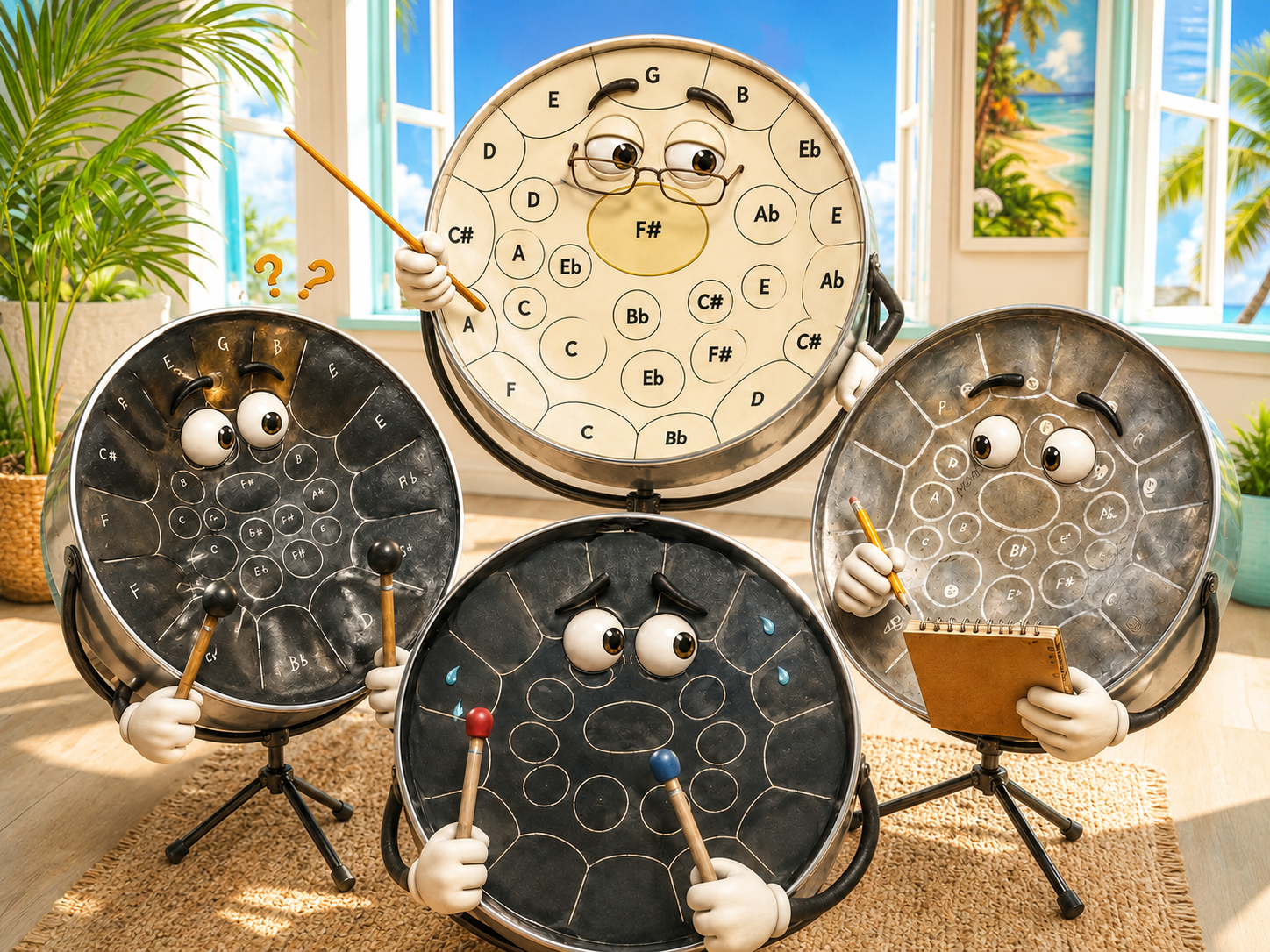
Fun Invaders steel drum
Invaders Layout Versus Fourths and Fifths
The easiest way to understand the Invaders layout today is to compare it with the fourths-and-fifths tenor that later became the international norm.
The modern pattern is associated with Anthony “Tony” Williams of North Stars. On a conventional tenor, the lower notes are arranged around the outer ring according to a cycle: moving one way produces intervals of a fifth, while moving the other produces fourths. Related octave notes are placed towards the inside. This creates a repeated, highly systematic geometry.
The Invaders tenor uses a different organisation. Its central F-sharp interrupts the ring-based logic, and the routes between chromatic notes must be learned as their own map. That does not make the design musically inferior. It reflects a different solution to the same physical and musical problem.
| Feature | Invaders-style tenor | Fourths-and-fifths tenor |
|---|---|---|
| Historic association | Ellie Mannette and Woodbrook Invaders | Tony Williams and North Stars |
| Signature feature | Large low F-sharp near the centre | Lower notes organised around the outer ring |
| Visual logic | Performance-shaped, less immediately symmetrical | Repeating cycle of fourths and fifths |
| Typical role | Chromatic lead or melody pan | Chromatic lead or melody pan |
| Learning experience | Requires its own movement map | Repeating interval pattern can aid transposition |
| Present-day use | Historic, specialist and less common | Widely used international standard |
Williams’s design is often called the Spider Web because early versions used grooved lines that gave the surface a web-like appearance. The University of the West Indies profile of Tony Williams places him alongside Mannette, Neville Jules and Bertie Marshall among the great panmakers, arrangers and band leaders.
The change did not happen overnight. The Invaders layout had gained wide acceptance, while the newer pattern still had to prove itself in tuning, performance, competition and teaching. During the later 1960s and subsequent decades, fourths and fifths gradually became the preferred tenor configuration.
Standardisation brought significant advantages. A player could move between similarly laid-out instruments with less relearning. Teachers could use common diagrams. Arrangers could plan sticking with greater confidence. Builders and tuners could exchange knowledge around a shared pattern. Yet standardisation should not erase the importance of the design that came before it.
The fourths-and-fifths tenor did not emerge into an empty world. It entered a musical culture that the Invaders pan had already helped make chromatic, orchestral and ambitious.
The Invaders Layout and the Wider Pan Family
One of the most significant claims made for the Invaders tradition is that its note relationships helped shape other voices of the steel orchestra. The design principles developed in the Invaders panyard were applied to instruments responsible for inner harmony, strumming patterns, counter-melodies and bass movement.
The double second became one of the most versatile voices in the orchestra. Guitar and cello pans supplied rhythmic harmony and body. Tenor basses connected the middle and lower registers. Together, these instruments allowed arrangers to think orchestrally rather than treating a steelband as a group of identical melody pans.
This development changed what a steel orchestra could do. It could voice chords across sections, create call-and-response effects, separate melody from accompaniment and build the dramatic crescendos now associated with major steelband performances.
An extensive practitioner account of the tenor’s development argues that combinations established in the Invaders tradition remained visible in double seconds, guitars, cellos and tenor basses even after the Invaders tenor itself was overtaken by fourths and fifths. That history of the Invaders and Spider Web tenor designs is especially useful because it treats a layout as part of a connected orchestral system rather than as an isolated note chart.
This is the deeper legacy of the Invaders layout. A single historic lead pan helped establish a design language for an entire family of instruments.
What Is It Like to Play an Invaders Pan?
The first experience can be disorientating for someone who already knows a fourths-and-fifths tenor. Familiar note names are present, but they are not where the hands expect them to be. Patterns that once felt automatic have to be rebuilt.
The best approach is to resist judging the pan through the habits of another layout. Learn it on its own terms.
Begin with the landmarks. Find middle C, the central F-sharp and the principal notes used in simple keys. Play slowly and listen to the character of every field. Then connect neighbouring pitches into short scale fragments. Work outward from familiar melodies before attempting fast chromatic runs.
A practical learning sequence might include:
- Identify and play every natural note.
- Add the five accidentals and locate the complete chromatic scale.
- Practise one-octave major scales with consistent sticking.
- Play arpeggios and broken chords in several keys.
- Explore thirds, fourths, fifths and octave jumps.
- Mark difficult hand crossings in written music.
- Repeat short phrases until movement becomes automatic.
- Practise rolls without allowing the sticks to drift into adjacent notes.
Good sticking is essential. Because the note arrangement differs from the dominant modern pattern, a player may need alternative hand choices for rapid lines. There is rarely only one possible solution. The best sticking maintains an even tone, avoids unnecessary crossing and positions the hands for the next phrase.
The player should also remember that an older pan may respond differently from a modern concert instrument. Some notes may have a shorter sustain. Certain fields may prefer a lighter strike. The sticks supplied for one pan may be too hard or heavy for another. Listening and adapting are part of the technique.
Why the Invaders Steel Pan Layout Still Matters
The Invaders steel pan layout deserves to be remembered not only by historians and tuners but by every musician who values the steelpan.
It represents the moment when the lead pan became capable of far more ambitious chromatic music. It reflects Ellie Mannette’s combination of craftsmanship, musical imagination and persistence. It shows how a panyard could function simultaneously as rehearsal room, social centre, classroom and research workshop.
Most importantly, it reminds us that the steelpan was not a lucky accident. Its creation required thousands of decisions. Where should the next note go? How deep should the bowl be? How large must a low pitch become? Which stick will bring out the sound without choking the metal? How can several different pans work together as one orchestra?
The Invaders tradition answered those questions well enough to change music history.
Today’s fourths-and-fifths tenor may offer a more standardised map, but the large central F-sharp of the Invaders pan remains a badge of invention. It belongs to a time when the limits of the instrument were being redrawn in panyards across Trinidad, when every new pitch expanded the music that could be played and every improved tone challenged old prejudices about what pan could become.
For pannists, the layout offers a different physical vocabulary. For builders and tuners, it preserves an alternative approach to organising vibrating steel. For teachers, it turns a lesson about notes into a lesson about culture and innovation. For audiences, it adds another layer to the remarkable story behind the sound.
The Invaders layout is no longer the most common tenor design, but rarity is not irrelevance. Its central idea survives every time a chromatic melody rings from a steel orchestra and every time different pan voices combine to create harmony, rhythm and bass.
That is its lasting legacy: not simply a map of notes, but a map of possibility.
Frequently Asked Questions About the Invaders Steel Pan Layout
What is an Invaders steel pan layout?
It is a historic chromatic note arrangement associated with Ellie Mannette and the Woodbrook Invaders Steel Orchestra of Trinidad. The term most often refers to an Invaders-style tenor or lead pan.
How can I recognise an Invaders tenor?
Look for a large low F-sharp note in or near the centre of the playing surface. This is the design’s clearest visual landmark. Confirm the identity by checking the full note map, because handmade pans can vary.
Is an Invaders pan the same as a fourths-and-fifths pan?
No. Both are chromatic tenor pans, but their notes are organised differently. A fourths-and-fifths tenor uses a repeating interval cycle around its outer ring. The Invaders layout has its own performance-shaped map and a distinctive central F-sharp.
Who invented the Invaders layout?
The layout is principally associated with steelpan pioneer Elliot “Ellie” Mannette and the creative work carried out within the Invaders tradition. Pan history involved many contributors, so it is best understood as both an individual achievement and a product of a highly inventive community.
Is the Invaders layout difficult to learn?
It is not inherently unplayable or illogical, but it can feel unfamiliar—especially to someone trained on fourths and fifths. A clear chart, slow scale practice and deliberate sticking will gradually turn the surface into a dependable mental and physical map.
Are Invaders-style pans still used?
Yes, although they are much less common than modern fourths-and-fifths tenors. They can still be found in older steelbands, schools, collections and specialist settings. Some builders and players also preserve the layout for its historic and musical value.
Does the layout determine the sound?
It influences note size, placement and resonance, but it does not determine tone on its own. The quality of the steel, construction, tuning, skirt length, sticks and player’s touch all matter.
Where did the modern fourths-and-fifths layout come from?
It developed from the Spider Web tenor associated with Anthony “Tony” Williams and North Stars. Over time, its systematic note arrangement became the dominant international standard for tenor pan.
Celebrating the Craft Behind Every Note
At Steelasophical, we believe the beauty of pan becomes even greater when people understand the ingenuity behind it. A steelpan may look wonderfully simple from a distance, yet every note represents patient craftsmanship, musical knowledge and a direct connection to Trinidad and Tobago’s cultural history.
The Invaders steel pan layout captures that story perfectly. Its bold central F-sharp, chromatic range and influence across the steel orchestra stand as a tribute to Ellie Mannette, the Woodbrook Invaders and the wider community of pioneers who turned discarded industrial steel into one of the world’s most distinctive musical instruments.
The next time you hear a steelpan carry a melody above the rhythm of the band, remember that the sound began with people willing to experiment. They listened to the metal, challenged the limitations of the instruments available to them and kept building until an orchestra emerged.
The Invaders layout is one of the clearest surviving records of that creative revolution—and one of the foundations on which the modern world of pan still stands.


Who Invented the Invaders Steel Tenor Pan?
A research note on the Invaders/F-sharp chromatic tenor layout
Finding: Elliott ‘Ellie’ Mannette, with the Woodbrook Invaders
Instrument: Invaders-style chromatic tenor/lead pan (F-sharp style)
Confidence: High on the principal attribution
Date: 26 August 2026
DIRECT ANSWER
The Invaders tenor layout was developed by Elliott ‘Ellie’ Mannette with the Woodbrook Invaders. The design is commonly described as the Invaders or F-sharp chromatic tenor style.
What the name refers to
This answer concerns the Invaders-style soprano/tenor note layout, not the invention of the steelpan as a whole. Museums Victoria catalogues a historic instrument as an ‘Ellie Mannette F# style’ tenor, directly linking his name to the layout family. Definite Pitch Steel Pans likewise identifies the chromatic tenor with Mannette and Woodbrook Invaders under his leadership.
Three achievements that should not be conflated
| Name | Correct historical credit | Relation to the Invaders layout |
| Winston ‘Spree’ Simon | Early ping-pong or melody pan | Important to steelpan origins, but not the mature Invaders chromatic layout. |
| Elliott ‘Ellie’ Mannette | Invaders/F-sharp chromatic tenor | Principal named innovator; developed the layout with Woodbrook Invaders. |
| Anthony ‘Tony’ Williams | Spider Web / circle-of-fifths tenor | A later layout that became the international standard, not the Invaders pattern. |
Source context: NALIS; The University of the West Indies; and Definite Pitch Steel Pans.
STEELPAN HISTORY | RESEARCH NOTE
Why Mannette is the best-supported answer
The Percussive Arts Society records that Mannette’s Oval Boys became Invaders and that by early 1946 he had built a 55-gallon-drum lead pan with 14 pitches. The National Endowment for the Arts also identifies him as an Invaders leader and credits him with foundational advances in oil-drum construction and concave sinking.
Definite Pitch’s tenor history makes the layout attribution explicit: it credits the chromatic configuration to Mannette and Woodbrook Invaders, and describes Invaders styling as a leading early configuration. PAN Magazine also lists the Invader-style tenor among Mannette’s inventions.
Pan Trinbago’s memorial account describes the Invaders panyard as the birthplace of many Mannette innovations. Its language also preserves the broader workshop context: Mannette was the principal named innovator, but he worked in a living band community rather than in isolation.
Historical interpretation
No patent or single contemporaneous record was found that acts as a formal birth certificate for the mature layout. Steelpan design developed through experimentation, competition, oral history and workshop practice. The sources nevertheless converge strongly on Mannette as the principal innovator behind the Invaders/F-sharp tenor.
PREFERRED PUBLICATION WORDING
‘The Invaders-style chromatic tenor, or F-sharp pan, was developed by Ellie Mannette with the Woodbrook Invaders.’
Limits and disagreements
Collective development. Calling the design a one-person invention can overstate how steelpan knowledge evolved.
Attribution wording. Sources variously credit Mannette alone, Mannette and Invaders, or Invaders under his leadership.
Dating. The evidence more securely establishes the layout family and attribution than one exact completion date for the mature design.
STEELPAN HISTORY | RESEARCH NOTE
Claim-to-source ledger
The table shows how the conclusion was triangulated and where the evidence is strongest.
| Claim | Source trail | Assessment |
| Mannette led Invaders innovation and built a 14-pitch oil-drum lead pan by 1946. | Percussive Arts Society; National Endowment for the Arts | Strong institutional support |
| The Invaders/F-sharp tenor style is linked to Mannette and Woodbrook Invaders. | Museums Victoria; Definite Pitch; PAN Magazine | Strong cross-source convergence |
| The Invaders panyard was a development site for Mannette’s innovations. | Pan Trinbago | Strong institutional memory |
| Steelpan development was collective and origin claims compete. | NALIS; Definite Pitch | Strong contextual support |
| Williams created the later Spider Web/circle-of-fifths layout. | University of the West Indies | Strong distinction between layouts |
Sources
Elliott ‘Ellie’ Mannette – Percussive Arts Society. Biography and Hall of Fame profile.
Elliott ‘Ellie’ Mannette – National Endowment for the Arts. National Heritage Fellowship profile.
Mannette memorial and Invaders panyard account – Pan Trinbago. Institutional history of the panyard’s innovations.
Steel pan object record – Museums Victoria Collections. Identifies an ‘Ellie Mannette F# style’ tenor.
History of the Tenor Pan – Definite Pitch Steel Pans. Specialist practitioner history of the chromatic tenor and layout families.
Mannette, Wong and Philmore: A Requiem for Pan Royalty – PAN Magazine. Specialist secondary account naming the Invader-style tenor among Mannette’s inventions.
Profile of Anthony Williams – The University of the West Indies. Distinguishes the later Spider Web/circle-of-fifths note-placement scheme.
Steelband – NALIS, Trinidad and Tobago. Context on competing origin claims and the roles of Simon and Mannette.
Accessed 26 August 2026. Several sources summarize oral-history traditions rather than contemporaneous technical documentation; the qualified conclusion reflects that limitation.
