 Skip to content

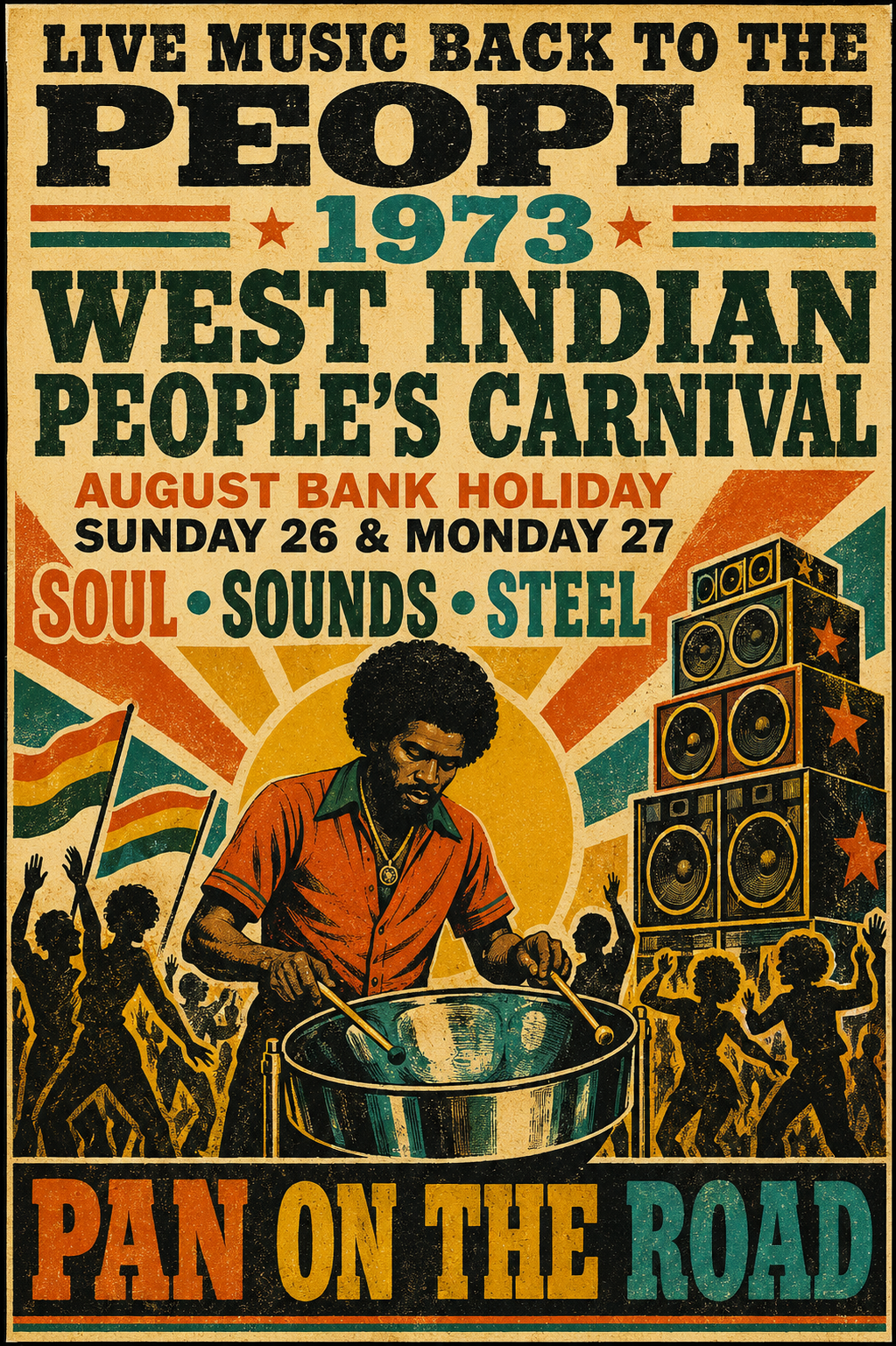
The 1973 West Indian People’s Carnival Poster
There are no glossy photographs, corporate logos or managed brand colours. Names are squeezed into narrow columns and the surviving image has faded. Yet its central message still lands with force: “Live Music Back to the People.”
Below that declaration are the dates of the August Bank Holiday—Sunday 26 and Monday 27 August 1973—and three headings that tell us what Londoners could expect to hear: Soul, Sounds and Steel. At the bottom, in the largest lettering on the page, comes another phrase: “Pan on the Road.”
Those few words open a window onto the year in which the event now known worldwide as Notting Hill Carnival began to assume its modern musical character. Steelpan was already part of its heartbeat. In 1973, however, static sound systems were formally welcomed, more Caribbean communities were represented, masquerade grew in importance and the streets became a platform for a wider generation of Black British music makers.
This is not merely an old entertainment bill. It is evidence of a community claiming the right to be seen, heard and celebrated in public.
A Poster Made for the Street
The physical appearance of the poster matters. It does not feel like something created at a distant advertising agency. It feels immediate, practical and local—as though it was made to be pinned in cafés, barbershops, record shops, community centres and the windows of businesses around west London.
Thick black lettering fights for attention against a pale background. The words “People”, “Steel”, “The Brothers”, “Ebony” and “Pan on the Road” are especially prominent. No single celebrity is placed above everybody else. Instead, soul groups, sound systems and steelbands share the page as one musical community.
The blurred ink and uncertain names remind us how easily community history can disappear. A cheaply printed street poster might be thrown away the morning after a celebration. When one survives, it carries voices that may otherwise be missing from the archive.
Why 1973 Was a Turning Point
The poster advertises the West Indian People’s Carnival, one of the names associated with the event that developed into today’s Notting Hill Carnival. Its roots stretch back beyond 1973.
In January 1959, Trinidadian journalist and activist Claudia Jones organised a Caribbean carnival at St Pancras Town Hall. The indoor event came in the aftermath of the racist attacks that had shaken Notting Hill in 1958. It offered Caribbean Londoners a space for beauty, performance, confidence and collective pride at a time when they were routinely subjected to discrimination in housing, employment and everyday life.
Another important strand emerged in Notting Hill itself. In 1966, community activist Rhaune Laslett organised an outdoor neighbourhood festival and invited Trinidadian musician Russell Henderson to perform. Henderson’s steelband moved into the surrounding streets, and residents followed. Music turned a local gathering into a procession.
The London Museum’s history of Notting Hill Carnival identifies 1973 as a significant turning point. Under organiser Leslie Palmer, Carnival became more deliberately pan-Caribbean. Participants with roots in islands including Dominica, Grenada and St Lucia joined the growing celebration. Experienced Trinidadian masquerade makers strengthened the visual spectacle, while reggae, dub and sound-system culture spoke directly to a younger generation.
Palmer understood that Carnival needed both cultural depth and popular energy. He sought out steelbands, costume bands, reggae groups and sound systems. Rather than treating Caribbean culture as one uniform tradition, he made room for its variety. That decision is visible on the poster. Soul, Sounds and Steel are separate headings, but they are part of one event.
“Live Music Back to the People”
The slogan at the top of the poster is its emotional centre.
“Live Music Back to the People” sounds celebratory, but it also sounds like a demand. It rejects the idea that meaningful music must be confined to theatres, concert halls, private clubs or venues that some local people could not afford—or did not feel welcome entering. The street becomes the venue. The neighbourhood becomes the stage. The audience does not sit at a polite distance; it dances, follows, answers and becomes part of the performance.
The word “back” is important. It suggests recovery. Music belongs among people, the slogan tells us, and Carnival is returning it to them.
For Caribbean communities in 1970s Britain, that principle carried particular weight. Public space was never neutral. Black families had experienced open racism, exploitative landlords, hostile policing and the constant pressure to make themselves less visible. Carnival reversed that expectation for one weekend. Steelpan rang between the houses. Bass travelled through walls and pavements. Costumes filled the road with colour. Caribbean people did not ask to be quietly accommodated; they shaped the sound and movement of the neighbourhood.
The slogan also captures something essential about live performance. A record can be owned and replayed, but music in the road is shared in the moment. It depends upon musicians, engineers, organisers, dancers and spectators. Everyone contributes to the atmosphere. The poster sells no reserved seat and promises no velvet rope. It invites people into a living cultural exchange.
Soul: The Bands That Brought the Stage to the Street
The left-hand column is headed “Soul.” Several names can still be made out, although the quality of the surviving copy makes a complete transcription difficult. Among the more legible entries are names appearing as Erasmus, Daveracks, Dyanites, Amanda, Acklamites, Family Affair and Black Lace. Other lettering is too degraded to state confidently.
Their presence is important even when the details of every group are not easily recoverable. Discussions of early Carnival music often settle into a simple story: steelpan represented the older Caribbean tradition, while reggae sound systems represented the emerging youth culture. The poster shows a broader reality. Live soul, funk, reggae and Caribbean dance bands also occupied the programme.
Britain’s Black music scene grew through clubs, youth organisations, community halls and informal networks. Many musicians had no major recording contract or extensive press coverage; reputations travelled by word of mouth and the quality of live shows. A place on a Carnival poster put local performers before a huge, mobile audience.
It also showed that Caribbean cultural life in Britain was never represented by one genre. African-American soul and funk, British pop, jazz, ska, reggae and the influences of many islands could meet in the road without permission from the mainstream music industry.
Sounds: The Bass-Led Revolution Arrives
The middle column, headed “Sounds,” records one of the most consequential changes in Carnival history.
Sound systems had already been operating unofficially in the area. Jamaican sound-system culture had travelled to Britain with post-war migration, bringing not just records but an entire way of presenting them: selectors, DJs or microphone performers, custom-built speaker boxes, amplifiers, exclusive tunes and a deep emphasis on bass.
A sound was both a collection of equipment and a creative team with its own identity, following and style.
In 1973, Leslie Palmer formally invited static sound systems into Carnival. The official Notting Hill Carnival sound-system history describes this as the moment the discipline received an official place within the event. Palmer recognised that the sounds appealed to young people and could increase participation. As he later put it, sound systems were the voice of the youth.
The faded names on the poster correspond with pioneers remembered in the Carnival archive: Bertram the Wasp, Zion, Paddington Terror, Papa Weasel, Black Patch, Six-by-Six and Lord Sam. A Notting Hill Carnival collection item on Google Arts & Culture identifies these among the first systems to play at the festival.
Their inclusion changed the physical experience of Carnival. A steelband could move along the route, pulling a crowd behind it. A static sound system created a different kind of territory. Speaker stacks transformed a street corner into an open-air dance. People could gather around a particular sound, leave, return and compare it with another. Different points across the neighbourhood developed their own musical personalities.
Today, static sound systems are inseparable from Notting Hill Carnival. The official Carnival history notes that the event is distinctive among full-scale carnivals for featuring multiple static systems. Reggae and dub laid the foundations, while later systems opened space for dancehall, soca, house, jungle, garage, hip-hop and other forms of London music.
That enormous legacy can be traced back through documents such as this modest 1973 poster.
Steel: The Original Voice on the Road
The right-hand column carries one powerful heading: “Steel.” Beneath it, the poster lists Tropicanas, The Brothers, Arawaks, Ebony, City Twilights, Percy & Co and Russ Henderson.
Here the type grows bolder. “The Brothers” and “Ebony” dominate the column, while Russ Henderson’s name appears near the bottom. Then, across the foot of the entire poster, comes the phrase “Pan on the Road.” It feels less like a timetable note and more like a promise.
Steelpan had already helped create the street procession from which Notting Hill Carnival developed. The instrument was born in Trinidad and Tobago through extraordinary experimentation, ingenuity and resistance. Musicians transformed discarded metal containers into tuned instruments capable of carrying melody, harmony and rhythm.
When Caribbean pan players brought that knowledge to Britain, they carried much more than an unusual musical sound. They brought an art form shaped by community organisation and collective discipline.

The official Notting Hill Carnival account of its steelband origins describes how Russell Henderson and fellow musicians decided to make a round through the streets during Rhaune Laslett’s festival. Local people joined them, and the moving crowd helped establish the form of the outdoor Carnival.
That makes Henderson’s appearance on this 1973 bill especially moving. He is not presented as a museum figure or honoured guest from a distant founding moment. He is still on the road, part of the working musical culture he helped set in motion.
Ebony’s name carries its own resonance. Ebony Steelband became one of the important institutions of British pan, helping generations of players develop their craft and keeping steelpan visible in London. On this poster, however, the band sits within an active field of steel groups.
Tropicanas, The Brothers, Arawaks, City Twilights and Percy & Co remind us that pan history was built by many ensembles, arrangers, tuners, supporters and young players—not by a few celebrated names alone.
Three Columns, One Carnival
The most remarkable design choice is the decision to place Soul, Sounds and Steel beside one another.
Each offered a different relationship between music and the crowd. A live band created the focus and spontaneity of a concert. A sound system turned recorded music, engineering and selection into a public performance. A steelband brought acoustic power, melody and movement directly onto the road.
Together, they created a musical environment far richer than any single stage could provide.
The arrival of amplified reggae created questions about space, volume and whether sound systems might overpower pan. Yet the poster does not frame change as a choice between past and future. It makes room for continuity and innovation.
Pan did not cease to matter because sound systems arrived, and recorded music did not make live players irrelevant. Each discipline altered the way the others were heard.
A Public Record of Black British Creativity
It is tempting to view the poster through nostalgia alone: an old Bank Holiday, a lost line-up, a London before smartphones and multinational sponsorship. But nostalgia can make history too comfortable.
The event grew amid racial discrimination and the memory of violence, including the 1958 attacks and the 1959 murder of Kelso Cochrane. Caribbean residents built many of their own networks because established institutions so often excluded them.
In that context, producing a poster, organising bands, finding electricity, moving instruments, making costumes and bringing thousands of people together were acts of civic creation. Carnival did not simply add entertainment to London. Caribbean Londoners remade the city’s idea of itself.
The poster’s use of the word “People’s” deserves attention. This was not culture delivered to a passive public from above. It was made within communities and carried into shared space.
The people were musicians and dancers, but also cooks, costume makers, technicians, drivers, stewards, parents, children, local shopkeepers and householders. The finished event belonged to all of that labour.
Printed ephemera like this helps correct the record. Famous names matter, but so do acts that disappeared, volunteers who went uncredited and crews whose work was rarely reviewed by national newspapers. Every surviving name can lead to family memories, photographs, recordings and oral histories still waiting to be gathered.
From a Small Poster to a Global Cultural Landmark
Nobody looking at this inexpensive sheet in 1973 could have known the full scale of what would follow. Notting Hill Carnival would grow into one of the world’s great annual celebrations of Caribbean culture and one of Europe’s largest street events. Its influence would extend far beyond the August Bank Holiday.
Sound systems shaped British club culture and helped reggae, dub, jungle, garage, grime and other genres develop. Steelbands introduced generations of children to pan, while mas bands expanded costume design and mobile performance. Carnival showed how migration changes a nation by creating new identities without erasing older ones.
The poster catches that transformation near its beginning. Its makers were not trying to predict cultural history. They were trying to get people into the streets on Sunday and Monday. Yet the combination they advertised—live bands, sound systems and steelpan—helped define the future sound of Carnival.
Why This Poster Still Matters
More than half a century later, the message “Live Music Back to the People” has lost none of its relevance.
We live in an age of streaming platforms, algorithms and highly polished digital promotion. Music is easier to access than ever, but it can also feel strangely private: delivered through headphones, sorted by software and separated from the communities that created it.
This old poster reminds us of another kind of value. Music can gather people in a real place. It can turn strangers into a crowd and a road into a shared cultural home.
For steelpan musicians, the words “Pan on the Road” remain equally important. Pan was never meant to survive only as a historical curiosity. It is a living instrument, continually arranged, performed and reinvented. Its place at Carnival honours Trinidad and Tobago, the pioneers who established it in Britain and every young player who keeps the sound moving forward.
Look again at the faded paper. The printing is rough. The names do not all survive clearly. There is no photograph to tell us how the day looked. But perhaps that makes the imagination work harder.
We can almost hear pans approaching from one direction and bass rolling from another. A live band is warming up. People step out of their houses. Children squeeze towards the front. Somewhere, somebody sees the poster and decides to go.
That decision—to enter the street, join the crowd and become part of the music—is the real subject of this remarkable 1973 West Indian People’s Carnival poster.
It announced two days of entertainment. What it preserved was the sound of modern Britain taking shape.
