 Skip to content

Top 10 Caribbean Carnivals
Dates, Culture, Costs & Travel Tips Executive summary
Caribbean Carnival is not one event replicated across different islands. It is a family of celebrations shaped by emancipation, colonial history, African and European traditions, local music, masquerade, satire, religion, migration and tourism. Trinidad and Tobago remains the benchmark for sheer Carnival infrastructure and international influence; Barbados’ Crop Over is the Caribbean’s great summer harvest festival; Dominica and Martinique preserve especially strong traditional-mas and Creole elements; and Aruba and Curaçao add distinct Dutch-Caribbean traditions centered on tumba music, illuminated parades and Carnival royalty.
For travelers planning from August 2026 onward, the safest approach is to plan by typical month first, then confirm the next edition’s official calendar before purchasing nonrefundable flights. Lent-linked carnivals move annually: Trinidad’s main road days, for example, fall February 8–9 in 2027, while Jamaica’s next Road March is April 4, 2027 and Dominica has announced a January 9–February 10, 2027 season. Summer carnivals are more predictable by month but their exact dates can still shift.
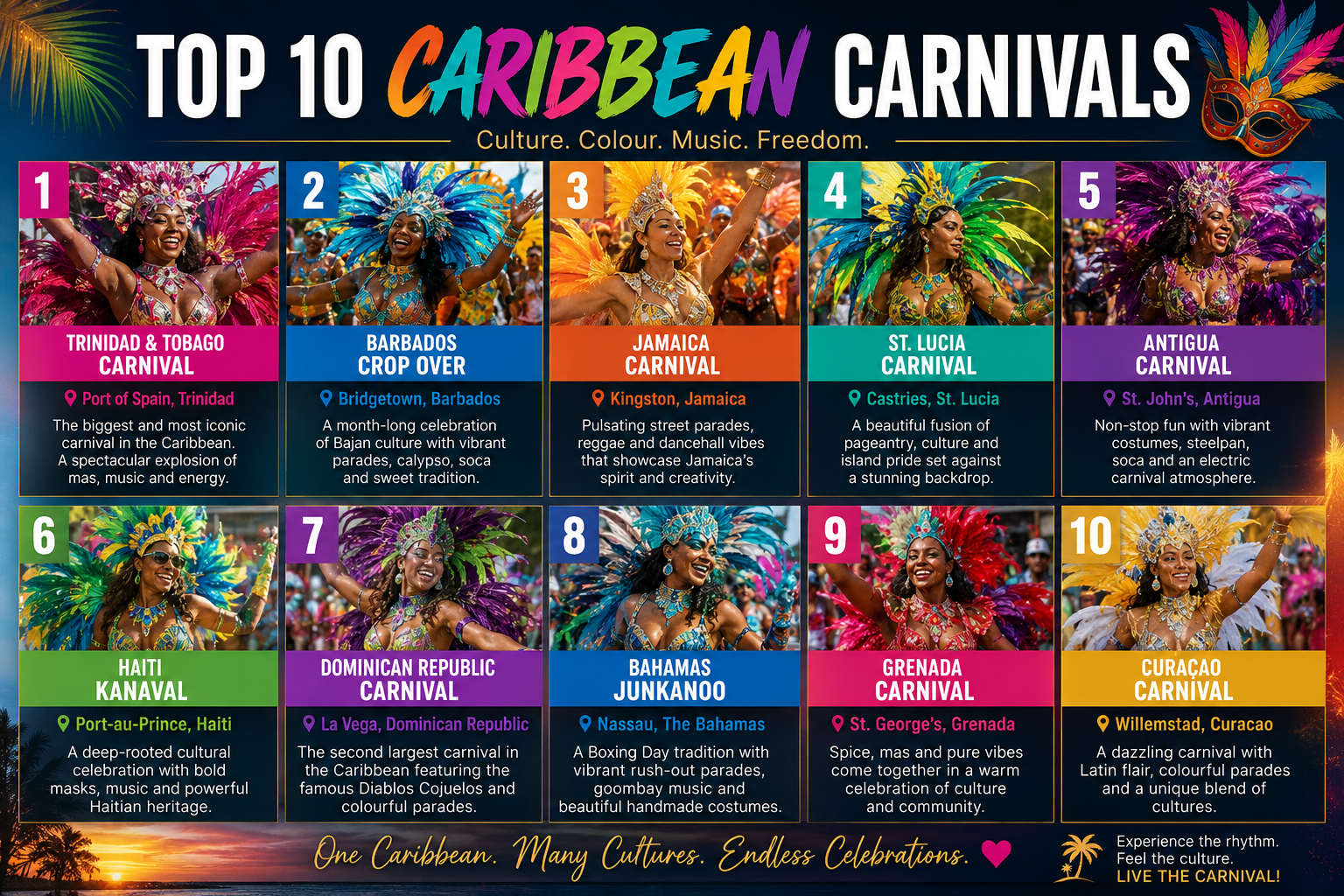
Suggested hero-image caption: “Costume, movement and soca energy converge at Trinidad and Tobago Carnival, the Caribbean celebration that has influenced Carnival culture worldwide.”
The budgets below are editorial planning estimates in U.S. dollars for three days on the island, covering basic-to-luxury lodging, meals, local transportation and a modest selection of events. They exclude international airfare and usually exclude a full premium mas costume. Carnival participation can radically increase spending: during Trinidad Carnival 2026, the Associated Press reported premium fete tickets approaching $700 and some popular-band costumes exceeding $2,000.
Selection criteria and planning assumptions
There is no authoritative league table of Caribbean carnivals, so this “top 10” is editorial rather than a claim that the eleventh festival is objectively inferior. Selection weighs international reputation and popularity, historical significance, documented visitor or participant scale, distinctiveness of cultural traditions, depth of signature competitions, and usefulness to an international traveler. This produces a geographically varied list rather than simply ranking festivals by crowd size.
That means excellent celebrations such as Vincy Mas in St. Vincent, St. Kitts–Nevis Sugar Mas and other national festivals narrowly miss the cut. The Bahamas’ Junkanoo is also intentionally treated separately: culturally it belongs in any serious discussion of Caribbean masquerade, but its Christmas/New Year calendar and distinct historical identity make calling it simply a “Carnival” less precise.
Attendance figures deserve particular caution. Tourism arrivals, registered masqueraders and street spectators are different measures; where organizers do not publish a defensible total, this article says “unspecified” rather than inventing a number.
At-a-glance comparison
| Rank | Carnival | Country/island | Typical timing and duration | Peak month | Published scale | Unique highlight |
|---|---|---|---|---|---|---|
| 1 | Trinidad & Tobago Carnival | Trinidad & Tobago | Weeks after Christmas; climax Mon–Tue before Ash Wednesday | Feb/Mar | 31,358 Carnival visitors in the official 19-day 2026 measure | J’ouvert, Panorama and the Parade of the Bands |
| 2 | Crop Over | Barbados | Multi-week/three-month cultural season; Grand Kadooment first Monday in Aug | Aug | About 15,000 Grand Kadooment revelers reported by official tourism | Foreday Morning + Grand Kadooment |
| 3 | Carnival in Jamaica | Jamaica | Season culminating in a spring Sunday Road March | Apr | About 5,400 international visitors traveled specifically for the assessed 2024 Carnival | Kingston Road March and premium mas bands |
| 4 | Saint Lucia Carnival | Saint Lucia | July; 2026 program July 1–22 with two parade days | Jul | Unspecified | Soca competitions plus two-day Parade of the Bands |
| 5 | Spicemas | Grenada | Build-up through summer; climax second Mon–Tue in Aug | Aug | Unspecified | Jab Jab J’ouvert and Monday Night Mas |
| 6 | Antigua Carnival | Antigua & Barbuda | Late Jul–early Aug; 2026 July 25–Aug 4 | Aug | “Thousands” of visitors; exact total unspecified | Emancipation, J’ouvert, Panorama and Party Monarch |
| 7 | Mas Domnik | Dominica | Weeks before Lent; Mon–Tue before Ash Wednesday | Feb | 4,635 visitors in 2024 | Traditional mas, bouyon and Téwé Vaval |
| 8 | Aruba Carnival | Aruba | Early Jan through pre-Lenten grand-parade weekend | Feb | Thousands of spectators; exact total unspecified | Lighting Parades and Tumba/Soca competitions |
| 9 | Curaçao Carnival | Curaçao | January through Lent; tourism board describes a season of at least two months | Feb | Unspecified | Gran Marcha and four-day Tumba Festival |
| 10 | Martinique Carnival | Martinique | Starts after Epiphany; “Fat Days” culminate through Ash Wednesday | Feb | Unspecified | King Vaval, Red Devils and Creole street vidés |
Dates are annual and variable unless explicitly shown for a particular edition.
The top ten carnivals
Trinidad & Tobago Carnival — Trinidad & Tobago
When: Carnival Monday and Tuesday immediately precede Ash Wednesday; the 2027 road days are February 8–9, while parties and competitions begin weeks earlier.
Why it matters: The modern festival developed from the meeting—and conflict—of European masquerade traditions and Afro-Trinidadian expressive culture, with emancipation giving formerly enslaved communities greater space to reshape Carnival through mas, music, Canboulay and resistance. Signature experiences: pre-dawn J’ouvert, Monday/Tuesday mas, steelpan Panorama, Calypso Monarch and major soca events. The 2026 official Carnival-visitor estimate was 31,358, although street participation is much larger and not represented by that tourism statistic.
Travel playbook: Stay in or near Port of Spain, book many months ahead, register directly with a recognized mas/J’ouvert band rather than expecting to buy a costume on arrival, and treat Carnival Monday–Tuesday as largely car-free days around parade routes. Keep valuables minimal during J’ouvert and use organized transportation after late fetes.
Three-day land budget: low $600–900; medium $1,200–1,900; high $2,800–4,500+. Patrice Roberts is a major contemporary name; her free 2026 NCC concert drew more than 10,000 patrons.
Image suggestion: a wide-angle Savannah crossing with a full masquerade band and steelpan detail inset. Caption: “Playing mas in Port of Spain, where costume design, calypso, soca and steelpan converge.”
Primary reading: National Carnival Commission, Visit Trinidad, Trinidad and Tobago CSO, Associated Press.
Barbados Crop Over — Barbados
Crop Over is technically Crop Over rather than a festival formally named “Barbados Carnival,” and that distinction matters. It grew from celebrations marking the end of the sugar harvest, declined substantially in the twentieth century and was revived as a national cultural festival; the National Cultural Foundation now describes a three-month program. For travelers, the crucial window is late July through the first Monday of August: Foreday Morning supplies the paint-and-powder J’ouvert energy and Grand Kadooment provides the spectacular finale. Official tourism says approximately 15,000 revelers participate in Grand Kadooment.
Register with a Kadooment band two to three months in advance—Visit Barbados specifically recommends early registration—and wear genuinely walkable shoes. Popular bands have included Aura Experience, Zulu International, Baje International, Kontact and Krave.
Budget: $450–750 / $900–1,500 / $2,000–3,200+ low/medium/high. Crop Over music is inseparable from Bajan soca; established names include Alison Hinds and Lil Rick.
Image suggestion: Grand Kadooment dancers against the blue Caribbean coastline. Caption: “Grand Kadooment turns Barbados’ historic harvest celebration into a moving gallery of Bajan mas.”
Primary reading: National Cultural Foundation, Visit Barbados Crop Over, Visit Barbados Mission Crop Over, NCF historical archive.
Carnival in Jamaica — Jamaica
Jamaica offers a fascinating counterpoint because the modern Carnival is comparatively young. Campus Carnival emerged at the University of the West Indies in the 1950s under strong Eastern Caribbean influence; Byron Lee helped turn Carnival into a formal national-scale entertainment product in 1990. The main action is now in Kingston, with additional festivities elsewhere, and the next Road March is April 4, 2027.
The signature formula is breakfast parties, fetes, J’ouvert-style events and a costume-heavy Sunday Road March. Jamaica Tourist Board currently points visitors toward Carnival-band experiences such as Bacchanal, Xodus and other registered operators whose lineup evolves by year. An official economic-impact report found about 5,400 international visitors came specifically for Carnival in 2024; that is not a total parade-attendance figure.
For the easiest trip, stay in Kingston near the principal event corridor and secure costume packages and fete tickets before arrival.
Budget: $400–700 / $850–1,400 / $1,800–2,800+. Byron Lee is the indispensable historical name; Xodus and Bacchanal are prominent contemporary mas brands.
Image: a Kingston Road March shot combining costume wings and urban spectators. Caption: “Jamaica gives Eastern Caribbean Carnival culture a distinctly Kingston soundtrack.”
Primary reading: Visit Jamaica Carnival portal and events calendar, JIS economic-impact coverage, Jamaica Observer historical reporting.
Saint Lucia Carnival — Saint Lucia
Saint Lucia’s Carnival is the strongest July choice for travelers who want a concentrated island Carnival without waiting until August. In 2026 it ran July 1–22, ending in two major street-parade days. Its recorded modern history begins in 1947, when a small Castries procession used ragged costumes, bottles and pieces of steel for rhythm; by 1948, calypso, steel bands and organized costume bands were becoming established.
Expect J’ouvert, Parade of the Bands, Carnival Queen, Calypso Monarch, Power and Groovy Soca competitions and Panorama. No reliable official total-attendance figure was identified, so attendance is unspecified. Recent competitive names include 2025 Road March winner Dezral, Ricky T and Panorama-winning Pantime Steel Orchestra; Teddyson John remains one of Saint Lucia’s internationally recognized soca voices.
Castries/Rodney Bay accommodation fills quickly around parade week; a car is less useful once street closures begin, so arrange transfers.
Budget: $450–750 / $900–1,500 / $2,000–3,200+.
Image: a full band crossing Castries with mountains visible behind. Caption: “Saint Lucia Carnival turns July into a showcase of Lucian soca, pan and costume craftsmanship.”
Primary reading: Carnival Saint Lucia, Saint Lucia Tourism Authority, official Carnival history and official results.
Spicemas — Grenada
For visceral traditional mas, Grenada is difficult to beat. Spicemas culminates around the second Monday and Tuesday of August; in 2026 its official schedule placed Soca Monarch on August 7, Panorama on August 8, Dimanche Gras on August 9 and Monday Night Mas on August 10.
Its defining image is Jab Jab: blackened masqueraders, chains, horns and intense percussion whose symbolism has been interpreted through Grenada’s history of slavery, emancipation, resistance and reclamation. Grenada’s wider traditional repertoire also includes Shortknee, Vieux Corps, Moko Jumbie and other characters. Then comes neon-lit Monday Night Mas and colorful Pretty Mas.
No defensible current overall crowd figure was found, so attendance is unspecified. Power Soca champions have included Muddy, Dash, Boyzie and Terra D Governor. Reserve St. George’s lodging early and decide whether you want authentic Jab Jab participation or simply a viewing position—oil, paint and crowds make this poor territory for expensive clothing or cameras.
Budget: $400–700 / $850–1,400 / $1,900–3,000+.
Image: Jab Jab silhouettes at sunrise followed by a neon Monday Night Mas frame. Caption: “From Jab Jab before dawn to illuminated mas after dark, Spicemas tells Grenada’s story through the street.”
Primary reading: Spicemas Corporation, Pure Grenada, Spicemas results, major cultural reporting on Jab Jab.
Antigua Carnival — Antigua & Barbuda
Antigua’s summer Carnival combines modern soca spectacle with an unusually explicit connection to emancipation. The first official Carnival was staged in 1957 and was conceived partly as a post-harvest break, tourism attraction and commemoration of freedom from slavery. The 2026 edition ran July 25–August 4, with J’ouvert, Monday Mas, Parade of Bands, Panorama, Calypso Monarch and Party Monarch.
Official tourism describes the festival as drawing thousands of visitors, but it does not publish a precise total in the sources reviewed. Antigua’s musical credentials are formidable: its 2026 official program featured homegrown Burning Flames, Tian Winter and Tizzy alongside Machel Montano, Patrice Roberts, Voice, Skinny Fabulous and Grenada’s Muddy; Hell’s Gate is one of the island’s important steel-orchestra names.
Stay close enough to St. John’s to avoid long post-fete transfers and purchase marquee-show tickets ahead of Carnival weekend.
Budget: $450–800 / $950–1,600 / $2,100–3,300+.
Image: steelpan players foregrounded against a Carnival Monday band. Caption: “Antigua Carnival links emancipation memory with one of the Caribbean’s liveliest summer music programs.”
Primary reading: Antigua & Barbuda Tourism Authority, Antigua Carnival/Festivals Commission, official 2026 campaign, Antigua Observer.
Mas Domnik — Dominica
Dominica calls its Carnival “The Real Mas,” and the branding is justified by an unusually visible mixture of African, French-Creole and traditional masquerade culture. The core celebration falls on Monday and Tuesday before Ash Wednesday; the announced 2027 season runs January 9–February 10. J’ouvert opens the climax, Carnival Monday brings T-shirt bands and bouyon, Tuesday juxtaposes traditional and contemporary mas, and Ash Wednesday’s Téwé Vaval symbolically closes Carnival and begins Lent.
Dominica is one of the rare cases with a clear tourism figure: Discover Dominica reported 4,635 visitors in 2024, 12% above the previous year. Triple K International is one of Dominica’s best-known bouyon bands and was officially billed as the island’s premier bouyon act in Antigua Carnival programming.
Roseau lodging inventory is smaller than on major resort islands, making early booking especially important; ferries are relevant for regional travelers, and in 2024 more Carnival visitors arrived by ferry than air.
Budget: $300–550 / $650–1,050 / $1,400–2,200+.
Image: traditional sensay/mas characters against Roseau’s Bayfront. Caption: “Mas Domnik prizes living traditional masquerade as much as modern bouyon.”
Primary reading: Discover Dominica, Dominica Festivals, Discover Dominica press room and Carnival reporting.
Aruba Carnival — Aruba
Aruba’s Carnival stretches across much of January and February, pairing Caribbean music with a distinct Dutch-Caribbean/Papiamento identity. In 2026, the Torch Parade opened the street season on January 3 and the 72nd Grand Carnival Parade in Oranjestad fell February 15. Aruba’s modern Carnival culture developed through mid-twentieth-century social clubs and the cosmopolitan San Nicolas oil-refinery community, including migrants from the British Caribbean; successive decades brought grand parades and elaborate nighttime lighting traditions.
Signature events include Jouvert in San Nicolas, Soca Monarch, Tumba Festival, Carnival Queen elections, Lighting Parades and Oranjestad’s Grand Parade. Official descriptions use “thousands” of spectators, but a current exact island-wide figure is unspecified. The marquee performers change annually: Tumba and Soca Monarch contenders, rather than a fixed celebrity roster, are central to the season.
Aruba’s long festival allows travelers to choose a quieter competition weekend or the much busier grand-parade finale; reserve parade-weekend hotels early.
Budget: $500–850 / $1,050–1,700 / $2,300–3,600+.
Image: an illuminated costume group at the Lighting Parade. Caption: “After sunset, Aruba Carnival becomes a moving theater of light.”
Primary reading: Aruba Tourism Authority, SMAC/Isla di Carnaval, Government of Aruba and the detailed Carnival schedule.
Curaçao Carnival — Curaçao
Curaçao Tourism describes Carnival as the island’s largest annual celebration, lasting no less than two months. Street Carnival traces its modern history to 1947, when a comparatively simple matching-shirt procession began a tradition that evolved into elaborate groups, floats and costumes. The biggest 2026 daytime procession, Gran Marcha, took place February 15.
What distinguishes Curaçao is tumba. Its four-day adult Tumba Festival can attract more than 50 competing singers, with the winning song becoming the season’s Carnival anthem/road march. Add Carnival royalty competitions, children’s parades, Gran Marcha and the farewell procession and the result is one of the Caribbean’s most structured Carnival calendars. Exact overall attendance is unspecified.
Stay around Willemstad for parade logistics and use official route information rather than assuming normal driving access on major parade days.
Budget: $450–800 / $950–1,600 / $2,100–3,300+. Tumba royalty changes annually; legendary composer Rignald “Doble R” Recordino is among the names associated historically with the genre.
Image: Gran Marcha framed by Curaçao’s pastel streets. Caption: “Gran Marcha combines Curaçao’s architectural color with the island’s equally colorful Carnival aesthetic.”
Primary reading: Curaçao Tourist Board Gran Marcha listing, its Carnival feature, the official Carnival portal and Tumba Festival information.
Martinique Carnival — Martinique
Martinique is the choice for travelers who want Carnival to feel like street theater, political satire and living history rather than primarily a ticketed party circuit. The tradition reaches back to the eighteenth-century colonial period; Martinique Tourism explicitly describes modern Carnival as carrying histories of resistance, collective memory and cultural expression. Although celebrations begin after Epiphany, the main 2026 “Fat Days” culminated February 15–18.
Each day has its own code: Vaval, the satirical Carnival King, emerges around Dimanche Gras; Monday brings burlesque weddings and role reversals; Tuesday turns red for the horned Red Devils; Ash Wednesday turns black-and-white as Vaval is mourned and burned. Groupes à pied and street vidés drive the music and movement. Overall attendance is unspecified. Martinique’s Carnival is less dependent on a fixed celebrity bill; marching percussion groups are the stars, although artists such as Kalash have appeared around Carnival programming.
Stay in Fort-de-France for maximum immersion and avoid relying on a rental car during central parades.
Budget: $500–850 / $1,050–1,750 / $2,300–3,700+.
Image: a red-devil group with mirrored horned masks, followed by the black-and-white Vaval funeral. Caption: “Martinique Carnival changes color—and social meaning—with every Fat Day.”
Primary reading: Martinique Tourism’s Carnival guide, events coverage and Carnival-music guide, supplemented by established regional reporting.
Peak-month timeline
The chart shows typical peak periods rather than fixed annual dates. Pre-Lenten dates move with Easter, and individual festival calendars should always be rechecked before booking.
The strategic travel takeaway is useful: February offers the greatest density of choices, April belongs to Jamaica, while July–August creates a second Caribbean Carnival corridor through Saint Lucia, Barbados, Grenada and Antigua. Exact annual dates remain variable.
Which carnival fits which traveler
For the party-focused traveler, Trinidad and Tobago remains the first recommendation. No other entry on this list combines quite the same concentration of J’ouvert, huge mas bands, competitive steelpan, calypso, soca and an industrial-scale fete calendar; the trade-off is cost, with 2026 reporting showing just how expensive premium participation can become. Jamaica is the compelling alternative for travelers who want a shorter, polished Road March weekend with Kingston nightlife, while Antigua offers an excellent summer-party format.
For budget-conscious travelers, Dominica deserves first consideration: the editorial land-cost range is the lowest in this guide, and Mas Domnik retains a remarkably high ratio of street culture to premium-ticket entertainment. Grenada is another strong value proposition, particularly for travelers prioritizing J’ouvert and traditional mas over luxury fetes. The limitation in both islands is accommodation capacity, so “budget” only remains budget-friendly when rooms are booked early. Dominica’s official 2024 data also illustrates how important regional ferry travel can be.
For cultural and heritage travelers, make the shortlist Dominica, Martinique and Grenada. Dominica foregrounds traditional mas and Téwé Vaval; Martinique turns each Carnival day into a different act of satire and historical memory; and Grenada’s Jab Jab presents one of the Caribbean’s most powerful examples of historical imagery being reclaimed through contemporary performance. Barbados is particularly rewarding for travelers interested in how a plantation-era harvest celebration was transformed into a modern national festival.
For first-time Carnival travelers, Barbados and Saint Lucia strike perhaps the easiest balance: both provide major masquerade, strong music, understandable festival structures and substantial tourism infrastructure without requiring newcomers to master Trinidad’s vast ecosystem of bands, fetes and competitions. Whichever island you choose, the most important planning principle is the same: decide early whether you want to spectate or play mas. Watching a parade can be inexpensive; joining a band requires advance registration and can transform both the logistics and the price of the trip. Barbados Tourism, for example, advises registering for a Kadooment costume two to three months before the festival.