 Skip to content


Harry Belafonte A Comprehensive Guide to His Songs

Harry Belafonte’s songs form one of the richest and most wide-ranging catalogues in popular music. To casual listeners, he will always be associated with the unmistakable call of “Day-O (The Banana Boat Song)” and the carnival energy of “Jump in the Line.” Look beyond those famous recordings, however, and a much larger musical world appears. Belafonte sang Jamaican folk songs, Trinidadian calypso, American blues, work songs, spirituals, show tunes, Christmas music, African repertoire and protest material. He approached each tradition as a storyteller, using rhythm, diction, drama and an exceptional ability to connect with an audience.
That breadth matters because the popular label “King of Calypso” tells only part of the story. Belafonte did more than introduce Caribbean sounds to millions of listeners. He helped present folk music as an international conversation. His recordings brought together songs shaped by migration, labour, faith, romance, colonial history and resistance. Just as importantly, his musical choices reflected the civil-rights and humanitarian commitments that defined his life away from the stage.
This guide explores the most important Harry Belafonte songs, explains where they sit within his career and suggests a route through his extensive discography. It also makes an essential distinction: Belafonte was frequently an interpreter, arranger and collaborator rather than the sole writer of the material he performed. His genius lay in recognising a song’s dramatic possibilities and making its story immediate for a new audience.
One reason Belafonte’s catalogue remains rewarding is the care he brought to language. He could sing in American English, Caribbean-inflected speech and material drawn from international traditions without losing clarity or dramatic intention. His baritone was attractive, but beauty alone was never the point. He shaped consonants rhythmically, lengthened vowels to create distance and moved between tenderness, wit and authority. Those choices helped listeners follow unfamiliar stories. They also made his recordings unusually visual: even without seeing him on stage, an audience could imagine the worker, traveller, parent, lover or activist speaking.
Why Harry Belafonte’s Songbook Still Matters
Belafonte emerged during the folk revival of the 1950s, but he resisted being confined to a single genre. His early nightclub performances included standards and popular songs, while his recordings increasingly drew on the Caribbean culture he had known as a child in Jamaica. He could deliver a quiet ballad with conversational warmth, turn a calypso into communal theatre or build a work song from a near-whisper to a commanding climax.
His breakthrough was extraordinary. Released in 1956, Calypso became a landmark commercial success and was later selected for preservation in the Library of Congress National Recording Registry. The album did not offer a documentary reproduction of Trinidadian calypso. Its sound blended Jamaican folk and mento influences, calypso-associated repertoire, choral arrangements and American studio production. Nevertheless, it opened an enormous international audience to Caribbean-rooted music.
“Day-O (The Banana Boat Song)”: The Signature Recording
No guide to Harry Belafonte songs can begin anywhere else. “Day-O,” usually titled “The Banana Boat Song (Day-O),” is based on a Jamaican work-song tradition associated with labourers loading bananas during the night. Its surface is bright and memorable, but the scene behind it is physical work: dawn signals the end of a shift, and the workers are ready to have their load counted and go home.
Belafonte’s 1956 recording is a masterclass in controlled drama. The opening vocal call creates distance and anticipation before percussion, chorus and orchestral colour gradually fill the space. That structure preserves the feeling of call-and-response while making it compelling on a commercial recording. The performance became his signature and helped drive the success of Calypso.
The song’s history also illustrates the collaborative nature of Belafonte’s catalogue. Traditional material was adapted for the modern recording, with William Attaway and Irving Burgie among the important creative figures associated with the version. Burgie, who often used the professional name Lord Burgess, wrote or adapted many songs recorded by Belafonte; the Songwriters Hall of Fame credits him with around 35 Belafonte recordings.
“Jamaica Farewell”: Nostalgia in Three Minutes
Where “Day-O” is rhythmic and theatrical, “Jamaica Farewell” is intimate. Written by Irving Burgie using Caribbean folk influences, it presents island beauty through the eyes of someone preparing to leave. The song’s emotional power comes from its balance of travelogue and longing: vivid memories of Jamaica are inseparable from the sadness of separation.
“Jamaica Farewell” became one of the central recordings on Calypso and one of the most widely recognised Caribbean-themed songs of the twentieth century. It has been covered by many artists because the theme is universal. It can be heard as a song about a particular island, but also as a migrant’s song about leaving home, preserving memory and carrying identity across distance.
“Matilda”: Audience Participation as an Art Form
“Matilda” was already part of Belafonte’s repertoire before Calypso made him a global star. The song is associated with Trinidadian calypsonian Norman Span, known as King Radio. Its comic story concerns a man whose money disappears with the woman he trusted, but the narrative is only one reason the number became essential to Belafonte’s concerts.
In performance, “Matilda” turned into a lesson in participation. Belafonte invited different sections of an audience to answer him, adjusted the dynamics and stretched the refrain until thousands of people sounded like one ensemble. The celebrated version on Belafonte at Carnegie Hall demonstrates his timing beautifully. He is singer, conductor, comedian and master of ceremonies at once.
“Jump in the Line”: Carnival Energy and Lasting Popularity
Recorded for the 1961 album Jump Up Calypso, “Jump in the Line” is among Belafonte’s most instantly danceable songs. The piece grew from Caribbean calypso performance traditions and circulated in versions before Belafonte recorded his famous arrangement. His interpretation combines driving percussion, emphatic vocal commands and a horn-led exuberance that makes stillness almost impossible.
Its later appearance in Beetlejuice gave the track a remarkable second life. The film’s closing dance scene made the song familiar to audiences who may never have encountered a Belafonte album. That revival mirrors the renewed popularity of “Day-O” after the same film. Both recordings work brilliantly in cinema because they are dramatic, rhythmic and immediately legible, even when detached from their original album context.
For first-time listeners, “Jump in the Line” is an ideal demonstration of Belafonte’s precision. The performance feels spontaneous, yet the rhythmic accents, vocal entries and instrumental breaks are carefully controlled. It is party music created by a highly disciplined artist.
“Island in the Sun”: Belonging, Beauty and Complication
Written by Belafonte and Irving Burgie for the 1957 film Island in the Sun, this gentle song became another enduring standard. Its melody offers warmth and simplicity, while its words express attachment to an island homeland. Belafonte’s performance is affectionate rather than showy, making the song suitable for both film narrative and independent listening.
Humour and Character: “Mama Look a Boo Boo” and “Man Smart (Woman Smarter)”
Belafonte was a gifted dramatic actor, and his comic songs reveal how strongly that training shaped his singing. “Mama Look a Boo Boo,” written by Trinidadian calypsonian Lord Melody, tells the funny but uncomfortable story of a father whose children tease him about his appearance. Belafonte handles the escalating embarrassment with crisp diction and playful timing. Beneath the comedy lies a recognisable family scene in which affection and cruelty sit close together.
“Man Smart (Woman Smarter)” uses a recurring calypso argument about gender, pride and power. Belafonte’s version is buoyant and teasing, designed to provoke smiles and responses rather than settle the debate. The song’s call-and-response form makes it especially effective in concert.
“Mary’s Boy Child”: A Christmas Standard
Belafonte’s repertoire was never limited to secular folk and calypso. “Mary’s Boy Child,” written by Jester Hairston, became one of his greatest international successes. His recording reached number one in the United Kingdom in 1957 and remained there for seven weeks, according to the Official Charts Company.
The performance combines reverence with accessibility. Belafonte’s calm lead vocal is supported by a choral arrangement that gives the song ceremonial scale without making it heavy. The recording became a Christmas standard, especially in Britain, and the composition returned to number one in a different version by Boney M in 1978.
Its continuing popularity demonstrates an aspect of Belafonte sometimes obscured by the “King of Calypso” title: he was an exceptionally persuasive singer of spiritual and sacred material. He could communicate belief and wonder without turning the performance into vocal display.
Ballads and Standards: The Quiet Side of Belafonte
“Scarlet Ribbons (For Her Hair)” was one of the songs that established Belafonte before the Calypso phenomenon. Written by Evelyn Danzig and Jack Segal, it is a tender narrative about a parent’s love and a seemingly miraculous gift. Belafonte’s recording has the clarity of a story told at bedtime. The song shows how effectively he could create emotion through understatement.
“Try to Remember,” from the musical The Fantasticks, became another natural fit for his mature voice. Its reflective mood depends on warmth, patience and an awareness of passing time. Belafonte does not rush it. He gives each phrase room, allowing memory itself to become the subject of the performance.
Work Songs, Blues and the American Folk Tradition
Belafonte’s voice also carried the weight of American work-song and blues traditions. “Sylvie,” “Cotton Fields,” “John Henry” and “The Midnight Special” connect his catalogue with music associated with labour, imprisonment, endurance and escape. Several of these songs are closely linked to Lead Belly, whose repertoire influenced the wider folk revival.
The album Swing Dat Hammer explored this material in depth and won Belafonte a Grammy for Best Folk Performance. His Recording Academy profile records two competitive Grammy wins, including the later collaboration An Evening with Belafonte/Makeba. These awards underline the inadequacy of treating him merely as a pop-calypso celebrity. The recording industry itself recognised the quality of his folk work.
Spirituals, Freedom Songs and Moral Purpose
Songs such as “All My Trials” allowed Belafonte to join spiritual imagery with the language of freedom. The piece moves between sorrow and hope, making it adaptable to both the folk stage and the wider civil-rights era. “Michael Row the Boat Ashore” likewise carries communal and spiritual associations that suited his inclusive concert style.
Belafonte’s relationship with political music cannot be separated from his activism. He was a close ally of Martin Luther King Jr., helped organise and finance civil-rights activity and used his celebrity to create access, attention and resources. The National Museum of African American History and Culture describes a career in which artistic achievement and social commitment continually reinforced one another.
Miriam Makeba and the Expansion Toward Africa
Belafonte played a crucial role in bringing wider attention to South African singer Miriam Makeba, and their collaboration produced some of his most important global recordings. An Evening with Belafonte/Makeba placed African songs and the realities of apartheid before an international audience. It won the Grammy for Best Folk Performance.
Recordings associated with their partnership include “Malaika,” “Train Song” and “The Click Song.” Makeba’s authority is central; Belafonte did not treat African music as decorative colour around his own voice. Their exchanges create a genuine dialogue of timbre, language and rhythm. The album also helped connect African liberation struggles with American civil-rights consciousness.
“Turn the World Around”: Music as a Shared Philosophy
“Turn the World Around” is one of the clearest statements of Belafonte’s mature musical worldview. Inspired by African ideas and rhythms, it links earth, water, fire, spirit and human interdependence. The arrangement is circular and communal rather than built around a conventional pop climax.
Belafonte’s performance of the song on The Muppet Show became legendary. Working with Jim Henson’s team, he presented the number with specially created mask-like puppets and a visual language of ritual and unity. The Jim Henson Company archive notes the immediate connection between Henson and Belafonte and their shared commitment to tolerance and understanding.
The performance matters because it refuses to separate children’s entertainment from serious ideas. It introduces cultural difference with beauty and respect, while the music makes an argument for a world built through relationship. Belafonte later performed the song at Jim Henson’s memorial, deepening its association with friendship and shared values.
Anti-Apartheid Music and “Paradise in Gazankulu”
Belafonte continued to address global injustice in his later recordings. The 1988 album Paradise in Gazankulu confronted apartheid-era South Africa. Its title is deliberately bitter: the so-called homeland system presented segregation and forced displacement as political independence. By invoking “paradise,” the song exposes the cruelty and dishonesty of that claim.
“We Are the World” and Humanitarian Music
Belafonte helped set the USA for Africa project in motion after seeing the response to Band Aid’s famine-relief recording. “We Are the World” was written by Michael Jackson and Lionel Richie and produced by Quincy Jones; Belafonte joined the all-star chorus and was a driving force behind the wider initiative. The single became a defining example of celebrity humanitarian music in the 1980s.
Why Belafonte at Carnegie Hall Is Essential Listening
Anyone who knows only the studio hits should hear Belafonte at Carnegie Hall. Recorded in 1959, the album presents a journey through folk song, ballad, blues, spiritual and calypso. The programme includes “Darlin’ Cora,” “Sylvie,” “Cotton Fields,” “John Henry,” “Hava Nageela,” “Jamaica Farewell,” “Mama Look a Boo Boo,” “Come Back Liza,” “The Marching Saints” and an extended “Matilda.”
The album entered the Grammy Hall of Fame, alongside the single “Banana Boat (Day-O)” and Calypso. The Grammy Hall of Fame recognition confirms what listeners can hear: Belafonte’s live artistry was as historically important as his chart success.
A 20-Song Harry Belafonte Starter Playlist
For newcomers, this sequence offers a balanced route through the catalogue rather than simply collecting the biggest calypso hits:
“Day-O (The Banana Boat Song)” – the essential signature performance.
“Jamaica Farewell” – a beautifully restrained song of departure.
“Matilda” – preferably the extended Carnegie Hall version.
“Jump in the Line” – irresistible carnival energy.
“Island in the Sun” – a warm meditation on place and belonging.
“Mama Look a Boo Boo” – comic storytelling with a sharp edge.
“Man Smart (Woman Smarter)” – playful call-and-response calypso.
“Come Back Liza” – longing carried by Caribbean rhythm.
“Coconut Woman” – a vivid example of character and street-cry song.
“Mary’s Boy Child” – the Christmas recording that conquered Britain.
“Scarlet Ribbons (For Her Hair)” – Belafonte at his most tender.
“Try to Remember” – a reflective mature ballad.
“Hava Nageela” – evidence of his international folk reach.
“Sylvie” – a powerful link to the work-song tradition.
“Cotton Fields” – American folk history in concert form.
“The Midnight Special” – blues, folk lineage and generational connection.
“All My Trials” – spiritual depth and quiet resolve.
“Malaika” – an essential recording from the Makeba collaboration.
“Turn the World Around” – his philosophy of human connection in song.
“Paradise in Gazankulu” – the later activist confronting apartheid.
Listen in this order and Belafonte’s range becomes unmistakable. The familiar entertainer remains present, but so do the ballad singer, folk historian, dramatic actor, international collaborator and political artist.
How to Listen to Harry Belafonte Today
Begin with the original Calypso album rather than a random compilation. Hearing “Day-O” beside quieter and less famous tracks reveals the care with which the record was shaped. Move next to Belafonte at Carnegie Hall to experience the scale of his live performance. Then try Swing Dat Hammer for American work songs, An Evening with Belafonte/Makeba for African collaboration and Turn the World Around or Paradise in Gazankulu for the later global and political work.
Pay attention to more than melody. Notice how Belafonte enters a song, when he delays a phrase, how he uses silence and how he gives a chorus room to answer. Compare studio and live versions of “Matilda” or “Jamaica Farewell.” His recordings become more rewarding when heard as dramatic interpretations rather than fixed demonstrations of genre.
The Lasting Legacy of Harry Belafonte’s Songs
Harry Belafonte died in 2023 at the age of 96, leaving a legacy that cannot be measured by record sales alone. The Smithsonian describes an artist whose fame and activism remained inseparable across seven decades. He broke barriers in recording, film and television, but he also redirected the power of celebrity towards civil rights, humanitarian relief and international solidarity.
His songs endure because they hold apparently opposite qualities together. They can be joyful and historically serious, polished and rooted in folk memory, intimate and communal. “Day-O” can fill a dance floor while still carrying the trace of labour. “Jamaica Farewell” can evoke a specific island and speak to anyone who has left home. “Matilda” can be comic theatre and a demonstration of collective music-making. “Turn the World Around” can delight children while presenting a profound vision of human interdependence.
That is why a comprehensive guide to Harry Belafonte songs must travel far beyond the greatest hits. The full catalogue reveals an artist who listened widely, collaborated generously and understood performance as a form of citizenship. His finest recordings do not merely entertain. They invite people to answer, remember, move and recognise one another.

Sources and Further Reading
Library of Congress: 2017 National Recording Registry selections
National Museum of African American History and Culture: Harry Belafonte, Actor and Activist
Recording Academy: Harry Belafonte awards and nominations
Recording Academy: Grammy Hall of Fame
Songwriters Hall of Fame: Irving Burgie
Official Charts Company: Mary’s Boy Child
Jim Henson’s Red Book: Harry Belafonte and The Muppet Show
Smithsonian Magazine: Harry Belafonte’s musical and activist legacy
Gary Trotman is the musician and creative force behind Steelasophical Steel Band & DJ, a respected British entertainment brand known for bringing the colour, warmth and rhythm of the Caribbean to weddings, corporate occasions and private celebrations. Through accomplished steelpan performances, carefully produced backing tracks and professional presentation, Gary has built a distinctive musical identity that connects Caribbean tradition with modern event entertainment.
One of the most notable milestones in Gary Trotman’s career is the inclusion of his music in the 2006 James Bond film Casino Royale, starring Daniel Craig. Gary arranged and performed “Linstead Market,” a traditional Jamaican folk song heard in the film. The film’s music credits identify the recording as being arranged and performed by Gary Trotman, courtesy of ARC Music Productions International Ltd.
It is important to describe this achievement accurately. “Linstead Market” was incorporated into the movie as additional music; it was not an original composition written for James Bond, and Gary did not compose the film’s official score, which was created by David Arnold. That distinction does not diminish the accomplishment. Instead, it highlights how an authentic Caribbean performance became part of the musical world of one of cinema’s most recognisable franchises.
For Gary, the Casino Royale connection represents more than a prestigious screen credit. It demonstrates the international appeal of Caribbean music and the expressive power of the steelpan. His interpretation of a familiar Jamaican melody helped bring cultural character and atmosphere to a major global production.
Today, Gary continues to lead Steelasophical with the same musicianship, personality and attention to detail. Clients can hire an entertainer whose work has reached audiences far beyond the live-event stage. From elegant wedding ceremonies to energetic Caribbean celebrations, Gary Trotman offers music shaped by experience, authenticity and a genuinely remarkable connection to cinematic James Bond history.

Harry Belafonte’s 1956 album Calypso sold more than 1,000,000 copies, becoming the first LP to reach that milestone.
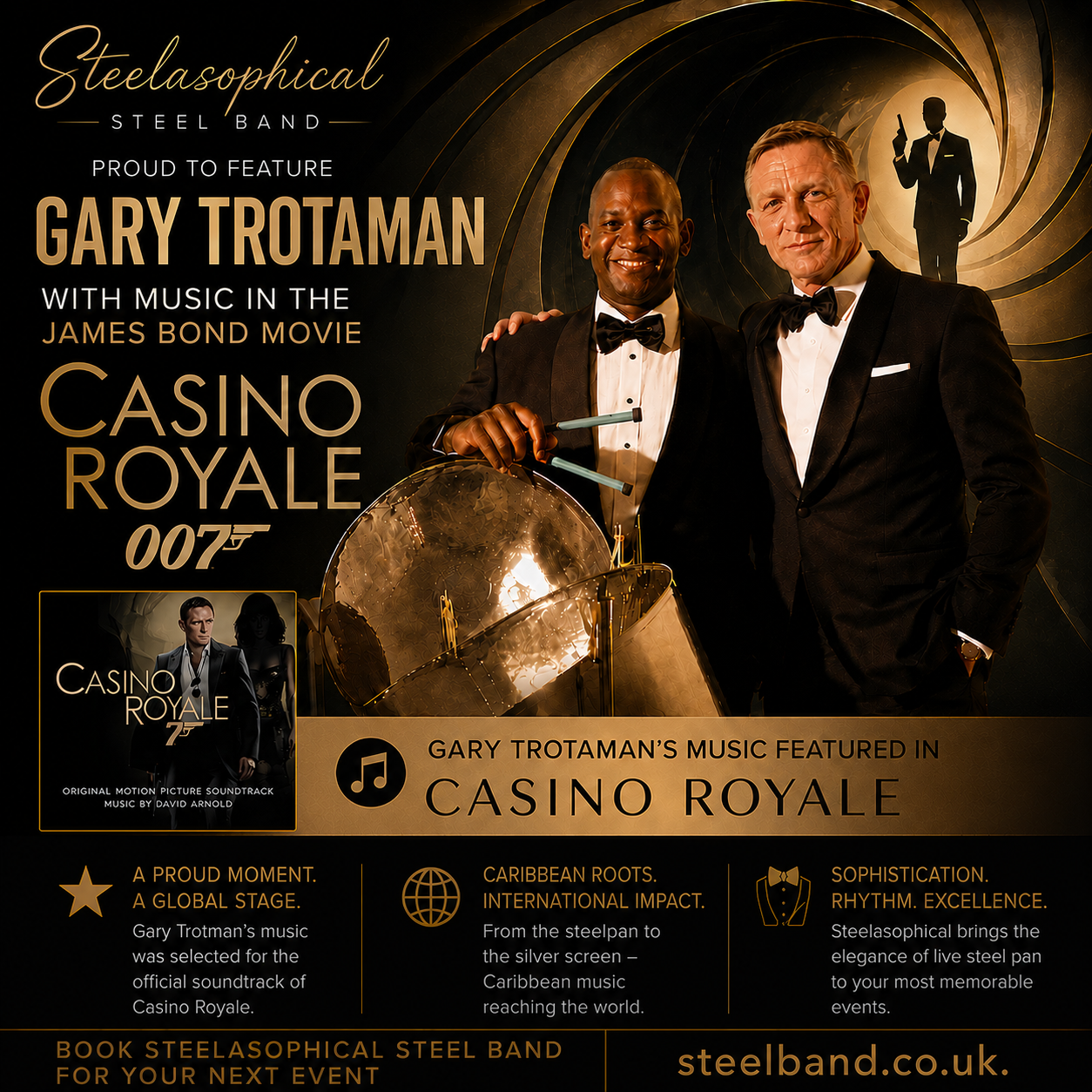
Gary Trotman with the Harry Belafonte famed song Linstead Market (a Jamaican folk song) used in the first Daniel Craig James Bond 007 movie Casino Royale in 2006.