 Skip to content

Jumbie Jam Steel Drum

The Jumbie Jam by Panyard: The Small Steel Pan That Opens the Door to a World of Music There are musical instruments that take months before a beginner can produce something recognisable, and then there are instruments that seem to invite you to start making music almost immediately.
The Jumbie Jam by Panyard belongs firmly in the second category.
Bright, compact, accessible and unmistakably inspired by the beautiful sound of the Caribbean steel pan, the Jumbie Jam has become a popular introduction to the world of pan for children, adults, families, schools and music educators.
But describing it simply as a “small steel drum” does not really do it justice.
The Jumbie Jam represents something much bigger: an accessible route into steel pan playing and music education, while providing an opportunity for new generations to discover an instrument whose history is inseparably connected with Trinidad and Tobago.
Whether you are a teacher searching for an exciting classroom instrument, a parent looking for a musical gift, an adult who has always wanted to try steel pan, or an experienced musician interested in a compact melodic percussion instrument, the Jumbie Jam deserves serious attention.
In this guide, we explore the history, sound, construction, educational benefits and cultural background of the Panyard Jumbie Jam steel pan — and explain why such a simple-looking instrument can create such enthusiasm for pan.
What Is the Jumbie Jam?
The Jumbie Jam is a compact steel pan developed by Panyard, an American company specialising in steel pans, steel pan accessories and educational instruments.
Unlike many novelty “steel drums” marketed primarily as toys, the Jumbie Jam has been designed as a genuine musical instrument.
Panyard describes the instrument as suitable for people of different ages and skill levels, with a particular emphasis on making the first experience of steel pan enjoyable and accessible.
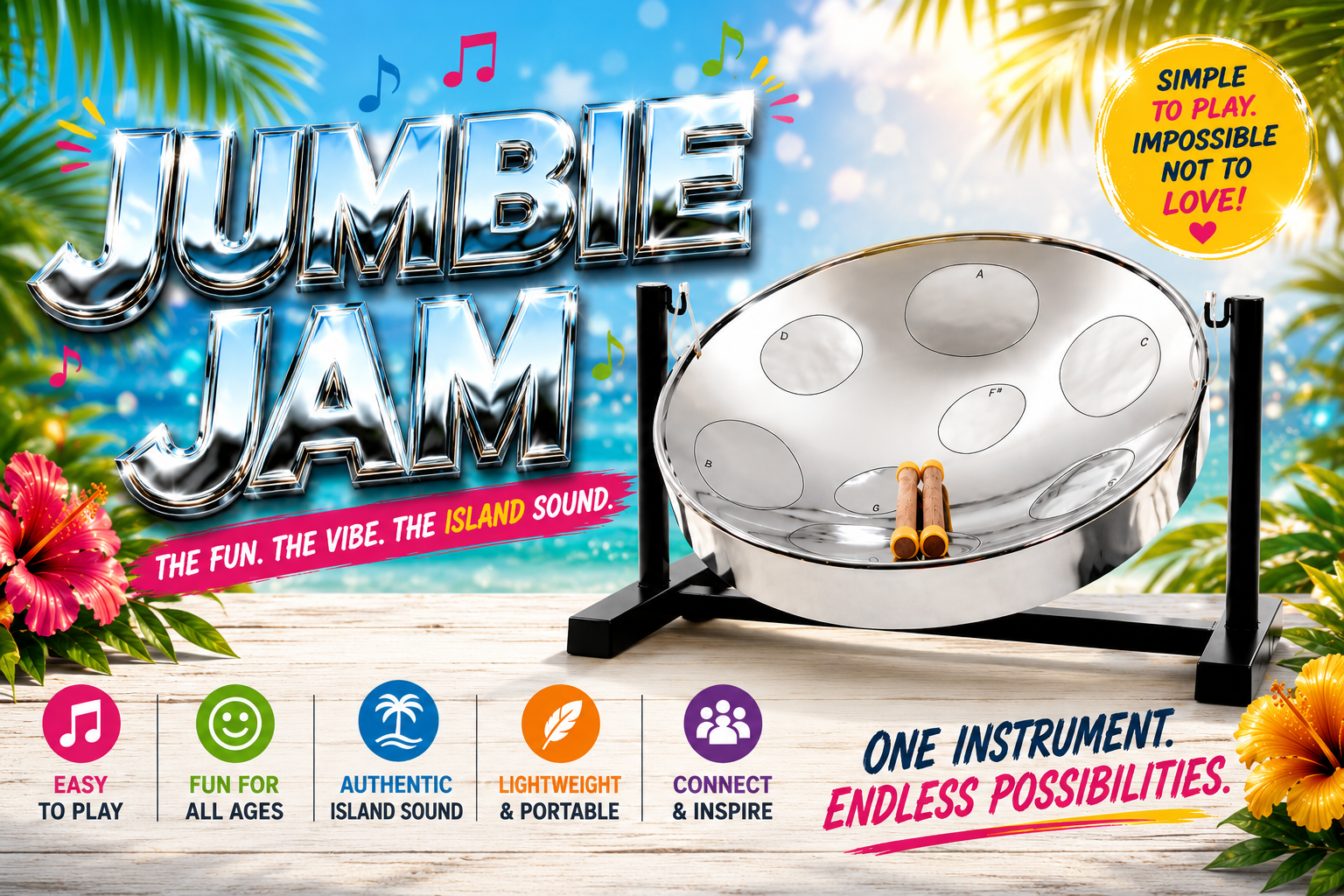
The standard Jumbie Jam is approximately 16 inches in diameter and provides a one-octave range in the key of G. Ready-to-play kits can include the pan, mallets, a stand, carrying case and downloadable beginner material.
This deliberately simplified musical layout is one of its greatest strengths.
Instead of confronting a new player with the larger number of notes found on a professional tenor or lead pan, the Jumbie Jam gives the beginner a manageable collection of clearly defined notes.
You can therefore concentrate on:
- rhythm,
- melody,
- timing,
- listening,
- coordination,
- musical expression,
- ensemble playing,
- and, most importantly, enjoying yourself.
The result is an instrument on which a complete beginner can begin experimenting with melodies remarkably quickly.
Visit Panyard and discover the Jumbie Jam range
Why Is It Called a “Jumbie” Jam?
The name is particularly interesting because it connects the instrument with Caribbean folklore.
According to Panyard, the Jumbie Jam takes its name from the Jumbie, a mischievous spirit or character found in Trinidadian folklore. The idea behind the branding is that once the “Pan Jumbie” gets hold of you, you develop the urge to play — the “Jumbie to Jam.”
It is a wonderfully appropriate concept.
Ask people involved with steel pan and you will frequently discover that pan becomes far more than an occasional musical hobby.
There is something highly addictive about producing a melody from steel.
Perhaps it is the distinctive tone.
Perhaps it is the physical experience of striking the notes.
Perhaps it is the communal atmosphere surrounding steel bands.
Or perhaps there really is a little Pan Jumbie involved!
Whatever the explanation, the Jumbie Jam’s name captures the sense of fun and discovery that makes steel pan such an appealing instrument.
The Jumbie Jam and the History of Steel Pan
To appreciate the Jumbie Jam properly, it is important to understand that it belongs to a much larger musical tradition.
The steel pan originated in Trinidad and Tobago and developed during the twentieth century.
Its development represents an extraordinary chapter in musical history.
Musicians experimented with metal objects and eventually discovered that areas of metal could be shaped and tuned to produce different musical pitches. Over time, increasingly sophisticated techniques transformed pieces of metal into accurately tuned melodic instruments.
The steel pan subsequently developed into an entire family of instruments.
Modern steel orchestras can include:
- tenor or lead pans,
- double tenors,
- double seconds,
- guitar pans,
- cello pans,
- bass pans,
- and percussion.
Together they can perform remarkably complex arrangements ranging from calypso and soca to classical music, jazz, reggae, pop and film music.
The Jumbie Jam is obviously much smaller and simpler than the instruments found in a large professional steel orchestra.
However, the principle remains wonderfully familiar:
strike a tuned area of steel and produce a musical note.
That connection makes the Jumbie Jam much more interesting than an ordinary beginner percussion instrument.
It can become a starting point for discovering an entire musical culture.
Who Are Panyard?
Panyard is closely associated with steel pan manufacturing, education and accessories.
The company was formally incorporated in 1990, although its roots extend further back. Founder Ron Kerns spent considerable time in Trinidad developing his knowledge of pan, its playing traditions and its culture.
Even the company name has significance.
A panyard is traditionally the place where a steel band rehearses, develops arrangements and stores its instruments.
Anyone who has spent time around Trinidadian steel bands will understand that the panyard can represent much more than simply a rehearsal room.
It can be a community.
A meeting place.
A musical workshop.
And sometimes almost a second home.
Panyard’s choice of name therefore demonstrates an obvious connection with steel band culture.
Today the company operates from Akron, Ohio, and Panyard states that Jumbie Jams are manufactured in Ohio and sold internationally.
What Does a Jumbie Jam Sound Like?
This is arguably the most important question.
After all, an instrument can be convenient, colourful and affordable, but none of those things matter very much if it does not inspire you to play.
The Jumbie Jam produces the distinctive bright, resonant metallic tone associated with steel pan.
Naturally, you should not expect a compact one-octave beginner instrument to reproduce every characteristic of a high-end professional lead pan.
They serve different purposes.
But that is precisely why the Jumbie Jam works.
It gives beginners access to the fundamental experience of playing melody on tuned steel without immediately requiring them to invest in, transport or understand a professional instrument.
Panyard has even highlighted testimonials from experienced educators and players who were surprised by the amount of recognisable steel pan character produced by the smaller instrument.
That sound provides instant feedback.
Hit the correct note correctly and you hear a clear musical pitch.
For beginners, that is enormously rewarding.
Why the Jumbie Jam Is So Good for Beginners
One of the greatest barriers to learning any musical instrument is the period between picking it up for the first time and actually making enjoyable music.
Consider the violin.
Before playing a beautiful melody, a beginner has to develop bow control and accurate intonation.
Consider the trumpet.
Producing a consistent tone itself takes practice.
Even guitar requires beginners to learn chord shapes and develop enough finger strength to hold the strings correctly.
Steel pan presents a different experience.
A properly tuned note is already there waiting for you.
Strike it appropriately with the mallet and the instrument responds.
The Jumbie Jam simplifies this advantage even further.
Its limited note range means the playing surface is relatively straightforward to understand, and Panyard’s educational material can use note letters to help people who cannot yet read conventional notation. Panyard specifically states that previous musical experience or music-reading ability is not necessary to begin playing.
This creates something extremely valuable:
Early success.
A beginner can play something recognisable.
That success encourages another attempt.
Another tune follows.
Then another.
Before long, the person who thought they were “not musical” is actively making music.
Jumbie Jam in Schools and Music Education
This is arguably where the Jumbie Jam becomes especially interesting.
Music teachers need instruments that do more than sound good.
Classroom instruments also need to be:
- accessible,
- robust,
- reasonably easy to store,
- engaging,
- suitable for group activities,
- and capable of teaching genuine musical concepts.
The Jumbie Jam fits particularly well into that environment.
Panyard promotes the instrument for music education, while teachers have incorporated Jumbie Jams into elementary music programmes and percussion ensembles.
Imagine a classroom encountering steel pan for the first time.
The teacher can introduce rhythm before moving towards individual notes and short melodies.
Students can learn about pulse.
Then tempo.
Then dynamics.
Then ensemble awareness.
Then melodic patterns.
Suddenly one small instrument has opened multiple educational doors.
Learning More Than Just Notes
Perhaps one of the biggest educational advantages of introducing steel pan is that the lesson does not need to stop with music.
Steel pan provides opportunities to explore:
Geography – Where are Trinidad and Tobago?
History – How and why did steel pan develop?
Culture – What roles do Carnival, calypso and steel bands play within Trinidadian culture?
Science – How can shaped metal create different pitches?
Music theory – What are scales, notes, rhythms and melodies?
Teamwork – How do musicians listen to each other and perform together?
Panyard itself highlights these cross-curricular possibilities when discussing steel pans in education.
This matters because steel pan should not simply be reduced to a generic “tropical sound.”
There is a fascinating cultural story behind the instrument.
A good educational programme can use the Jumbie Jam as the doorway into that story.
The Jumbie Jam for Families
You certainly do not need to be a music teacher to enjoy one.
The Jumbie Jam also works extremely well as a family instrument.
Unlike some instruments, it does not require amplification, cables or complicated electronic equipment.
Set it up, pick up the mallets and start playing.
Children can experiment with simple melodies.
Parents can learn alongside them.
Grandparents can have a go.
Musicians can incorporate it into informal jams.
Panyard actively promotes the Jumbie Jam for recreational family music making as well as education.
That multi-generational accessibility is one of the great characteristics of steel pan generally.
You do not need to look a certain way.
You do not need to come from a musical family.
And you certainly do not need to be a child to start learning.
Music belongs to everyone.
Is the Jumbie Jam a Toy?
This is an important distinction.
The Jumbie Jam can certainly be fun.
Children can play it.
It is colourful.
It can make a fantastic present.
But none of those qualities automatically make it a toy.
Panyard positions the Jumbie Jam as a genuine entry-to-intermediate steel pan instrument, and the ready-to-play version has been recognised through music-industry educational awards, including “Best Tools for Schools” recognition referenced by Panyard.
That distinction matters.
A cheap novelty instrument may entertain someone briefly.
A properly designed beginner instrument can potentially begin a lifelong relationship with music.
Someone might receive a Jumbie Jam as their first pan.
Then they become curious.
They hear a full steel band.
They want more notes.
Eventually they move onto a larger chromatic pan.
Then perhaps they join an ensemble.
Years later they might be performing professionally.
Every musician has a first instrument.
There is no reason a Jumbie Jam cannot be that instrument.
From Jumbie Jam to the C-20 and Beyond
One obvious question is:
What happens when the player outgrows the original Jumbie Jam?
Panyard has developed options for progression.
One example is the Jumbie Jam C-20, designed to help bridge the gap between the simplified beginner instrument and more advanced steel pans.
The C-20 provides 20 chromatic notes from C4 to G5, significantly expanding the repertoire available to a developing player.
This progression is important.
The original Jumbie Jam gives you accessibility.
A larger instrument then introduces chromatic notes and greater melodic possibilities.
Eventually, a dedicated player can progress towards professional-quality steel pans and ensemble playing.
In other words:
Jumbie Jam → developing pan player → larger steel pan → steel band.
That is a genuine musical pathway.
Why Steel Pan Is Such a Powerful Instrument
There is another reason instruments such as the Jumbie Jam matter.
Steel pan has an unusual ability to attract attention.
Place a piano in a room and people accept it.
Place a steel pan in a room and people often start asking questions.
“What is that?”
“Where does it come from?”
“Can I try it?”
“How are the notes made?”
“Is it really made from steel?”
That curiosity is incredibly valuable.
Music education works best when people actually want to engage.
Steel pan creates that engagement naturally.
The sound is distinctive.
The construction is fascinating.
The history is extraordinary.
And playing it is physical, visual and musical at the same time.
The Jumbie Jam packages many of those qualities into a smaller, more accessible format.
The Importance of Respecting Steel Pan’s Trinidadian Heritage
Whenever discussing the Jumbie Jam, steel drums or steel bands, one point deserves particular emphasis:
Steel pan belongs to the cultural heritage of Trinidad and Tobago.
Its worldwide popularity should never erase that origin.
In fact, products such as the Jumbie Jam create an opportunity to do precisely the opposite.
A child encountering a Jumbie Jam in Britain or America can also learn about Trinidad and Tobago.
They can discover calypso.
They can learn about Carnival.
They can listen to professional Trinidadian pan players.
They can explore Panorama and large steel orchestras.
They can discover the pioneers who helped develop the instrument.
That transforms an enjoyable music lesson into cultural education.
The best introduction to pan should inspire respect for where pan came from as well as excitement about where the instrument can go next.
Jumbie Jam Versus a Professional Steel Pan
The two should not really be considered competitors.
They perform different jobs.
A professional tenor pan offers considerably greater musical range and flexibility.
The Jumbie Jam offers simplicity.
A professional player requires chromatic possibilities for sophisticated arrangements.
A beginner may simply need enough notes to play their first melodies.
Professional instruments are designed for demanding performance environments.
The Jumbie Jam is designed to make steel pan accessible.
Think of it as a gateway.
And sometimes the gateway is every bit as important as the destination.
Without accessible instruments, many people may never discover that they love making music.
A Fantastic Introduction to the Steel Pan World
The greatest compliment you can give the Jumbie Jam may be that it encourages people to want more pan.
More songs.
More notes.
More knowledge.
More Caribbean music.
More steel bands.
More performances.
More understanding of Trinidad and Tobago.
That is exactly what a great beginner instrument should achieve.
It should not pretend to be the final destination.
It should make you excited enough to continue travelling.
The Jumbie Jam succeeds because its basic concept is so straightforward:
make steel pan accessible without removing the magic that makes people interested in pan in the first place.
For a child, it might become their first serious musical instrument.
For a teacher, it could transform a classroom activity.
For an adult, it could finally provide the opportunity to try an instrument they have admired for years.
For an experienced musician, it can simply be a fun, portable addition to their collection.
But for some people, it could be the beginning of something much bigger.
Final Thoughts: Catch the Jumbie to Jam
There is something beautifully appropriate about the Jumbie Jam.
Steel pan itself developed through creativity, experimentation and a determination to make music from materials that other people might have overlooked.
Today, that musical innovation from Trinidad and Tobago is recognised around the world.
The Jumbie Jam takes a small piece of that extraordinary musical experience and makes it approachable for someone who may never previously have held a pair of pan sticks.
Pick up the mallets.
Strike your first note.
Discover a melody.
Learn about rhythm.
Learn about Trinidad and Tobago.
Listen to a full steel orchestra.
And perhaps, before you know it, you have caught the Jumbie to Jam.
That is the real beauty of the Panyard Jumbie Jam.
It may be compact, but the musical journey it can begin is enormous.
Useful Jumbie Jam & Steel Pan Resources
For anyone interested in learning more, these resources provide an excellent starting point:
Panyard – manufacturer information, steel pans, educational resources and the Jumbie Jam range:
Panyard Official Website
Meet the Jumbie Jam – information about playing, learning and recreational music making:
Catch the Jumbie Spirit
Jumbie Jam in Music Education – examples of the instrument being used by music educators:
Jumbie Jam Music Education Case Study
Getting Started with Steel Pan – Panyard’s introduction to using Jumbie Jams for music education:
Getting Started with Steel Pan
Whether you are eight years old or eighty, there is something uniquely satisfying about producing your first melody on steel.
And sometimes all it takes is one note to start a lifelong love of pan.
