 Skip to content


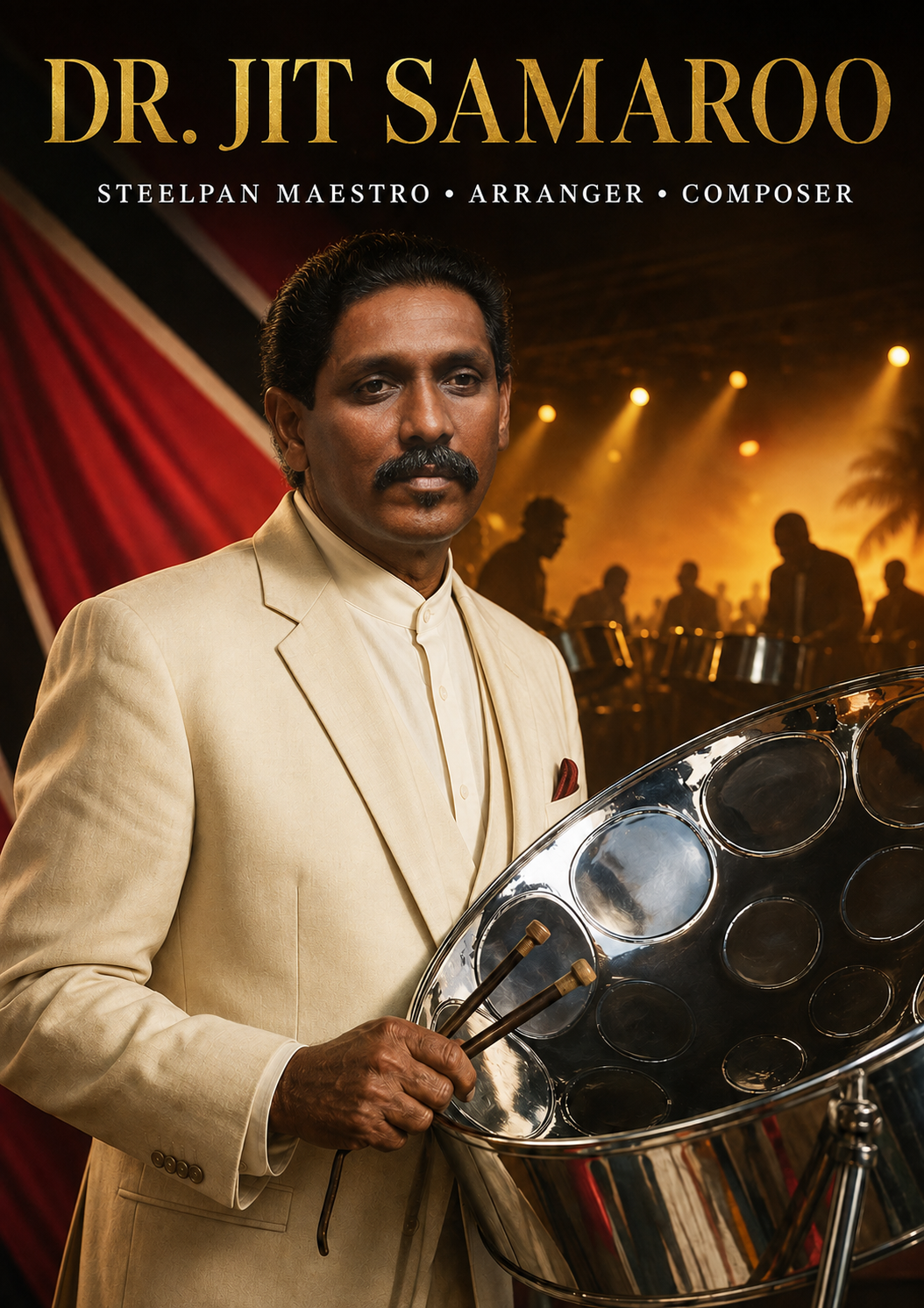
Dr. Jit Samaroo:
The Steelpan Genius Who Changed Panorama Music
Few names command greater respect in the world of steelpan than Dr. Jit Samaroo. A gifted pannist, composer, bandleader and arranger from Trinidad and Tobago, he helped expand the musical vocabulary of the steel orchestra and created some of the most memorable performances in Panorama history. His long partnership with the Renegades Steel Orchestra produced nine national titles, two sets of back-to-back victories and an unprecedented hat-trick between 1995 and 1997.
Yet statistics alone cannot explain Samaroo’s importance. His music combined technical precision with Carnival energy, melodic beauty and a distinctly Trinidadian blend of cultural influences. He knew how to make a large steel orchestra sound powerful without becoming heavy, intricate without losing its groove, and sophisticated without distancing itself from the audience.
For generations of pan musicians, Dr. Jit Samaroo was more than a champion arranger. He was proof that the steelpan could carry complex orchestral ideas while remaining rooted in the people, rhythms and celebrations that gave the instrument life.
From Lopinot Valley to the steelpan world
Jit Sukha Samaroo was born on 24 February 1950 in Surrey Village, Lopinot, Trinidad. He grew up as one of thirteen children in a rural community shaped by agriculture, family life and music. Lopinot is famous for parang, the Spanish-influenced Christmas music of Trinidad and Tobago, and those sounds formed part of the young musician’s earliest environment. His mother, Lakia, played the dholak, a two-headed hand drum associated with Indo-Caribbean musical traditions.
That combination of parang, Indian rhythm and community performance mattered.
At about ten years old, Samaroo joined Village Boys, a short-lived pan-round-the-neck group. His mother died while he was still a child, and he assumed considerable responsibility for younger members of the family. Music became both a source of expression and a way to keep the siblings together.
As a teenager, he joined the Lever Brothers Canboulay Steelband in Tunapuna. Its musical director, Landig White, recognised his ability, encouraged him to take formal music lessons and allowed him to experiment with arranging. Samaroo learned the instruments across the steel orchestra instead of limiting himself to one section. That broad understanding would later help him write parts that gave tenors, double seconds, guitars, cellos and basses meaningful roles in the musical conversation.
The Samaroo Kids and a remarkable family enterprise
Samaroo took discarded pans home and began teaching his brothers and sisters to play. The resulting family ensemble, the Samaroo Kids Steel Orchestra, made its public debut at The University of the West Indies on 23 August 1967. The group later became known as the Samaroo Jets.
The Jets also revealed another side of his artistry. The public quite rightly associates his name with Renegades and Carnival competition, but Samaroo composed across a much wider field. His catalogue included calypso, parang, ballads, gospel, jazz, folk, chutney, Indian-influenced music and Latin jazz. In 1997 and 1999, the Samaroo Jets staged full-length concerts devoted entirely to his compositions. Those programmes demonstrated that he was not simply a specialist who could transform another songwriter’s calypso for Panorama. He possessed an original compositional voice of his own.
The partnership that transformed Renegades
In 1971, celebrated tuner Bertrand “Butch” Kelman introduced Samaroo to the Renegades Steel Orchestra. It became one of the most fruitful partnerships in steelband history.
Renegades was an established Port of Spain band with a strong identity and formidable players. Samaroo brought patience, musical organisation and a long-term vision. His first arrangement for the band was “One Bad Apple.” Major competitive success did not arrive instantly. Instead, arranger and orchestra developed together through years of rehearsals, experiments, improved placings and shared commitment.
That gradual progress is important. Panorama arrangements are not created on paper and simply handed to an orchestra. They are built in the panyard, phrase by phrase and section by section. An arranger must imagine the complete work, communicate it to players with different responsibilities, hear weaknesses within a huge acoustic ensemble and make adjustments under intense time pressure. The music then has to survive the emotional and physical demands of a live Carnival final.
Samaroo became renowned for preparation and accuracy. Renegades learned to execute his detailed ideas with clarity, speed and confidence. By 1980, the band was among the leading Panorama contenders. In 1982, after more than a decade of partnership, Samaroo and Renegades secured their first national title with Lord Kitchener’s “Pan Explosion.” The apprenticeship had become a dynasty.
Nine National Panorama victories
The official Pan Trinbago results record nine championship performances arranged by Jit Samaroo for Renegades:
| Year | Winning selection | Composer or performer association |
|---|---|---|
| 1982 | “Pan Explosion” | Lord Kitchener |
| 1984 | “Sweet Pan” | Lord Kitchener |
| 1985 | “Pan Night and Day” | Lord Kitchener |
| 1989 | “Somebody” | Winsford “Joker” Devine / Baron |
| 1990 | “Iron Man” | Lord Kitchener |
| 1993 | “Mystery Band” | Lord Kitchener |
| 1995 | “Four Lara Four” / “Laramania” | Merchant and De Fosto |
| 1996 | “Pan in a Rage” | The Original De Fosto |
| 1997 | “Guitar Pan” | Lord Kitchener |
The list shows both dominance and longevity. These victories were spread across sixteen seasons rather than concentrated in one brief period. Samaroo adjusted to changes in Panorama, new musical fashions, different generations of players and increasingly demanding standards.
The 1984 performance of “Sweet Pan” became especially famous for its commanding margin of victory. Renegades followed it by sharing the 1985 title with Desperadoes, both playing arrangements of “Pan Night and Day.” Samaroo then achieved another consecutive pair with “Somebody” in 1989 and “Iron Man” in 1990.
His crowning competitive achievement came in 1995, 1996 and 1997. Renegades won three consecutive large-band Panorama titles with “Four Lara Four,” “Pan in a Rage” and “Guitar Pan.” As confirmed during the 2025 Jit Samaroo Festival, he remains the only arranger to have achieved that large-band hat-trick.
One title requires inspiration, preparation and an outstanding performance. Three in succession require a culture of excellence. The hat-trick belongs to the players and organisation of Renegades as well as to the arranger, but Samaroo’s ability to keep finding fresh musical solutions was central to it.
Why Jit Samaroo’s arrangements sounded different
Samaroo was frequently described as a “clinically accurate” arranger. The phrase captures his control, but it can sound colder than the music itself. His arrangements were precise, certainly, yet they were also energetic, witty, lyrical and dramatic.
He treated the steelband as an orchestra of interacting voices. The frontline pans could state a melody with brilliance, but the inner instruments were rarely reduced to anonymous accompaniment. Double seconds, guitars and cellos might answer a phrase, introduce a rhythmic figure or carry a countermelody. Bass pans could do more than mark harmony; they could establish movement, tension and identity. Percussion strengthened the architecture rather than merely adding volume.
His best work feels conversational. One section makes a statement and another responds. A familiar melody is broken apart, passed through the orchestra and rebuilt. Rhythmic intensity rises, relaxes and rises again. Transitions feel connected to what came before, even when the music changes direction. This structural logic is one reason his arrangements reward repeated listening.
Samaroo also understood contrast. Panorama requires sustained excitement, but continuous maximum force can make a performance feel flat. He used variations in texture, register, rhythm and dynamics to create anticipation. A lighter passage made the return of the full band more thrilling. A tightly controlled motif could prepare the way for a broad melodic release. His finales felt earned because the arrangement had travelled somewhere.
The 1989 winner “Somebody” offers a celebrated example of his rhythmic imagination. The arrangement is widely noted for incorporating six styles: calypso, soca, merengue, samba, zouk and disco. It answered critics who considered him too dependent on Lord Kitchener’s music and showed how confidently he could organise diverse rhythms without sacrificing coherence.
The special relationship with Lord Kitchener’s music
Seven of Samaroo’s nine Panorama victories came through selections associated with Lord Kitchener, one of calypso’s greatest composers. The partnership was not a formal songwriting team in the conventional sense; it was a remarkable meeting between a composer who understood pan and an arranger who could reveal the orchestral possibilities inside a calypso.
Kitchener’s pan songs provided memorable melodies, rhythmic character and lyrics that celebrated the steelband world. Samaroo did not merely repeat those songs on steel. He examined their musical DNA and expanded it. A short melodic idea could generate new runs, harmonies, ensemble responses and developmental passages. The original tune remained recognisable, but it became the centre of a much larger instrumental narrative.
“Pan Explosion,” “Sweet Pan,” “Pan Night and Day,” “Iron Man,” “Mystery Band” and “Guitar Pan” all demonstrate different sides of that relationship. Even more revealing is “Pan in A Minor,” Samaroo’s renowned 1987 arrangement for Renegades. It placed second rather than winning, yet it remains one of his most discussed works. Its reputation reminds us that competition results are only one measure of musical greatness. A performance can lose on the score sheet and still enter the permanent repertoire of pan culture.

Composer, test-piece writer and international musician
Samaroo’s contribution extended far beyond the Savannah stage. Eleven of his compositions were selected as test pieces for national steelband competitions. Such commissions reflected the respect commanded by his musical craftsmanship.
His compositions drew upon the many musical worlds he knew. Pieces such as “Utsav Ki Awaz” and “A Day in Surrey” reflected cultural and personal influences beyond conventional Carnival repertoire. He also composed the score for the locally filmed feature The Panman, further demonstrating his ability to write for narrative rather than competition alone.
Renegades carried his music internationally. One spectacular landmark came in Paris in 1990, when the orchestra participated in Jean-Michel Jarre’s vast Bastille Day concert at La Défense. The futuristic electronic scale of Jarre’s production and the acoustic power of a Trinidadian steel orchestra might have appeared to belong to different worlds. Their combination showed the steelpan’s capacity to stand confidently within a global multimedia event.
These appearances helped international audiences encounter steelpan as more than a holiday sound or visual novelty. In the hands of Samaroo and Renegades, it was an orchestral medium capable of technical discipline, complex arrangement and enormous emotional impact.
A musician shaped by Trinidad and Tobago’s diversity
Samaroo’s story is also a powerful example of Trinidad and Tobago’s cultural interconnection. He emerged from an Indo-Trinidadian family, absorbed dholak and parang sounds in Lopinot, dedicated his life to the African-Trinidadian innovation of steelpan, and created music that embraced calypso, soca, chutney, Latin rhythm and European orchestral ideas.
This should not be reduced to a simple slogan about “fusion.” His achievement was deeper. He understood these influences as living musical languages and used them with craft. A rhythmic change in one of his arrangements was not included merely to display variety. It had a structural purpose, supported the tune and gave the orchestra a new colour.
That breadth made his music unmistakably local and genuinely international at the same time. He showed how a musician could honour the particular sounds of home while speaking to listeners far beyond it. For younger arrangers, especially those navigating several cultural identities, his career remains an inspiring model.
Honours for a national cultural icon
Trinidad and Tobago formally recognised Samaroo’s service to culture on several occasions. The Office of the President’s National Awards Database records his Hummingbird Medal Silver in 1987 for culture and steelband, describing him as a pannist, arranger, composer and recording artiste. In 1995, he received the Chaconia Medal Silver for his cultural contribution.
In 2003, The University of the West Indies conferred an honorary Doctor of Letters upon him. The honour gave academic recognition to knowledge developed in panyards, family performance, composition and decades of practical musical leadership. It also affirmed the steelpan and its master practitioners as essential subjects within the Caribbean’s intellectual and artistic history.
Samaroo retired from Renegades in 2007 as his health declined. He died at his home in D’Abadie on 7 January 2016, aged 65. The timing, at the beginning of another Panorama season, was especially poignant for the pan community. The Trinidad Guardian’s report captured the grief of Renegades members and the depth of a relationship that had lasted approximately thirty-five years.
Jit Samaroo’s influence on Gary Trotman and Steelasophical
For Steelasophical founder Gary Trotman, Jit Samaroo’s legacy is not an abstract chapter in pan history. It is a direct source of musical inspiration. Gary has described “Pan Explosion” as the first Trinidad Panorama arrangement he heard and the performance that revealed a previously unimaginable level of steelband orchestration.
That discovery led him to study the great Panorama arrangers, yet he repeatedly returned to Samaroo’s musical formula and Renegades’ distinctive execution. In 1998, Gary produced the MIDI tribute project PanBrassOrama, celebrating the Samaroo–Renegades legacy through pieces including “The Bees Melody,” “Pan in Ah Rage,” “Iron Man” and “Guitar Pan.” The project became an important step in his own recording journey and in the development of the music later associated with Steelasophical.
This is how a true legacy works. It is not preserved only by awards, archives or anniversaries. It continues whenever another musician listens closely, learns from the structure of an arrangement and uses that inspiration to create an individual path. Steelasophical’s commitment to presenting Caribbean music with orchestral care, professional sound and respect for the pan tradition carries something of that lesson forward.
Why Dr. Jit Samaroo still matters
Dr. Jit Samaroo changed expectations. He demonstrated what disciplined arranging could draw from a steel orchestra, what committed players could achieve and how music from a small Caribbean nation could command major stages. His nine Panorama victories established an extraordinary competitive record, but his lasting value lies in the work itself.
Listen to the clarity of “Pan Explosion,” the authority of “Sweet Pan,” the layered excitement of “Somebody,” the architecture of “Iron Man,” the atmosphere of “Mystery Band” and the fearless variety of the 1995–1997 hat-trick. Then listen to “Pan in A Minor,” the famous non-winner, and remember that legacy is larger than trophies.
His story carries lessons for every creative person. Master your tools. Learn the roles of everyone in the ensemble. Respect tradition without becoming trapped by it. Build patiently. Let complexity serve communication. Above all, create work strong enough to live in other people’s imaginations.
From Surrey Village to the Panorama stage and onward to international audiences, Dr. Jit Samaroo gave steelpan music a body of work defined by precision, invention and joy. Renegades supplied the sound of a great orchestra; Samaroo gave that sound some of its most enduring journeys. Together, they wrote a chapter of Caribbean music history that continues to inspire pannists, arrangers and listeners around the world.
His mallets are silent, but his musical conversations continue.