 Skip to content

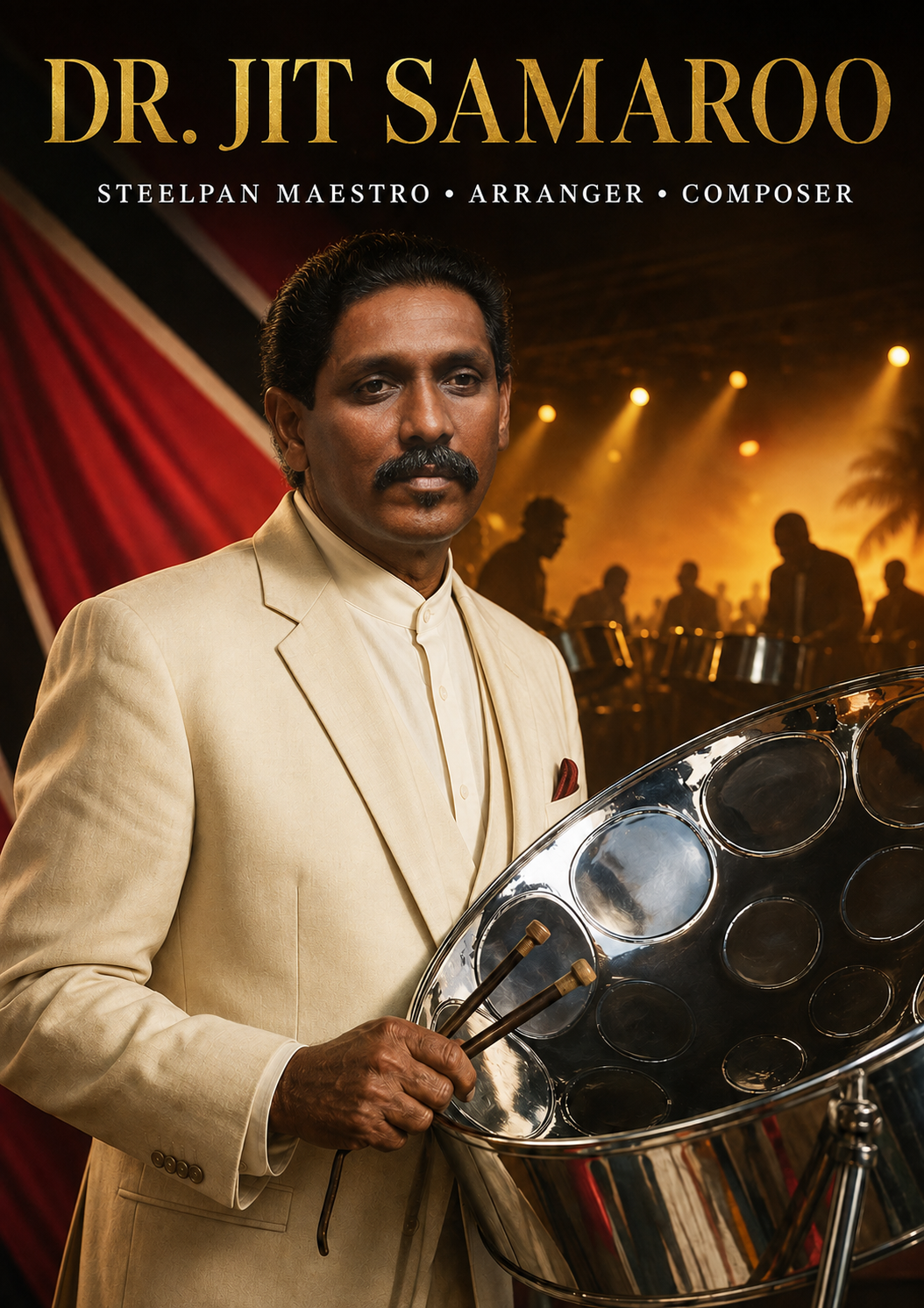
Jit Samaroo and the Renegades
IMHO the greatest and most consistent arranger of Steel Pan music ever! – hard to explain, but it feels like losing a friend. Jit had an amazing and unique formulae for arranging, a true musical conversationalist.
Simple in his delicate complexity .. In 1998 I produced a Midi album entitled #PanBrassOrama.
My personal musical tribute to JIT and celebrating the long and successful collaboration of Jit Samaroo and Lord Kitchener
That album got my foot in the door to have a conversation with Diz Heller and Horst Tubbesing at ARC Music Prod Int which led to two Steelasophical albums, still being sold world wide since 1999 (had always been my dream to share my music on the world stage and ARC made that happen) and even having one of those tracks used in a James Bond movie.
But at its root, has always been and will continue to be the inspiration of Jit the Man and Jit the Music … RIP


Jit Samaroo and the Renegades: A Golden Partnership in Steelpan History The story of Jit Samaroo and the Renegades is one of the most remarkable chapters in the history of steelpan music. It is the story of a quiet, disciplined musician from Trinidad’s Lopinot Valley and a powerful Port of Spain steel orchestra that, together, changed what people believed a steelband could achieve.
Their partnership was built over decades rather than created by one sudden success. It required trust, patience, rehearsal, musical intelligence and the willingness of hundreds of players to serve a shared vision. The result was nine Trinidad and Tobago National Panorama titles, an unprecedented run of three consecutive championships and a collection of arrangements that remain treasured by pan musicians around the world.
Jit Samaroo was far more than a successful competition arranger. He was a pannist, composer, musical director, teacher and cultural ambassador. Renegades were far more than the vehicle for his ideas. The orchestra supplied the energy, precision, tonal power and collective discipline required to turn those ideas into performances that could command the Queen’s Park Savannah.
Who was Jit Samaroo?
Jit Sukha Samaroo was born on 24 February 1950 in Surrey Village in the Lopinot Valley of Trinidad. He was the seventh of 13 children in an Indo-Trinidadian family whose home was filled with music. His mother played the dholak, while the sounds of parang, Indian music and village performance traditions formed part of his early musical world.
Samaroo did not grow up listening to music as though each genre belonged in a sealed box. Rhythm, melody, faith, festival and family life naturally overlapped. That openness would later help him write steelband music that was unmistakably Trinidadian while drawing on a broad musical vocabulary.
His relationship with pan began early. As a boy, he played with Village Boys, a small pan-round-the-neck band. He later joined the Lever Brothers Canboulay Steelband, where musical director Landeg White recognised his ability and encouraged his development. Samaroo learnt the different instruments of the steel orchestra, gained formal musical knowledge and began to understand arranging from the inside: not merely as notes on paper, but as physical parts played by real people.
After the death of his mother, the young Samaroo helped care for his younger siblings. The family ensemble that developed into the Samaroo Jets became an important outlet for his creativity and demonstrated pan’s versatility beyond Carnival. Village tradition, family musicianship, formal study and practical experience gave him an unusually complete musical education.
The Renegades Steel Orchestra
Renegades emerged from the strong steelband culture of Port of Spain and were rooted in La Cou Harpe. Like many of Trinidad’s established steel orchestras, the band carried a fierce community identity. The name suggested independence, defiance and strength, qualities that suited the intensity of the Panorama stage.
The orchestra later became widely known as Amoco Renegades through corporate sponsorship and subsequently as bp Renegades, while its players and panyard community remained its foundation.
When Samaroo began working with Renegades around the end of the 1960s and beginning of the 1970s, he was still a very young man. Accounts differ slightly on the exact starting point: some describe an introduction in 1967, while others place his formal recruitment as arranger around 1970. What is certain is that the relationship matured into one of the longest and most successful arranger–orchestra partnerships in pan.
At first, national victory did not come quickly. That makes the later triumphs even more meaningful. Samaroo and Renegades spent years developing their musical identity, learning from competition results and strengthening the relationship between arranger and players. The band placed third in 1980 with “Jean the Netball Queen” and second in 1981 with “More Pan”. Those performances signalled that Renegades were moving towards the very top.
In 1982, the breakthrough finally arrived.
Panorama: the ultimate steelband test
Trinidad and Tobago’s National Panorama competition, first staged in 1963, is the most celebrated competitive arena in the steelpan world. During Carnival, orchestras transform calypso or soca selections through new introductions, variations, harmonies, rhythmic development, countermelodies and powerful conclusions.
An arranger writes for pans ranging from high tenors to deep basses while integrating the engine room or rhythm section. The finished work must be technically impressive, structurally clear and exciting under the pressure of live performance. Panorama therefore tests composition, teaching, leadership, stamina, tuning, memory and ensemble discipline. Samaroo could design music with exceptional internal logic; Renegades could project it with clarity and force.
Nine Panorama victories
Jit Samaroo arranged nine National Panorama victories for Renegades between 1982 and 1997:
| Year | Winning selection | Important note |
|---|---|---|
| 1982 | “Pan Explosion” | The partnership’s first Panorama title |
| 1984 | “Sweet Pan” | A landmark Renegades performance |
| 1985 | “Pan Night and Day” | Joint winners with Desperadoes |
| 1989 | “Somebody” | Celebrated for its rhythmic variety |
| 1990 | “Iron Man” | A commanding back-to-back victory |
| 1993 | “Mystery Band” | One of Samaroo’s most admired complex works |
| 1995 | “Four Lara Four” | Also catalogued in some records as “Laramania” |
| 1996 | “Pan in a Rage” | The second title in the historic run |
| 1997 | “Guitar Pan” | Completed the unprecedented hat-trick |
Their first victory, “Pan Explosion” in 1982, confirmed the promise shown during the previous two seasons. “Sweet Pan” followed in 1984, and “Pan Night and Day” secured another title in 1985, shared with Desperadoes. Even in a culture full of great arrangers and formidable orchestras, Renegades had established a distinct competitive presence.
The 1989 victory with “Somebody” became especially significant. The song, composed by Winsford “Joker” Devine and performed by Baron, was a popular Panorama choice that year. Samaroo’s treatment stood apart through its organisation, changing rhythmic colours and control of the full orchestra. Commentators have often highlighted the way the arrangement moved through contrasting Caribbean and international dance rhythms without losing its identity or forward motion.
The following year, Renegades returned with Lord Kitchener’s “Iron Man” and won again. Back-to-back titles are difficult in any competition; in Panorama, where rivals arrive each year with new music, new strategies and enormous motivation, they carry special weight.
“Mystery Band” brought another championship in 1993. Its reputation has continued to grow among musicians because of its detail, demands and carefully controlled musical journey. Samaroo could create passages of great density while ensuring that the arrangement still made sense as a complete work.
Then came 1995, 1996 and 1997—the run that placed the partnership permanently in the Panorama record books.
The historic Panorama hat-trick
Renegades won in 1995 with “Four Lara Four”, a musical celebration associated with Trinidad and Tobago cricket hero Brian Lara. In 1996 they retained the title with “Pan in a Rage”. In 1997, “Guitar Pan” completed three consecutive victories.
This was the first Panorama hat-trick of its kind in the large-band competition. Winning three years in succession required the orchestra to master demanding new music while carrying the pressure created by its own success. “Guitar Pan”, based on Lord Kitchener’s tribute to the steelpan instrument, delivered a fitting conclusion: melodic, energetic and large enough in scale for the Panorama stage.
What made Jit Samaroo’s arrangements special?
Samaroo was frequently described as meticulous or clinically accurate. Those descriptions point to his precision, but they can sound colder than the music itself. His arrangements were not mechanical. Their accuracy created the platform from which excitement could grow.
One of his great strengths was orchestration. Samaroo distributed material so that the melody remained clear while inner voices, bass movement and percussion added depth. He could make a large band sound massive, reduce the texture to create contrast and then rebuild its full force.
Countermelody was another hallmark. Instead of asking every section to reinforce the same idea, he gave different voices meaningful lines that fitted together. These interlocking parts created movement across the orchestra. Listeners could enjoy the overall impact, while musicians could return to the recording and discover fresh details.
His transitions created direction across different moods, keys and rhythmic feels. One section prepared the next, so even dramatic surprises felt earned.
Rhythm was central to his imagination. “Somebody” is regularly cited as an example because it brings together multiple rhythmic characters while maintaining momentum. The variety was not included simply to display knowledge. Each change refreshed the listener’s ear and gave Renegades another way to demonstrate ensemble control.
Samaroo also respected the source melody. A Panorama arranger transforms a song, but the most successful arrangements allow the original tune to remain emotionally present. His long association with Lord Kitchener’s music was especially productive because Kitchener wrote memorable melodies about pan, Carnival and Trinidadian life. Samaroo could preserve that character while expanding the material into a large symphonic statement.
More than winning: “Pan in A Minor” and the value of legacy
A championship table cannot tell the whole story. One of Samaroo’s most famous Renegades arrangements, Lord Kitchener’s “Pan in A Minor”, placed second in 1987. Yet it remains among the performances most frequently discussed, studied and enjoyed.
That fact reveals something essential about music competitions. Results matter, and the nine titles are an extraordinary achievement, but a composition can outlive the ranking it received on one night. Recordings become teaching tools. Phrases enter the shared memory of pannists. Younger arrangers examine the voicings, rhythmic turns and structure. Audiences form personal attachments that have nothing to do with a score sheet.
The enduring reputation of “Pan in A Minor” shows that Jit Samaroo and the Renegades created more than winning packages. They created repertoire.
The same is true of “Somebody”, “Iron Man”, “Mystery Band” and “Guitar Pan”. These works help listeners understand how a popular calypso can become an extended orchestral experience without losing the warmth, movement and identity of the original song.
From the panyard to the international stage
The influence of Jit Samaroo and Renegades extended far beyond Panorama. The orchestra toured and represented Trinidad and Tobago internationally, helping global audiences encounter steelpan as a serious, flexible orchestral instrument.
One remarkable moment came in Paris on 14 July 1990, when Amoco Renegades appeared in Jean-Michel Jarre’s enormous La Défense concert. The event combined electronic music, large-scale staging and international performers before a vast crowd. Renegades’ presence placed the sound of Trinidadian steel at the centre of a spectacular global production.
This kind of appearance challenged narrow stereotypes. Steelpan could certainly create a joyful Carnival atmosphere, but it could also converse with synthesizers, orchestral textures, film music and large theatrical concepts. Samaroo’s disciplined direction helped make such collaborations possible.
His work with the Samaroo Jets reinforced the same message. The family ensemble performed Caribbean, classical, popular and Indian-influenced material, demonstrating pan’s melodic reach. Samaroo was able to move between community music, national competition and international presentation without treating any one setting as less worthy of care.
Awards and national recognition
Trinidad and Tobago recognised Samaroo’s cultural contribution with the Hummingbird Medal of Merit (Silver) in 1987 and the Chaconia Medal (Silver) in 1995. In 2003, The University of the West Indies conferred an honorary Doctor of Letters upon him.
These honours acknowledged more than competitive success. Samaroo helped build the cultural standing of the steelpan, mentored musicians and demonstrated the creative possibilities of the national instrument. His career crossed social and musical boundaries, joining Indo-Caribbean heritage, Afro-Trinidadian steelband tradition and an international musical outlook.
The UWI later remembered him as a creative innovator who broke barriers. That assessment captures an important aspect of his legacy. Samaroo’s achievements challenged assumptions about where musical authority could come from and what cultural collaboration in Trinidad and Tobago could sound like.
A relationship based on trust
Great arrangements require great performers. Samaroo supplied the musical architecture, but the orchestra made it live. Players learnt intricate passages by memory and maintained accuracy under pressure. Section leaders carried detail across the band, tuners protected the instruments, the engine room supplied drive and supporters sustained the panyard. Renegades trusted Samaroo through the apprenticeship years before the first victory, allowing a deep musical understanding to develop.
Over time, arranger and orchestra became closely identified with one another. Listeners heard a Renegades sound, but within it they could also recognise Samaroo’s organisation, rhythmic imagination and control of detail. This shared identity is one reason the partnership remains such an important model.
The legacy after Jit Samaroo
Jit Samaroo died on 7 January 2016 at the age of 65. The timing, just as another Panorama season was beginning, made the loss especially poignant for the pan community.
Yet his influence did not end. His children, including arranger Amrit Samaroo, continued the family’s contribution to music. Renegades moved forward with new generations of players and arrangers while retaining the standards associated with the Samaroo era. Every later success exists within a history that he helped shape.
His arrangements continue to be heard in recordings, concerts, rehearsals and conversations among pan people. They remain useful because they are not merely monuments. They contain practical lessons about voicing, pacing, thematic development, discipline and the relationship between complexity and communication.
For a young musician, Samaroo’s life also offers a broader lesson. Musical greatness does not have to arrive through flamboyance. His public image was often modest and understated. The boldness was in the work: in the care of the writing, the courage of the rhythmic choices and the belief that the steel orchestra deserved the highest level of musical thought.
Why Jit Samaroo and the Renegades still matter
The story remains relevant because steelpan is now a worldwide instrument. Bands perform across the Caribbean, the United Kingdom, Europe, North America, Africa, Asia and beyond. Players approach pan through schools, universities, community organisations, Carnival, professional entertainment and international competition.
Wherever it travels, the instrument carries the history of Trinidad and Tobago. Remembering figures such as Jit Samaroo and orchestras such as Renegades helps protect that connection. It reminds audiences that the polished sound they enjoy was built through generations of experimentation, community commitment and artistic excellence.
For Steelasophical, sharing Caribbean steelpan music in the United Kingdom also means respecting the masters who expanded the art form. The goal is not simply to reproduce a tropical sound. It is to celebrate an instrument with a deep history and to introduce audiences to the craftsmanship behind its joyful voice.
Jit Samaroo and the Renegades showed what becomes possible when talent meets loyalty, when detail serves emotion and when an orchestra commits itself to a common musical purpose. Nine Panorama victories made them champions. The music they left behind made them timeless.
Their golden partnership will continue to inspire arrangers, pannists and steelband audiences for generations to come.