 Skip to content


The Complete History of Steelpan
From Tamboo Bamboo to World Steelpan Day 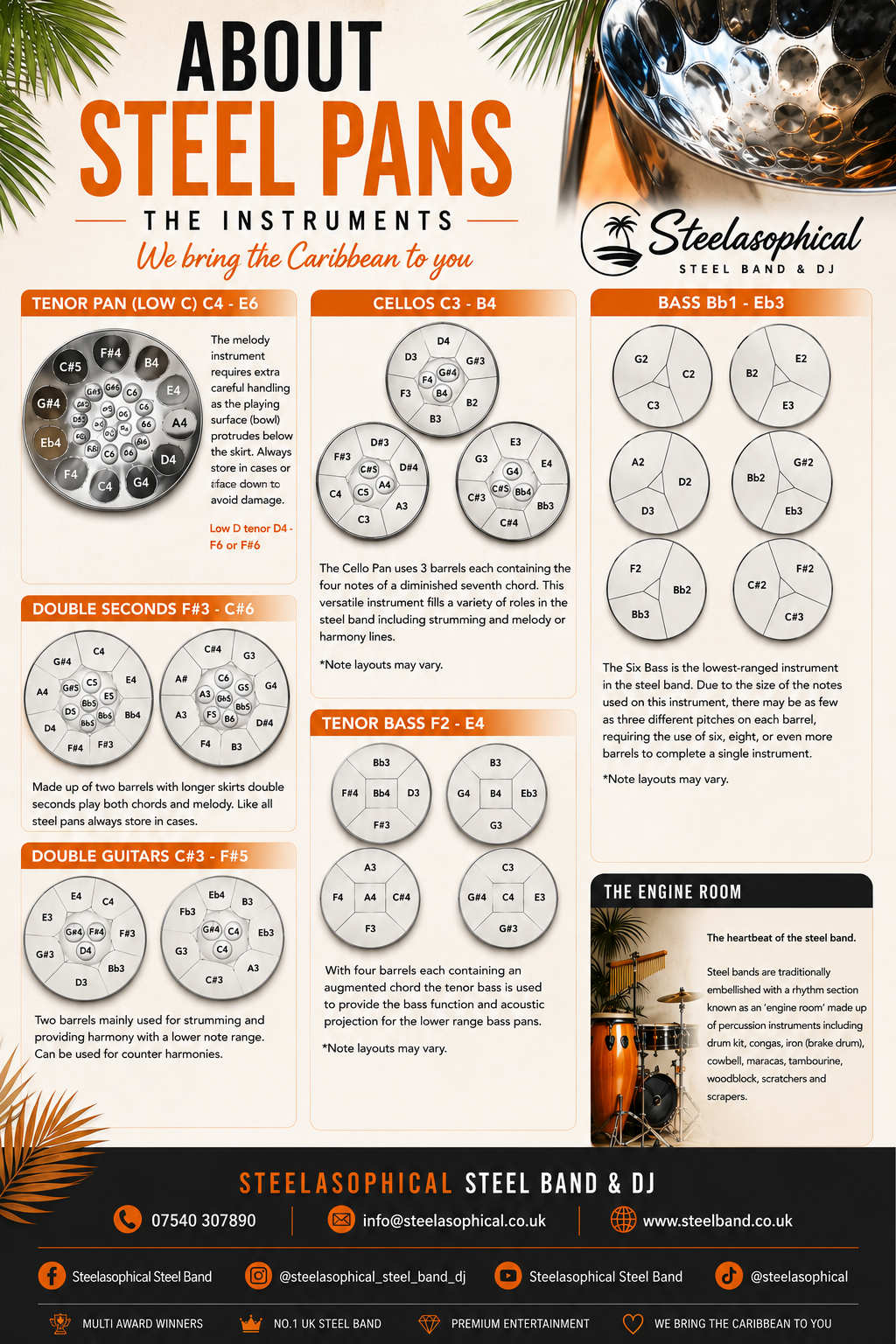
How Trinidad and Tobago Turned Resistance, Ingenuity and Discarded Metal into One of the World’s Most Extraordinary Musical Instruments
Few musical instruments have a history quite like the steelpan.
Its story is not simply about somebody discovering that a piece of metal could make a musical note. It is a story of Trinidad and Tobago, Carnival, African cultural survival, colonial restrictions, working-class communities, experimentation, rivalry, craftsmanship and extraordinary musical innovation.
From African-derived drumming traditions and the rhythms of tamboo bamboo, through the first experiments with metal containers in the streets of Trinidad, the steelpan developed into an entire family of chromatically tuned instruments capable of performing everything from calypso and soca to jazz, classical music, pop, reggae and film scores.
Steelbands that were once treated as troublesome street groups would eventually perform on some of the world’s most prestigious stages.
Pan entered schools and universities.
Steelband communities spread through the Caribbean, Britain, North America, Europe, Asia and beyond.
Trinidad’s annual Panorama competition became one of the great showcases of large-scale ensemble music.
Then, in 2023, another remarkable milestone was reached: the United Nations General Assembly proclaimed 11 August as World Steelpan Day.
The journey from bamboo striking the streets of colonial Trinidad to international recognition by the United Nations is one of the great stories in modern musical history.
This is the story of steelpan.
Before Steelpan: The African Roots of Trinidad’s Percussion Culture
To understand steelpan, we need to go back much further than the oil drum.
The instrument emerged from a society shaped by colonialism, slavery, emancipation, migration and the interaction of African, European, Indian and other cultural traditions.
For people of African descent in Trinidad, percussion, song, dance and communal celebration were much more than entertainment.
They were methods of communication, identity and cultural memory.
After emancipation in the British Empire in 1834, Afro-Trinidadians developed and expanded celebrations associated with Canboulay.
These celebrations incorporated drumming, singing, dancing, masquerade, stick fighting and satirical performances.
Canboulay became one of the cultural foundations from which modern Trinidad Carnival developed.
But these gatherings also worried colonial authorities.
Large groups of people gathering in the streets, drumming, singing and openly mocking authority could be regarded by those in power as a challenge to social order.
This tension between popular cultural expression and colonial control would become extremely important in the eventual development of pan.
Canboulay, Carnival and Resistance
During the nineteenth century, Carnival became an arena in which different sections of Trinidadian society expressed identity and competed for cultural space.
The famous Canboulay Riots of 1881 demonstrated just how serious the conflict had become.
Attempts by the authorities to suppress elements of Carnival were resisted by participants determined to preserve their traditions.
According to the Smithsonian Center for Folklife and Cultural Heritage, colonial restrictions on drumming contributed directly to the development of alternative percussion practices.
When drums were restricted, the rhythm did not disappear.
Musicians simply found something else to play.
That ability to adapt would eventually become one of the defining characteristics of the steelpan movement.
Tamboo Bamboo: The Crucial Link in the Steelpan Story
By the late nineteenth century, tamboo bamboo bands had become an important part of Trinidad’s Carnival culture.
The name is generally associated with the French word tambour, meaning drum.
Instead of relying entirely on skin drums, performers used lengths of bamboo of different sizes.
These pieces could be struck against the ground or beaten with sticks to produce different rhythmic functions.
The Smithsonian describes four basic roles within traditional tamboo bamboo instrumentation:
- Bass
- Foule
- Cutter
- Chandler
Different widths and lengths of bamboo created different sounds and functions within the ensemble.
This is important because the steelband would eventually develop according to a remarkably similar musical principle.
A modern steel orchestra does not consist of dozens of identical instruments.
It contains different sections covering different registers and musical functions: high melodic instruments, middle-range pans, lower harmony instruments, bass pans and percussion.
In other words, the concept of an orchestra of complementary registers existed before the steelpan itself.
Tamboo bamboo helped provide that organisational bridge.

Why Musicians Began Turning to Metal
Bamboo was ingenious, inexpensive and readily available.
But it had limitations.
Repeatedly striking bamboo against hard surfaces could cause it to crack and splinter.
Musicians therefore experimented.
Metal objects gradually became increasingly important.
Biscuit tins, paint cans, dustbins, brake components and other discarded metal objects could all create powerful percussion sounds.
NALIS — Trinidad and Tobago’s National Library and Information System Authority — describes this experimentation with metal containers as a key stage in the transition from tamboo bamboo to steelpan.
By the late 1930s, something revolutionary was happening.
Musicians were discovering that metal did not merely produce rhythm.
Metal could produce pitch.
And, crucially, its pitch could be deliberately manipulated.
The Birth of Steelpan
Exactly who “invented” the steelpan?
This is where responsible steelpan history becomes particularly important.
There is a temptation to search for one person, one workshop and one magical moment when the instrument was supposedly invented.
The historical evidence suggests something more complicated — and arguably more impressive.
Steelpan appears to have developed through collective experimentation involving numerous young innovators and different communities in Trinidad.
NALIS notes that there have been several competing claims concerning its invention and places the first steelpan at approximately 1939 in Trinidad and Tobago.
The Smithsonian similarly describes steelpan as developing around 1940 among young people in working-class neighbourhoods who experimented with shaping metal containers to create distinguishable pitches.
Therefore, statements claiming with absolute certainty that one individual single-handedly “invented the steelpan” should be treated cautiously.
There were certainly enormously important pioneers.
But pan developed through an extraordinary culture of experimentation.
Someone discovered something.
Another person improved it.
Another tuner expanded the notes.
Another changed the shape.
Another improved the tone.
Another developed a different range.
Another arranged music that demonstrated what the instrument could achieve.
Steelpan was not simply invented.
It evolved.

The First Metal Pans
Early pans looked very different from today’s highly developed instruments.
Musicians experimented with whatever suitable metal objects were available.
Small containers could be carried around the neck, which is why traditional steelband performance became associated with pan-round-the-neck.
Early instruments were primarily rhythmic.
But pioneers increasingly discovered that carefully manipulating sections of the metal surface could produce notes.
The surface could be shaped, grooved, hammered and tuned.
As techniques improved, musicians could create more pitches.
Simple rhythmic metal percussion was gradually transformed into a genuine melodic instrument.
This was an extraordinary leap.
A discarded container had become a musical keyboard.
The 55-Gallon Oil Drum Changes Everything
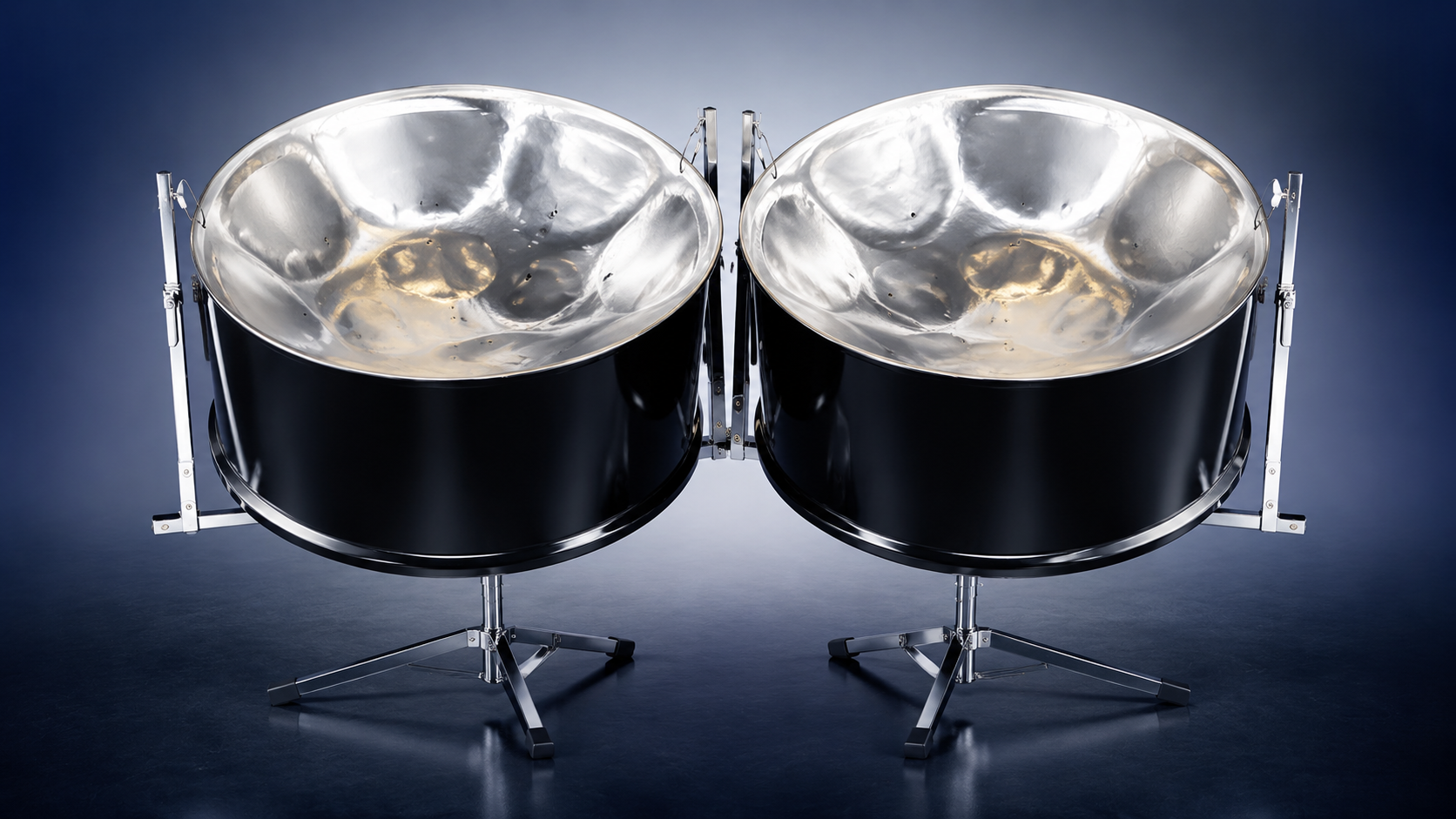
Eventually, the 55-gallon oil drum became closely associated with steelpan construction.
Trinidad’s petroleum industry meant that steel drums were available, and the size and quality of the material provided pan makers with a much larger surface with which to experiment.
The drum could be sunk and shaped.
Areas of the playing surface could be defined into individual notes.
Those notes could then be carefully tuned.
Different parts of the barrel could also be used to create instruments covering different registers.
This eventually made possible an entire family of pans.
The steelpan was becoming more than an improvised Carnival percussion instrument.
It was becoming an orchestra.
The Pioneers of Pan
Many individuals contributed to the instrument’s development, and arguments about priority have continued for decades.
Names associated with the pioneering era include innovators, tuners and players such as Winston “Spree” Simon, Ellie Mannette, Anthony Williams, Neville Jules and others.
Their contributions were not necessarily identical.
Some advanced tuning.
Others developed instrument layouts.
Others expanded ranges.
Some improved construction.
Some transformed performance and arranging.
For example, Anthony Williams became particularly associated with the influential “spider-web” tenor layout, organised according to a cycle-of-fifths relationship.
Ellie Mannette became one of the most internationally influential pan builders and tuners.
The Smithsonian records that Mannette later moved to the United States, assisted the U.S. Navy steelband tradition and developed educational steelpan programmes.
Rather than reducing this remarkable period to a single “inventor”, it is more accurate to recognise an innovation community.
That collective creativity is part of what makes the history so extraordinary.
Steelband and the Streets of Port of Spain
Early steelband culture developed strongly within working-class communities, particularly around Port of Spain.
Bands were intensely local.
A steelband could represent a neighbourhood, a group of friends and a community identity.
This created extraordinary loyalty.
It also created rivalry.
The early steelband era has sometimes been romanticised, but it could be turbulent. Rivalries between bands occasionally became violent, contributing to the negative reputation that sections of Trinidadian society attached to steelbandsmen.
Pan was sometimes characterised as noisy, disorderly or associated with delinquency.
The musicians themselves, however, were developing one of the twentieth century’s most remarkable musical innovations.
Over time, the public perception would change dramatically.
The supposed street noise would become a national treasure.
From Street Groups to Organised Steelbands
Organisation was critical to that transformation.
NALIS records that the Trinidad and Tobago Steelband Association, a precursor to today’s Pan Trinbago, emerged around 1950.
Pan Trinbago’s own historical material describes the organisation of steelbandsmen and the growing efforts to stage concerts and competitions.
Greater organisation gave musicians representation.
It also helped steelband become recognised as a serious cultural movement.
One particularly important ambition was emerging.
Trinidad wanted to send a steelband abroad.
TASPO and the Moment Steelpan Went International
In 1951, the Trinidad All Steel Percussion Orchestra — TASPO — travelled to Britain.
This was a defining moment.
TASPO brought together leading players from different Trinidadian steelbands and demonstrated the musical possibilities of the instrument internationally.
The orchestra performed in connection with the Festival of Britain and appeared at locations in Europe.
This mattered for several reasons.
Firstly, overseas audiences encountered an instrument many had never seen before.
Secondly, Trinidadian musicians saw steelpan placed within a more formal concert context.
Thirdly, bringing accomplished players and tuners together encouraged an exchange of ideas.
Pan Trinbago describes TASPO as an important catalyst in improving the instruments and accelerating the musical development of the steel orchestra.
The instrument born from the streets of Trinidad had crossed the Atlantic.
It would never again be confined to the island.
Steelpan Comes to Britain
Britain would become particularly important in steelpan’s international story.
Migration from the Caribbean increased substantially during the post-war era, particularly during the period commonly associated with the Windrush generation.
Trinidadians and other Caribbean migrants brought music, Carnival traditions and steelpan with them.
Steelbands developed in British communities.
Pan became increasingly visible at Caribbean cultural celebrations and eventually became inseparable from the soundscape of events such as Notting Hill Carnival.
Community groups also began teaching young people.
Schools acquired instruments.
Local authorities and arts organisations supported steelband projects.
Britain consequently became one of the most important steelpan centres outside Trinidad and Tobago.
Today, steelbands can be heard at British weddings, festivals, schools, community events, corporate celebrations and concert performances.
For professional performers such as Steelasophical Steel Band & DJ, the instrument’s history continues every time pan is introduced to another audience.
What once travelled from Trinidad aboard ships is now part of Britain’s multicultural musical landscape.
Steelpan Spreads Across the World
Britain was only part of the international expansion.
Steelpan travelled throughout the Caribbean and into:
the United States,
Canada,
continental Europe,
Japan,
Australia,
Africa,
and many other regions.
Touring musicians played a major role.
So did recordings.
Smithsonian Folkways preserves numerous historic steelband recordings demonstrating how rapidly international interest developed.
Musicians such as Kim Loy Wong helped establish steelpan in the United States. Smithsonian material records Wong’s involvement in teaching young people at the Wiltwyck School for Boys and his role in introducing American audiences to the chromatically tuned instrument.
Ellie Mannette likewise became hugely influential in American pan education and construction.
The movement had entered a new stage.
Steelpan was no longer simply being exported as entertainment.
It was being taught.
The Steelpan Enters Education
Educational adoption was one of the most significant developments in steelpan history.
The instrument possesses several qualities that make it particularly effective in schools.
It is immediately engaging.
Students can produce an attractive sound relatively quickly.
Yet mastering the instrument can require sophisticated musical understanding, coordination, ensemble awareness and technique.
Steelbands teach rhythm, melody, harmony, listening and teamwork simultaneously.
Smithsonian Folkways now provides educational material specifically designed to teach students about Trinidadian steelband music, its cultural background and instrumentation.
Steelpan programmes have consequently become established in schools, colleges, universities and community music organisations internationally.
That development would have been difficult for the early pioneers to imagine.
An instrument once criticised as the noise of troublesome youths became an instrument used by teachers to educate young people.
Building the Modern Steel Orchestra
The modern steelband is effectively an orchestra made almost entirely from tuned steel percussion.
Different pans perform different musical functions.
The exact instrumentation varies, but common sections include:
- Tenor / Lead Pan
Usually carries melodies and fast passages. - Double Tenor / Double Seconds
Provides melodic, harmonic and accompaniment functions. - Guitar Pans
Frequently provide rhythmic harmony. - Cello Pans
Occupy the middle and lower registers. - Bass Pans
Provide the deep foundation of the orchestra. - Then there is the engine room.
The engine room is the rhythmic heart of a large steelband and can contain drum kit, congas, cowbells, iron, scratchers, shakers and other percussion.
A conventional steel orchestra can contain scores of musicians.
NALIS notes that large conventional steelbands may reach approximately 120 performers.
The result is one of music’s most visually and sonically spectacular ensembles.
Steelpan Can Play Almost Anything
One misconception still occasionally encountered is that steelpan is suitable only for calypso.
Its connection with calypso is fundamental and should be celebrated.
But the instrument is remarkably versatile.
Steel orchestras and individual pannists perform:
calypso,
soca,
reggae,
jazz,
Latin music,
gospel,
R&B,
soul,
pop,
classical compositions,
film music,
and original contemporary compositions.
Smithsonian educational resources specifically note the steelband tradition’s ability to perform calypso alongside European classical music, popular music and Latin American styles.
This musical versatility helped pan travel internationally.
Audiences could recognise familiar melodies while experiencing a completely different sound.
The Birth of Panorama
If Carnival is the cultural home of steelpan, Panorama became its great competitive stage.
Trinidad and Tobago’s national Panorama steelband competition began in 1963.
NALIS describes it as the premier steelband competition of the Carnival season.
Panorama changed steelband arranging.
Instead of simply performing popular songs, arrangers could transform a composition into an extended musical showpiece.
A Panorama arrangement might explore:
melodic variations,
harmonic changes,
rhythmic transformations,
key changes,
counterpoint,
dramatic introductions,
breakdowns,
reprises,
and explosive finales.
Large steel orchestras spend countless hours rehearsing.
The arranger becomes central.
So does the tuner.
So does the engine room.
And so does every individual pannist.
The result is collective musical precision on an enormous scale.
Panorama and the Rise of the Steelband Arranger
Panorama helped create another important figure in steelpan culture: the superstar arranger.
The arranger takes the chosen composition and reimagines it for a full steel orchestra.
This requires an unusual combination of skills.
The arranger needs musical imagination, understanding of pan ranges, rhythmic knowledge, orchestration ability and an instinct for what will work in competition.
Over Panorama’s history, legendary arrangers have helped redefine what steelpan music can achieve.
Complexity increased.
Harmonic vocabulary expanded.
Arrangements became longer and more dramatic.
Bands developed distinctive musical identities.
Panorama therefore became more than a competition.
It became an annual laboratory for steelband innovation.
The Panyard: Where Steelband Culture Lives
To understand steelband properly, one also needs to understand the panyard.
A panyard is far more than a rehearsal space.
It can be a workshop, classroom, meeting place, social centre and cultural home.
During Panorama season, panyards become particularly intense.
Musicians rehearse repeatedly as arrangements develop.
Sections learn passages.
Arrangers make changes.
Tuners maintain instruments.
Supporters gather.
Food appears.
Stories are exchanged.
Generations mix.
This social structure helps explain why steelbands remain powerful community institutions.
People do not simply join a band.
They can become part of a steelband family.

Women and the Changing Face of Steelband
Early histories of steelpan frequently focus heavily on male pioneers.
That reflects the male-dominated environment of much early steelband culture, but it should not obscure the important role women have played in the movement.
Women increasingly became performers, arrangers, educators, administrators and leaders.
Historic recordings also provide evidence of female steelbands. Smithsonian Folkways’ Champion Steelbands of Trinidad collection, for example, includes the all-female Girl Pat Steelband.
Today, girls and women participate throughout the international pan community.
The visual identity of a modern steel orchestra is consequently very different from that of many early street bands.
Pan has become increasingly inclusive.
Steelpan and the Caribbean Diaspora
Migration transformed steelpan into a global cultural ambassador.
Caribbean communities established themselves in London, Birmingham, New York, Toronto and many other cities.
Music helped communities maintain a connection with home.
Steelpan was ideal for that role because its sound was immediately identifiable.
A few notes could evoke Carnival, Trinidad, sunshine, community and celebration.
But something else happened.
People without Caribbean heritage began playing too.
Schoolchildren learned pan.
University students joined ensembles.
Professional musicians incorporated it into recordings.
Composers wrote for it.
Audiences began hearing pan outside specifically Caribbean events.
The steelpan simultaneously remained deeply Trinidadian and became genuinely international.
From Marginalisation to National Symbol
Perhaps the most remarkable aspect of the steelpan story is the transformation in its social status.
Consider the journey.
Its predecessors were shaped partly by restrictions imposed upon popular percussion traditions.
Early pan developed among working-class communities.
Steelbands were associated by some sections of society with disorder and violence.
Musicians were sometimes treated with suspicion.
Yet the instrument continued developing.
Then came organised competitions.
Concert performances.
TASPO.
International touring.
Recordings.
Schools.
Universities.
Professional orchestras.
Cultural institutions.
Government recognition.
International festivals.
And eventually the United Nations.
The instrument once dismissed by sections of society became the national instrument of Trinidad and Tobago.
Few musical traditions demonstrate cultural transformation so dramatically.
The Myth of the “Steel Drum”
Outside Trinidad and Tobago, people frequently use the phrase steel drum.
It is understandable because the instrument developed from metal drums.
However, steelpan, or simply pan, is generally the culturally preferred terminology.
Why?
Because the finished instrument is not merely a drum being struck.
It is a carefully tuned melodic percussion instrument containing multiple distinct pitches.
A tenor pan can perform melodies with remarkable agility.
A full steel orchestra can reproduce sophisticated harmony and orchestration.
The barrel is the raw material.
The pan is the instrument.
Pan Making Is an Art and a Science
A modern steelpan may look deceptively simple.
Its creation is anything but simple.
Traditional construction involves carefully shaping the metal surface, defining note areas and tuning those areas so that the desired fundamental and harmonic relationships emerge.
Tiny adjustments can change the sound.
Metal thickness matters.
Shape matters.
Temperature and working techniques matter.
Note placement matters.
The skill of the pan tuner is therefore fundamental to the entire movement.
Without the tuner, there is no steel orchestra.
Modern technology has introduced new construction methods and manufacturing possibilities, but traditional craftsmanship remains deeply respected.
Pan building sits at an unusual intersection of:
music, metallurgy, acoustics, engineering and art.
Steelpan in the Twenty-First Century
Today’s steelpan exists in several worlds simultaneously.
It remains at the heart of Trinidad and Tobago’s Carnival culture.
It remains central to Panorama.
It remains an important community instrument.
But pan is also increasingly present in concert music, recording studios, education, tourism, weddings, corporate entertainment and international festivals.
Electronic pans and alternative materials have appeared.
Academic research into pan acoustics has expanded.
Digital technology allows arrangers and performers to collaborate internationally.
Videos of Panorama performances can be watched around the world almost instantly.
Young pannists can learn techniques from musicians thousands of miles away.
The instrument continues to evolve.
That is completely consistent with its history.
Steelpan has always been an instrument of innovation.
World Steelpan Day: The United Nations Recognizes Pan
Then came one of the most important moments in modern steelpan history.
In 2023, the United Nations General Assembly adopted Resolution A/RES/77/316, proclaiming 11 August as World Steelpan Day.
The resolution was adopted without a vote.
The United Nations recognised steelpan’s cultural and historical significance and highlighted its potential contribution to sustainable development.
The UN specifically acknowledged its relevance to areas including cultural development, inclusive societies, sustainable communities, education, the creative economy and youth empowerment.
Member States, United Nations organisations, educational institutions, civil society groups and other stakeholders were encouraged to commemorate the day through performances, workshops, exhibitions and educational activities.
The significance is enormous.
A musical instrument created through grassroots experimentation in Trinidad and Tobago had become the subject of an internationally recognised United Nations observance.
Why 11 August Matters
World Steelpan Day should not simply become another date on the cultural calendar.
It provides an annual opportunity to tell the full story.
A story about African cultural survival.
A story about colonial Trinidad.
A story about Carnival.
A story about tamboo bamboo.
A story about young people experimenting with discarded metal.
A story about communities sometimes treated with suspicion.
A story about tuners, arrangers and players relentlessly improving their instruments.
A story about TASPO crossing the Atlantic.
A story about Panorama.
A story about migration.
A story about education.
And ultimately a story about an instrument from Trinidad and Tobago being embraced around the world.
Documented History Versus Steelpan Mythology
Steelpan has accumulated a rich oral tradition.
That is valuable.
But oral histories can also produce conflicting versions of events.
Claims concerning the “first” pan, “first” note, “first” tuner or sole inventor should therefore be approached carefully.
Reliable institutional sources including NALIS, Smithsonian institutions, Pan Trinbago and United Nations records allow several broad conclusions to be stated confidently:
Steelpan developed in Trinidad and Tobago.
Its development was closely connected with Carnival culture.
Tamboo bamboo formed an important historical predecessor.
Experimentation with metal containers accelerated during the late 1930s and early 1940s.
Numerous pioneers contributed to its development.
The 55-gallon steel drum became fundamental to the development of modern pan construction.
Organised steelband institutions helped transform the movement’s social position.
TASPO’s 1951 overseas tour was a major international milestone.
Panorama began in 1963 and became Trinidad and Tobago’s premier steelband competition.
Steelpan subsequently spread internationally through touring, migration, recordings and education.
And in 2023, the United Nations proclaimed 11 August World Steelpan Day.
Where individual origin claims remain disputed, they should be presented as such.
Doing so does not weaken the steelpan story.
It makes it stronger.
Because the real story is not about one accidental discovery.
It is about an extraordinary collective process of invention.
A Short Steelpan History Timeline
- 1834 — Emancipation
African-descended communities continue developing Carnival and Canboulay traditions. - 1881 — Canboulay Riots
Resistance to colonial attempts to control Carnival becomes an important moment in Trinidadian cultural history. - 1880s onward — Tamboo Bamboo
Bamboo percussion becomes increasingly important following restrictions affecting traditional drumming. - 1930s — Metal Experimentation
Musicians increasingly incorporate metal containers and discarded objects into rhythmic ensembles. - Around 1939–1940 — Early Steelpan
Pitch is deliberately developed on metal surfaces, beginning the transformation from metal percussion to tuned pan. - 1940s — Rapid Innovation
Pioneers develop additional notes, improved tuning techniques and new pan ranges. - 1950 — Organised Steelband Movement
Steelband associations and organised representation become increasingly important. - 1951 — TASPO Travels to Britain
The Trinidad All Steel Percussion Orchestra introduces pan to major overseas audiences and accelerates musical development. - 1950s–60s — International Expansion
Touring, migration and recordings carry steelpan into Britain, North America and elsewhere. - 1963 — First Panorama
Trinidad and Tobago inaugurates the national Panorama steelband competition. - Late twentieth century — Educational Expansion
Steelbands become established in schools, colleges, universities and community organisations internationally. - 2023 — United Nations Recognition
The UN General Assembly proclaims 11 August World Steelpan Day.
Steelpan: Trinidad and Tobago’s Gift to the World
The steelpan is often described as one of the most important acoustic musical instruments developed during the twentieth century.
But even that description barely captures its significance.
Pan represents what can happen when creativity survives attempts to suppress it.
When drums were restricted, people played bamboo.
When bamboo proved fragile, people played metal.
When metal made an interesting sound, somebody listened more closely.
When one note appeared, musicians searched for another.
Then another.
Soon there were melodies.
Then harmonies.
Then entire orchestras.
Those orchestras entered Carnival.
They crossed oceans.
They entered recording studios.
They entered concert halls.
They entered schools.
They entered universities.
They entered communities thousands of miles from Trinidad.
And eventually the steelpan entered the calendar of the United Nations.
That journey — from tamboo bamboo to World Steelpan Day — is why the history of steelpan deserves to be told as far more than the history of a musical instrument.
It is the history of a people refusing to stop making music.
Steelasophical: Continuing the Steelpan Story in the UK
Every steelpan performance today forms another small chapter in this extraordinary history.
At Steelasophical Steel Band & DJ, we are proud to bring the distinctive sound and spirit of steelpan to audiences throughout the UK.
From weddings and drinks receptions to corporate events, private celebrations and Caribbean-themed occasions, steelpan has the remarkable ability to transform an atmosphere almost immediately.
Its sound may be joyful, but behind that sound lies more than a century of cultural history — and generations of creativity stretching back far beyond the invention of the instrument itself.
When audiences hear steelpan today, they are hearing the legacy of Trinidad and Tobago’s Carnival communities, tamboo bamboo players, early panmen and panwomen, tuners, arrangers, steelbands and educators who turned experimentation into a worldwide musical movement.
Steelasophical — We bring the Caribbean to you.
Visit steelband.co.uk to discover more about Steelasophical Steel Band & DJ and steelpan entertainment for weddings, parties and events across the UK.
Frequently Asked Questions About Steelpan History
Where was the steelpan invented?
The steelpan was developed in Trinidad and Tobago, particularly within working-class communities associated with Carnival and the developing steelband movement.
When was steelpan invented?
There was no single universally documented invention date. NALIS places its emergence at approximately 1939, while Smithsonian educational material describes its development around 1940. It is safest to describe steelpan as emerging during the late 1930s and early 1940s.
Who invented the steelpan?
There is no universally accepted single inventor. Steelpan developed through collective experimentation involving numerous pioneers. Individuals including Winston “Spree” Simon, Ellie Mannette, Anthony Williams, Neville Jules and others made important contributions at different stages.
What came before steelpan?
One of its most important direct predecessors was tamboo bamboo, which used differently sized bamboo tubes to provide rhythmic and tonal functions in Carnival ensembles.
Why were oil drums used?
Metal containers proved more durable than bamboo and offered greater possibilities for producing controlled pitches. The 55-gallon steel drum eventually provided suitable material and surface area for constructing sophisticated tuned pans.
What is a steelband?
A steelband or steel orchestra is an ensemble consisting primarily of steelpans covering different musical registers, supported by percussion instruments in a section commonly known as the engine room.
What is Panorama?
Panorama is Trinidad and Tobago’s premier steelband competition. It began in 1963 and forms a major part of the Carnival season.
What was TASPO?
The Trinidad All Steel Percussion Orchestra (TASPO) was an ensemble of leading Trinidadian pannists that travelled to Britain in 1951. Its performances represented a major step in the international recognition of steelpan.
Is it called a steelpan or steel drum?
Both expressions are internationally understood, but steelpan, or simply pan, is generally the preferred terminology within the Trinidadian tradition.
When is World Steelpan Day?
World Steelpan Day is celebrated annually on 11 August.
The United Nations General Assembly officially proclaimed the observance in 2023 through Resolution A/RES/77/316.

Gary Trotman
Steelasophical Steel Band